Home
Class 12
PHYSICS
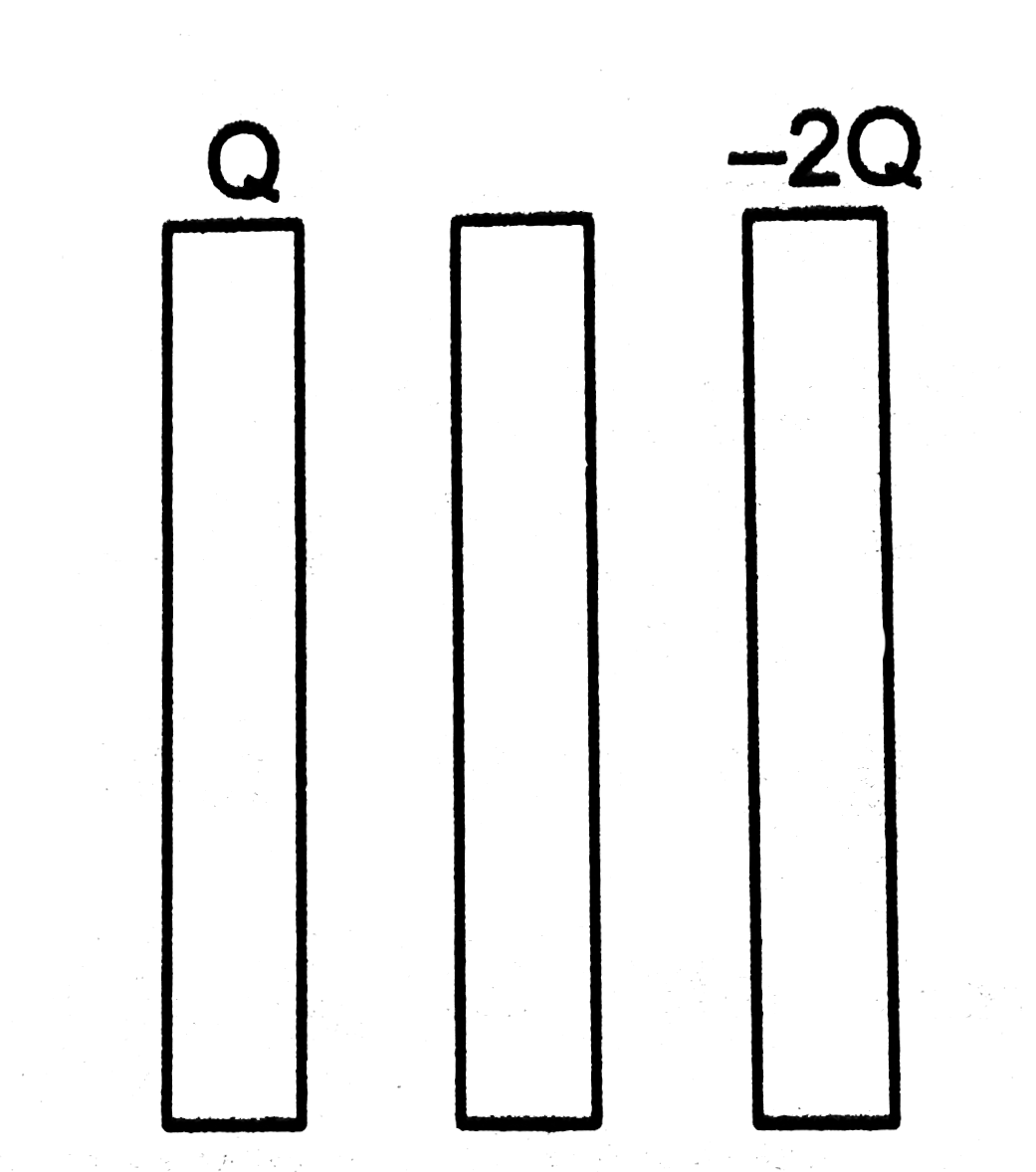
Three inentical metal plates with large ...

Three inentical metal plates with large surface areas are kept parallel to each as shown in figure (30-E8). The leftmost plate is given a charge Q, the rightmost a chrge _2Q and the middle one remains neutral. Finde the charge appearing on the outer surface of the rightmost plate.

Text Solution

Verified by Experts

Consider the gaussian surface the induced
charge be as shown in fig .
The nef field at p due to all the charge is
zero.
` (-2Q + q/2A(epsilon_0)) (left) + (q/2A (epsilon_0))(right)`
` + q - (q/2A(epsilon_0))(right) = 0 `
- 2 Q + q - Q + q = 0 `
q = 3/2 Q
charge on the side of right most plate
`= -2Q + q = -2Q + 3/2 Q `
` = - Q/2.`
Promotional Banner

Topper's Solved these Questions

  • GAUSS LAW

    HC VERMA|Exercise Objective 2|8 Videos
  • ELECTROMAGNETIC WAVES

    HC VERMA|Exercise Exercises|9 Videos
  • GEOMETRICAL OPTICS

    HC VERMA|Exercise Exercises|77 Videos

Similar Questions

Explore conceptually related problems

Figure shows three large metallic plates with chrges -Q, 3Q and Q respectively. Determine the final charges on all the surfaces.

X and Y are large, parallel conducting plates close to each other. Each face has an area A . X is given a charge Q . Y is without any charge. Points A,B and C are as shown in the figure.

Two conducting plates A and B are placed parallel to each other. A is given a charge Q_1 and B a charge Q_2 . Prove that the charges on the inner surfaces are of equal magnitude and opposite sign.

Show that the force on each plate of a parallel plate capacitor has a magnitude equal to (½) QE, where Q is the charge on the capacitor, and E is the magnitude of electric Held between the plates. Explain the origin of the factor 1//2

An isolated conducting sheet of area A and carrying a charge Q is placed in a uniform electric field E, such that the electric field is perpendicular to the sheet and covers all the sheet. Find out the charges appearing on its two surfaces.

Two large thin metal plates are parallel and close to each other on their inner faces the plates have surface charges densites of opposite region of the first plate (b) in the outer region of the second plate and (c ) between the plates

Show that the force on each plate of a parallel plate capacitor has a magnitude equal to (1//2) QE, where Q is the charge on the capacitor, and E is the magnitude of electric field between the plates. Explain the origin of the factor 1//2 .

Two fixed, identical conducting plates (a and (3), each of surface area S are charged to - Q and q, respectively, where Q > q > 0. A third identical plate ( lambda ), free to move Is located on the other side of the plate with charge q at a distance d as per figure. The third plate is released and collides with the plate f_3 . Assume the collision is elastic and the time of collision is sufficient to redistribute charge amongst beta and gamma . (a) Find the electric field acting on the plate gamma before collision. (b) Find the charges on beta and gamma after the collision. (c) Find the velocity of the plate gamma after the collision and at a distance d from the plate beta

A narrow monochromatic beam of light of intensity I is incident on a galss plate as shown in figure. Another identical glass plate is kept close to the first one & parallel to it. Each glass plate reflects 25% of the light incident on it and transmits the remaining find the ratio of the minimum & the maximum intensities in the interference pattern formed by the two beams obtained after one reflection at each plate.

(a) A conductor A with a cavity as shown in figure (a) is given a charge Q. Show that the entire charge must appear on the outer surface of the conductor. (b) Another conductor B with charge q is inserted into the cavity keeping B insulated from A. Show that the total charge on the outside surface of A is Q + q figure (b) ( C) A sensitive instruments is to be shielded from the strong electrostatic fields in its environment. Suggest a possible way.

HC VERMA-GAUSS LAW-Exercises
  1. A charge Q is placed at the centre of a cub. Find the flux of the elec...

    Text Solution

    |

  2. A charge Q is placed at a distance alpha/2 above the centre of a horiz...

    Text Solution

    |

  3. Find the fluz f the electric field through a spherical surface of radi...

    Text Solution

    |

  4. A charge Q is placed at the centre of an inaginary hemispherical surfa...

    Text Solution

    |

  5. A spherical volume contains a uniformaly distributed charge of densit...

    Text Solution

    |

  6. The radius of a gold nucleus (Z=79) is about 7.0 xx 10^9-15) m. Assume...

    Text Solution

    |

  7. A Charge Q is distributed uniformly within the material of a hollow sp...

    Text Solution

    |

  8. A charge Q is placed at the centre of an uncharged, hollow metallic sp...

    Text Solution

    |

  9. Consider the following very rough model of a beryllium atom. The nucle...

    Text Solution

    |

  10. Find the magnitude of the electric field at a point 4 cm away from a l...

    Text Solution

    |

  11. A long cylindrical wire carries a positive charge of linear density 2....

    Text Solution

    |

  12. A long cylindrical volume contains a uniformly distributed charge of d...

    Text Solution

    |

  13. A nonconducting sheet of large surface area and thickness d contains u...

    Text Solution

    |

  14. A charged partical having a charge of -2.0 xx 10^(-6) C is placed cl...

    Text Solution

    |

  15. One end of a 10 cm long silk thread is fixed to a large vertical surfa...

    Text Solution

    |

  16. Consider the situation of the previous problum. (a) Find the tension ...

    Text Solution

    |

  17. Two large conducting plates are placed parallel to each other with a ...

    Text Solution

    |

  18. Two large conducting plates are placed parallel to each other nad they...

    Text Solution

    |

  19. Two large conducting plates X and Y. each having large surface area A...

    Text Solution

    |

  20. Three inentical metal plates with large surface areas are kept paralle...

    Text Solution

    |
