Home
Class 12
PHYSICS
Figure shows a short magnet executing sm...

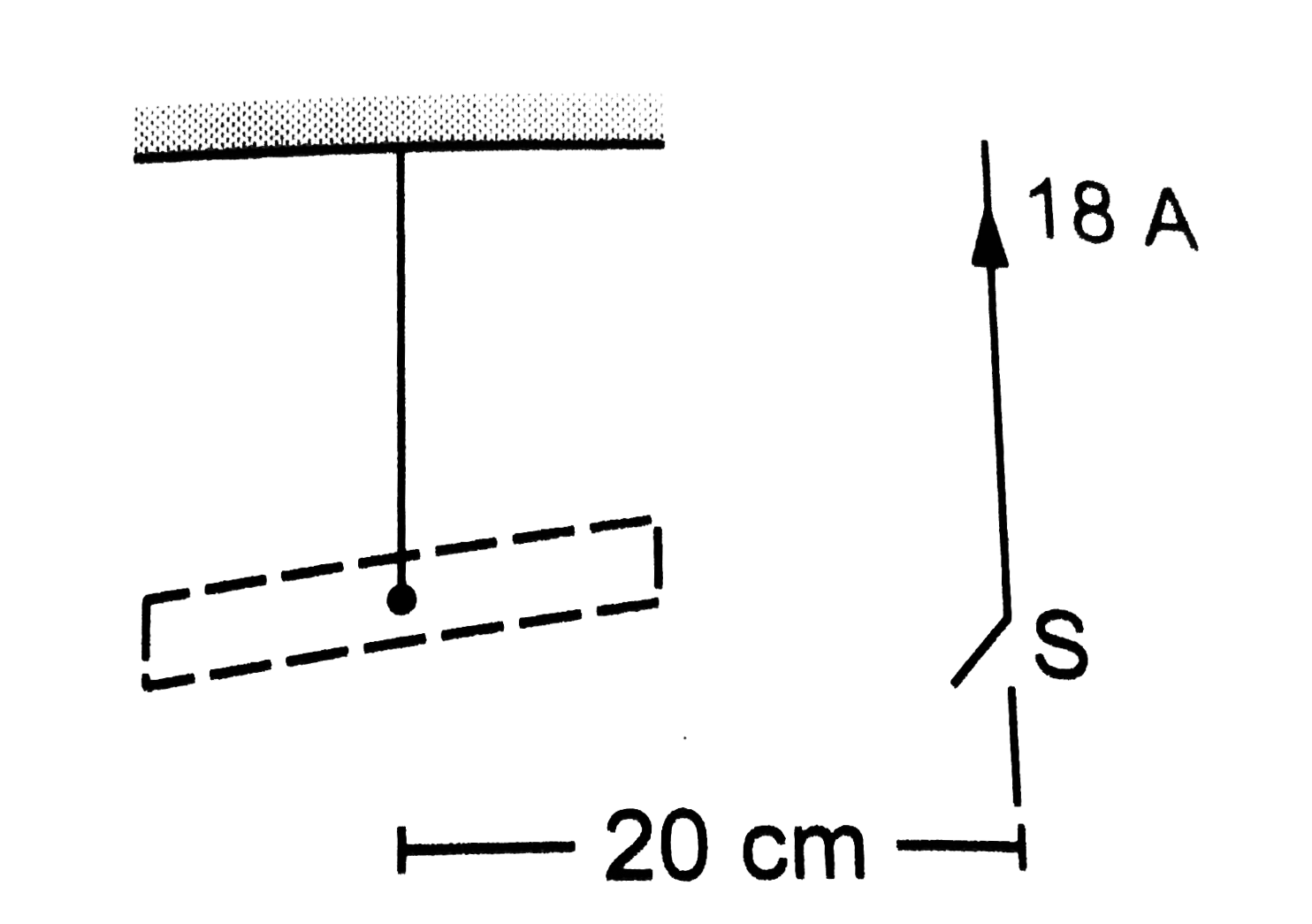
Figure shows a short magnet executing small oscillations in an oscillation magnetometer in earth's magnetic field having horizontal component `24 muT`. The time period of oscillation is `0.10 s`. An upward electric current of `18 A` is established in the vertical wire placed 20cm east of the magnet by closing the switch `S`. Find the new time

Text Solution

Verified by Experts

The magnetic field at the site of the short magnet due to the vertical current is
`B = (mu_0 i)/(2pid) = (2 xx 10^(-7) T m A^(-1)) (18 A)/(0.20 m)`
As the wire is east of the magnet, this magnetic field will be from north to south according to the right-hand thumb rule. The earth's magnetic field has horizontal component `24 muT` from south to north. Thus, the resultant field will be `6.0 muT` from south to north. If `T_1 and T_2` be the time periods without and with the current.
`T_1 = sqrt(I/(MB_H)` and T_2 = sqrt(I/(M(B_H - B))`
or, `T_2/T_1 = sqrt(B_H)/(B_H - B) = sqrt(24 muT)/(6 muT) = 2`
or, `T_2 = 2T_1 = 0.20 s`.
Promotional Banner

Topper's Solved these Questions

  • PERMANENT MAGNETS

    HC VERMA|Exercise Short Answer|11 Videos
  • PERMANENT MAGNETS

    HC VERMA|Exercise Objective 1|13 Videos
  • PERMANENT MAGNETS

    HC VERMA|Exercise Exercises|25 Videos
  • OPTICAL INSTRUMENTS

    HC VERMA|Exercise Exercises|23 Videos
  • PHOTO ELECTRIC EFFECT AND WAVE PARTICLE DUALITY

    HC VERMA|Exercise Exercise|2 Videos

Similar Questions

Explore conceptually related problems

At a certain place, the vertical component of the earth's magnetic field is 0.4 xx 10^(-4) T and horizontal component is 0.3 xx 10^(-4) T. What will be the total intensity of magnetic field of the earth ?

The horizontal component of earth's magnetic field is 3 xx 10^(-4) T. The magnetic dip angle is 45°. Find the vertical component.

A short bar magnet placed in a horizontal plane has its axis aligned along the magnetic north-south direction. Null points are found on the axis of the magnet at 14 cm from the centre of the magnet. The earth's magnetic Meld at the place is 0.36 G and the angle of dip 18 zero. What is the total magnetic feld on the normal bisector of the magnet at the same distance as the mull-point (i.e., 14 cm) from the centre of the magnet? At rull points, field due to a magnet 1s equal and opposite to the horizontal component of earth's magnetic field.)

A compass needle free to turn in a horizontal plane is placed at the centre of circular coil of 30 turns and radius 12 cm. The coil is in a vertical plane making an angle of 45° with the magnetic meridian. When the current in the coil is 0.35 A, the needle points west to east. (a) Determine the horizontal component of the earth's magnetic field at the location. (b) The current in the coil is reversed, and the coil is rotated about its vertical axis by an angle of 90° in the anticlockwise sense looking from above. Predict the direction of the needle. Take the magnetic declination at the places to be zero.

A 100 turn closely wound circular coil of radius 10 cm carries a current of 3.2 A. (a) What is the field at the centre of the coil? (b) What is the magnetic moment of this coil? The coil is placed in a vertical plane and is free to rotate about a horizontal axis which coincides with its diameter. A uniform magnetic field of 2T in the horizontal direction exists such that initially the axis of the coil is in the direction of the field. The coil rotates through an angle of 90^@ under the influence of the magnetic field. (c) What are the magnitudes of the torques on the coil in the initial and final position? (d) What is the angular speed acquired by the coil when it has rotated by 90^@ ? The moment of inertia of the coil is 0.1 kg m^2 .

A circular coil of radius 10 cm, 500 turns and resistance 2Omega is placed with its plane perpendicular to the horizontal component of the earth's magnetic field. It is rotated about its vertical diameter through 180^@ in 0.25 s. Estimate the magnitudes of the emf and current induced in the coil. Horizontal component of the earth's magnetic field at the place is 3.0xx10^(-5) T.

The magnetic needle has magnetic moment 3.14 xx 10^(-2) "Am"^(2) and moment of inertia 1=2 xx 10^(-6) kg m^(2) . It performs 314 complete oscillations in 100 s. What is the magnitude of the magnetic field ?

Figure shows a metal rod PQ resting on the smooth rails AB and positioned between the poles of a permanent magnet. The rails, the rod, and the magnetic field are in three mutual perpendicular directions. A galvanometer G connects the rails through a switch K. Length of the rod =15 cm, B =0.50 T, resistance of the closed loop containing the rod 9.0 m Omega . Assume the field to be uniform. (a) Suppose K is open and the rod is moved with a speed of 12 "cm s"^(-1) in the direction shown. Give the polarity and magnitude of the induced emf. (b) Is there an excess charge built up at the ends of the rods when K is open ? What if K is closed ? (c) With K open and the rod moving uniformly, there is no net force on the electrons in the rod PQ even though they do experience magnetic force due to the motion of the rod. Explain. (d) What is the retarding force on the rod when K is closed ? How much power is required (by an external agent) to keep the rod moving at the same speed (= 12 cm s^(-1) ) when K is closed ? How much power is required when K is open? (f)How much power is dissipated as heat in the closed circuit ? What is the source of this power ? (g) What is the induced emf in the moving rod if the magnetic field is parallel to the rails instead of being perpendicular ?

A rod of mass m and resistance R slides smoothly over two parallel conducting wires kept sloping at an angle theta with respect to the horizontal as shown in figure. The circuit is closed through a perfect conductor at the top. There is a constant magnetic field vecB along the vertical direction. If the rod is initially at rest, find the velocity of the rod as a function of time.

HC VERMA-PERMANENT MAGNETS-Worked Out Examples
  1. A bar magnet has a pole strengh of 3.6 A m and magnetic length 8cm. Fi...

    Text Solution

    |

  2. A magnet is suspended by a vertical string attached to its middle poin...

    Text Solution

    |

  3. A magnetic needle having magnetic moment 10 A m^2 and length 2.0 cm is...

    Text Solution

    |

  4. The magnetic scalar potential due to a magnetic dipole at a point on i...

    Text Solution

    |

  5. A bar magnet of magnetic moment 2.0 A m^2 is free to rotate about a ve...

    Text Solution

    |

  6. Figure shows two identical magnetic dipoles a and b of magnetic moment...

    Text Solution

    |

  7. A bar magnet of length 8 cm and having a pole strengh of 1.0 A m is pl...

    Text Solution

    |

  8. The magnetic field at a point on the magnetic equator is found to be ...

    Text Solution

    |

  9. A earth's magnetic field at geomagnetic poles has a magnitude 6.2 xx 1...

    Text Solution

    |

  10. A magnetic needle free to rotate in a fixed vertical plane stays in a ...

    Text Solution

    |

  11. A dip circle shows an apparent dip of 60^@ at a place where the true d...

    Text Solution

    |

  12. A magnetic needle of length 10cm, suspended at its middle point throug...

    Text Solution

    |

  13. A tangent galvanometer has a coil of 50 turns and a radius of 20cm. Th...

    Text Solution

    |

  14. A moving coil galvanometer has 100 turns and each turn has an area 2.0...

    Text Solution

    |

  15. A galvanometer coil has a resistance of 100 Omega. When a current pass...

    Text Solution

    |

  16. The needle of a deflection magnetometer deflects through 45^@ from nor...

    Text Solution

    |

  17. Figure shows a short magnet executing small oscillations in an oscilla...

    Text Solution

    |

  18. The frequency of oscillation of the magnet in an oscillation magnetome...

    Text Solution

    |

  19. A bar magnet of mass 100 g, length 7.0 cm, width 1.0 cm and height 0.5...

    Text Solution

    |
