Home
Class 12
PHYSICS
The collector plate in an experiment on ...

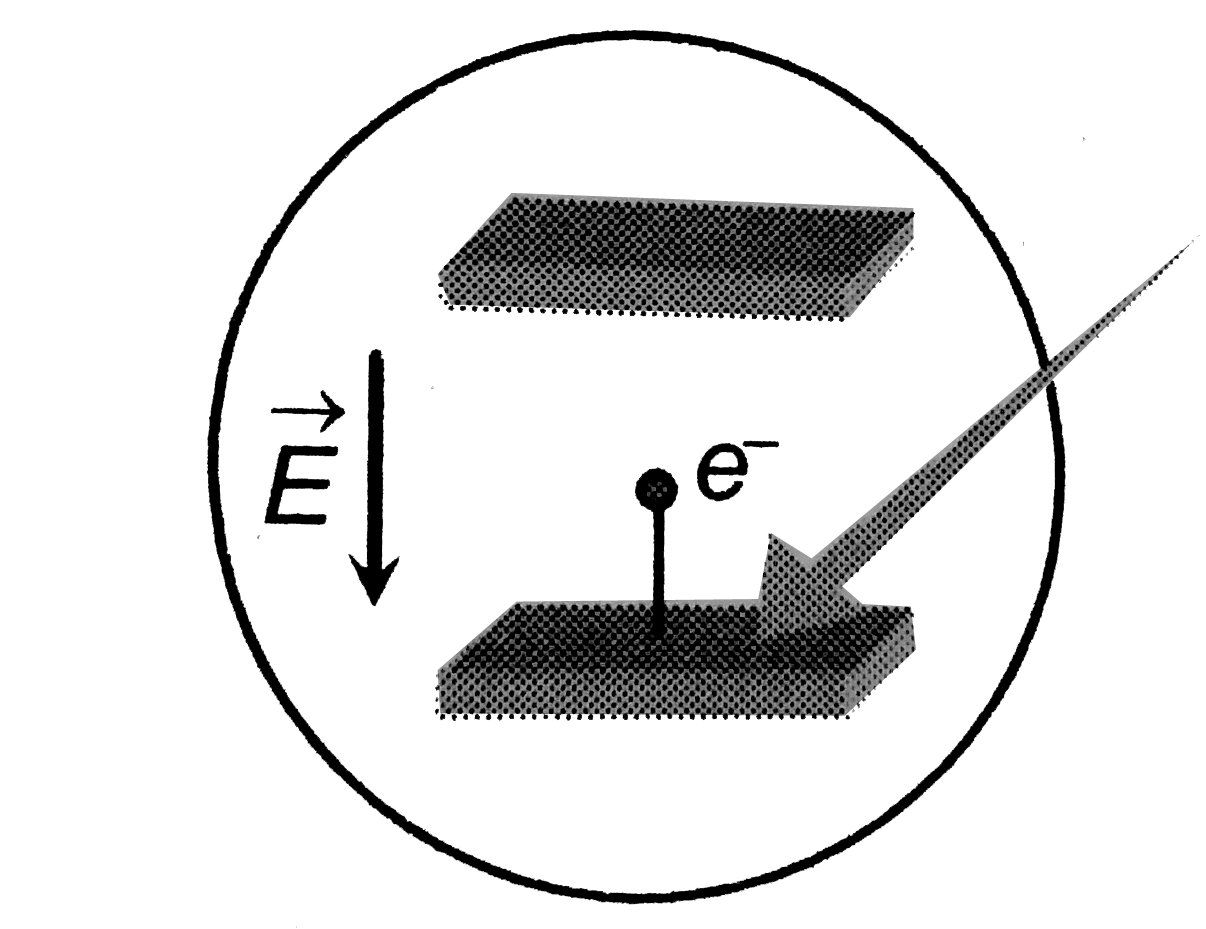
The collector plate in an experiment on photoelectric effect is kept vertically above the emitter plate . Light source is put on and a saturation photo current is recorded . An electric field is switched on which has a vertically downward direction . Then

A

The photocurrent will increased

B

The kinetic energy of the electrons will increase.

C

The stopping potential will decrease.

D

The threshold wavelength will increase.

Text Solution

Verified by Experts

The correct Answer is:

A
Promotional Banner

Topper's Solved these Questions

  • PHOTO ELECTRIC EFFECT AND WAVE PARTICLE DUALITY

    HC VERMA|Exercise Exercises|33 Videos
  • PHOTO ELECTRIC EFFECT AND WAVE PARTICLE DUALITY

    HC VERMA|Exercise Exercise|2 Videos
  • PHOTO ELECTRIC EFFECT AND WAVE PARTICLE DUALITY

    HC VERMA|Exercise Objective 1|14 Videos
  • PERMANENT MAGNETS

    HC VERMA|Exercise Exercises|25 Videos
  • PHOTOMETRY

    HC VERMA|Exercise Exercises|16 Videos

Similar Questions

Explore conceptually related problems

A charges particles particle is kept in equilibrium in the electric field between the plates of millikan oil drop experiment. If the direction of the electric field between the plates is reversed, then calculate acceleration of the charged particle.

A very large, charged plate floats in deep space. Due to the charge on the plate, a constant electric field E exists everry above the plate. An object with mass m and charge q is shot upward from the plate with a velocity v and at an angle theta . It follows the path shown reaching a height h and a ramge R. Assume the effects of gravity to be negligible. Which of the following is true concerning the flight of the projectile shown?

A very large, charged plate floats in deep space. Due to the charge on the plate, a constant electric field E exists everry above the plate. An object with mass m and charge q is shot upward from the plate with a velocity v and at an angle theta . It follows the path shown reaching a height h and a ramge R. Assume the effects of gravity to be negligible. Which of the following must be true concentration the object?

A very large, charged plate floats in deep space. Due to the charge on the plate, a constant electric field E exists everry above the plate. An object with mass m and charge q is shot upward from the plate with a velocity v and at an angle theta . It follows the path shown reaching a height h and a ramge R. Assume the effects of gravity to be negligible. Which of the following is true concerning all objects the path shown when propelled with a velocity v at an angle theta ?

A very large, charged plate floats in deep space. Due to the charge on the plate, a constant electric field E exists everry above the plate. An object with mass m and charge q is shot upward from the plate with a velocity v and at an angle theta . It follows the path shown reaching a height h and a ramge R. Assume the effects of gravity to be negligible. Which of the following will result in an increase in R?

A 100 turn closely wound circular coil of radius 10 cm carries a current of 3.2 A. (a) What is the field at the centre of the coil? (b) What is the magnetic moment of this coil? The coil is placed in a vertical plane and is free to rotate about a horizontal axis which coincides with its diameter. A uniform magnetic field of 2T in the horizontal direction exists such that initially the axis of the coil is in the direction of the field. The coil rotates through an angle of 90^@ under the influence of the magnetic field. (c) What are the magnitudes of the torques on the coil in the initial and final position? (d) What is the angular speed acquired by the coil when it has rotated by 90^@ ? The moment of inertia of the coil is 0.1 kg m^2 .

In a photoelectric experiment, the collector plate is at 2.0V with respect to the emitter plate made of copper (phi)=4.5eV) . The emitter is illuminated by a source of monochromatic light of wavelength 2000 Å nm.

An experimental setup of verification of photoelectric effect is shown in the diagram. The voltage across the electrode is measured with the help of an ideal voltmetar, and which can be varied by moving jockey 'J' on the potentiometer wire. The battery used in potentiometer circuit is of 20 V and its internal resistance is 2omega . The resistance of 100 cm long potentiometer wire is 8 omega . The photo current is measured with the help of an ideal ammeter. Two plates of potassium oxide of area 50 cm^(2) at separation 0.5 mm are used in the vacuum tube. Photo current in the circuit is very small so we can treat potentiometer circuit an indepdent circuit. The wavelength of various colours is as follows : |{:("Light",underset("Violet")(1),underset("Blue")(2),underset("Green")(3),underset("Yellow")(4),underset("Orange")(5),underset("Red")(6)),(lambda "in" Årarr,4000-4500,4500-5000,5000-5500,5500-6000,6000-6500,6500-7000):}| When other light falls on the anode plate the ammeter reading remains zero till, jockey till, jockey is moved from the end P to the middle point on the wire PQ. Thereafter the deflection is recorded in the ammeter. The maximum kinetic energy of the emitted electron is :
