Home
Class 12
PHYSICS
A totally reflecting, small plane mirror...

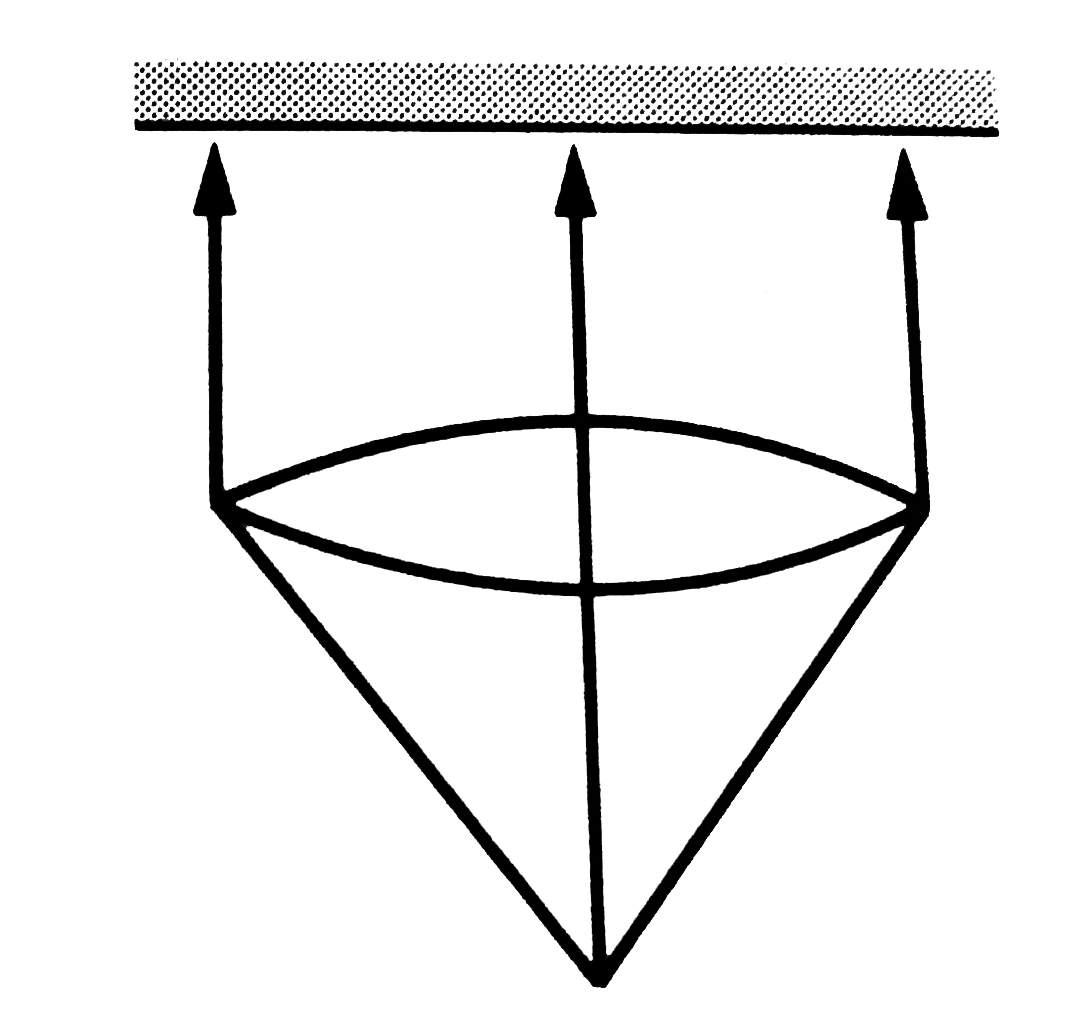
A totally reflecting, small plane mirror placed horizontally faces a parallel beam of lighy as shown in figure. The mass of the mirror is 20g. Assume that there is no absorption in the lens and that 30% of the light emitted by the source goes through the lens. Find the power of the source needed to support the weight of the mirror. Take ` g= 10 m s^-2.

Text Solution

Verified by Experts

Here `m = 20 g = 20 xx 10^(-3) kg `
The weight of the mirror is balanced. So, force exerted by the photons is equal to weight .
` P = h / lambda and E=(hc)/(lambda) = Pc`
`implies E/t = (P)/(t)c`
`implies `Rate of change of momentum
= power//c`
`30%` of light passes through the lens.
Thus it exerts force, `70%` is reflected
`:. Force exerted - 2
(rate of change of momentum)
`= 2xxPower//c`
`30%((2xxPower)/(theta)) =mg`
`implies Power = (20 xx 10^(-3)xx10xx3xx10^(3)xx10)/(2 xx 3)`
`=10 W power = 100 MW`.
Promotional Banner

Topper's Solved these Questions

  • PHOTO ELECTRIC EFFECT AND WAVE PARTICLE DUALITY

    HC VERMA|Exercise Exercise|2 Videos
  • PHOTO ELECTRIC EFFECT AND WAVE PARTICLE DUALITY

    HC VERMA|Exercise Objective 2|7 Videos
  • PERMANENT MAGNETS

    HC VERMA|Exercise Exercises|25 Videos
  • PHOTOMETRY

    HC VERMA|Exercise Exercises|16 Videos

Similar Questions

Explore conceptually related problems

A thin equiconvex lens of glass of refractive index mu=3//2 & of focal length 0.3m in air is sealed into an opening at one end of a tank filled with water (mu=4//3) .On the opposite side of the lens ,a mirror is placed inside the tank on the tank wall perpendicular to the lens axis ,as shown in figure .the separation between the lens and the mirror is 0.8m A small object is placed outside the tank in front of the lens at a distance of 0.9 m form the lens along its axis .Find the position (relative to the lens)of the image of the object fromed by the stsyem.

A balloon is rising up along the axis of a concave mirror of radius of curvature 20 m A ball is dropped from the balloon at a height 15m from the mirror when the balloon has velocity 20m//s .Find the speed of the image of the ball formed by concave mirror after 4 seconds[take: g=10m//s^(2) ]

A diverging lens of focal length 10cm is placed 10cm in front of a plane mirror as shown in Fig. Light from a very far away source falls on the lens. What is the distance of final image?

A convex lens of focal length 15 cm and a concave mirror of focal length 30 cm are kept with their optic axis PQ and RS parallel but separated in vertical directiion by 0.6 cm as shown . The distance between the lens and mirror is 30 cm . An upright object AB of height 1.2 cm is placed on the optic axis PQ of the lens at a distance of 20 cm from the lens . if A'B' is the image after refraction from the lens and the reflectiion from the mirror , find the distance of A'B' from the pole of the mirror and obtain its magnification . Also locate positions of A' and B' with respect to the optic axis RS.

Two plane mirrors, a source S of light, emitting monochromatic rays of wavelength lamda and a screen are arranged as shown in figure. If angle theta is very small, calculate fringe width of the interference pattern formed by reflected rays.

A beam of light from a source L is incident normally on a plane mirror fixed at a certain distance x from the source. The beam is reflected back as a spot on a scale placed just above the source L. When the mirror is rotated through a small angle theta , the spot of the light is found to move through a distance y on the scale. The angle theta is given by

in figure shown AB is a plane mirror of length 40cm placed at a height 40cm from ground . There is a light source S at a point on the ground ,Find the maximum and minimum height of a man(eye height)required to see the image of the source If he is standing at a point A on ground shown in figure.

A point sources S emitting light of wavelength 600nm is placed at a very small height h above the flat reflecting surface AB (see figure).The intensity of the reflected light is 36% of the intensity.interference firnges are observed on a screen placed parallel to the reflecting surface a very large distance D from it. (A)What is the shape of the interference fringes on the screen? (B)Calculate the ratio of the minimum to the maximum to the maximum intensities in the interference fringes fromed near the point P (shown in the figure) (c) if the intenstities at point P corresponds to a maximum,calculate the minimum distance through which the reflecting surface AB should be shifted so that the intensity at P again becomes maximum.

Huygen was the figure scientist who proposed the idea of wave theory of light he said that the light propagates in form of wavelengths. A wavefront is a imaginary surface of every point of which waves are in the same. phase. For example the wavefront for a point source of light is collection of concentric spheres which have centre at the origin w_(1) is a wavefront w_(2) is another wavefront. The radius of the wavefront at time 't' is 'ct' in thic case where 'c' is the speed of light the direction of propagation of light is perpendicular to the surface of the wavelength. the wavefronts are plane wavefronts in case of a parallel beam of light. Huygen also said that every point of the wavefront acts as the source of secondary wavelets. The tangent drawn to all secondary wavelets at a time is the new wavefront at that time. The wavelets are to be considered only in the forward direction (i.e., the direction of propagation of light) and not in the reverse direction if a wavefront w_(1) and draw spheres of radius 'cDeltat' they are called secondary wavelets. Draw a surface w_(2) which is tangential to all these secondary wavelets w_(2) is the wavefront at time t+Deltat Huygen proved the laws of reflection and laws of refraction using concept of wavefront. Q. Spherical wavefronts shown in figure, strike a plane mirror. reflected wavefront will be as shown in

Huygen was the figure scientist who proposed the idea of wave theory of light he said that the light propagates in form of wavelengths. A wavefront is a imaginary surface of every point of which waves are in the same. phase. For example the wavefront for a point source of light is collection of concentric spheres which have centre at the origin w_(1) is a wavefront w_(2) is another wavefront. The radius of the wavefront at time 't' is 'ct' in thic case where 'c' is the speed of light the direction of propagation of light is perpendicular to the surface of the wavelength. the wavefronts are plane wavefronts in case of a parallel beam of light. Huygen also said that every point of the wavefront acts as the source of secondary wavelets. The tangent drawn to all secondary wavelets at a time is the new wavefront at that time. The wavelets are to be considered only in the forward direction (i.e., the direction of propagation of light) and not in the reverse direction if a wavefront w_(1) and draw spheres of radius 'cDeltat' they are called secondary wavelets. Draw a surface w_(2) which is tangential to all these secondary wavelets w_(2) is the wavefront at time t+Deltat Huygen proved the laws of reflection and laws of refraction using concept of wavefront. Q. Plane are incident on a spherical mirror as shown in the figure. the reflected wavefronts will be

HC VERMA-PHOTO ELECTRIC EFFECT AND WAVE PARTICLE DUALITY-Exercises
  1. A parallel beam of monochromatic light of wavelength 663 nm is incide...

    Text Solution

    |

  2. A beam of white light is incident normally on a plane surface absorbin...

    Text Solution

    |

  3. A totally reflecting, small plane mirror placed horizontally faces a p...

    Text Solution

    |

  4. A 100 W light bulb is placed at the centre of a spherical chamber of r...

    Text Solution

    |

  5. A sphere of radius 1.00 cm is placed in the path of a parallel beam of...

    Text Solution

    |

  6. Consider the situation described in the previous problem. Show that th...

    Text Solution

    |

  7. It is not possible for a photon to be completely absorbed by a free el...

    Text Solution

    |

  8. Two neutral particles are kept 1m apart. Suppose by some mechanism som...

    Text Solution

    |

  9. Find the maximum kinetic energy of the photoelectrons ejected when lig...

    Text Solution

    |

  10. The work function of a photoelectric material is 4.0 e V. (a) What i...

    Text Solution

    |

  11. Find the maximum magnitude of the linear momentum of a photoelectron e...

    Text Solution

    |

  12. When a metal plate is exposed to a monochromatic beam of light of wave...

    Text Solution

    |

  13. In an experiment on photoelectric effect, the stopping potential is me...

    Text Solution

    |

  14. The electric field associated with a monochromataic beam of light beco...

    Text Solution

    |

  15. The electric field associated with a light wave is given by E= E0 sin...

    Text Solution

    |

  16. The electric field at a point associated with a light wave is E=(100Vm...

    Text Solution

    |

  17. A monochromatic light source of intensity 5 m W emits (8xx10^15) photo...

    Text Solution

    |

  18. A photographic film is coated with a silver bromide layer. When light ...

    Text Solution

    |

  19. In an experiment on photoelectric effect light of wavelength 400 nm is...

    Text Solution

    |

  20. A silver ball of radius 4.8 cn is suspended by a thread in a cacuum ch...

    Text Solution

    |
