Home
Class 12
CHEMISTRY
Consider the nucleophilic attacks given ...

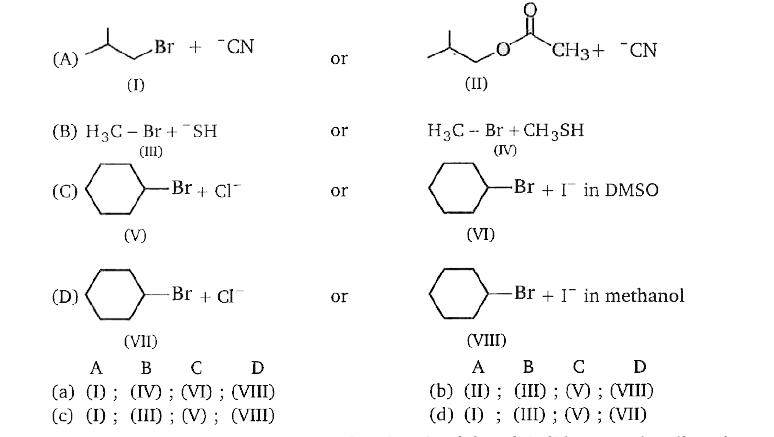
Consider the nucleophilic attacks given below. Select in each pair that shows the greater `S_(N^2)` reaction rate.

Text Solution

Verified by Experts

The correct Answer is:

D

(A) `Br^(Theta)` is best . L.G than `-O-overset(O)overset(||)C-Me`
(B) `SH^(Theta)` is best `Nu^(Theta) ` than MeSH
(C) `Cl^(Theta)` is best `Nu^(Theta)` than `I^(Theta)` is DMSO
(D) In polar protic solvent `I^(Theta)` is better `Nu^(Theta)` than `Cl^(Theta)`
Promotional Banner

Topper's Solved these Questions

  • ALKYL HALIDES (SUBSTITUTION REACTIONS)

    MS CHOUHAN|Exercise LEVEL-2|41 Videos
  • ALKYL HALIDES (ELIMINATION REACTION)

    MS CHOUHAN|Exercise LEVEL-2|25 Videos
  • AMINES

    MS CHOUHAN|Exercise Level-2|1 Videos

Similar Questions

Explore conceptually related problems

S_N2 reactions are

Which of the following is an example of S_(N^2) reaction ?

For a reaction A + 2B to 2C , the kinetic data is given below: Determine the order of the reaction and write the rate law.

SN^1 reaction is given by alkylhalide which forms stable carbocation during reaction. The carbonation, has sp^2 hybridisation. In SN^1 reaction, the attack of the nucleophile to carbocation inter mediate is from either side. In SN^2 reaction the attacking nucleophile attacks from the back leading to the formation of inversion complex. Alcohol reacts with PCI_5 to give alkyl chloride by an internal attack of nucleophile with in the molecule. In the following reaction

SN^1 reaction is given by alkylhalide which forms stable carbocation during reaction. The carbonation, has sp^2 hybridisation. In SN^1 reaction, the attack of the nucleophile to carbocation inter mediate is from either side. In SN^2 reaction the attacking nucleophile attacks from the back leading to the formation of inversion complex. Alcohol reacts with PCI_5 to give alkyl chloride by an internal attack of nucleophile with in the molecule. In the following reaction

SN^1 reaction is given by alkylhalide which forms stable carbocation during reaction. The carbonation, has sp^2 hybridisation. In SN^1 reaction, the attack of the nucleophile to carbocation inter mediate is from either side. In SN^2 reaction the attacking nucleophile attacks from the back leading to the formation of inversion complex. Alcohol reacts with PCI_5 to give alkyl chloride by an internal attack of nucleophile with in the molecule. In the following reaction . If R is H - undersetoverset(|)(D)oversetunderset(|)(CH_3)(C ) - R - OH underset(Py)overset(SOCl_2)(to) R - Cl + SO_2 + HCl

In the following pairs of halogen compounds which would undergo S_(N^(2)) reaction faster?

SN^2 reactions of alkyl halides is a bimolecular reaction which take place through formation of a transition state. The rate of reaction depends on the concentration of alkyl halide and nucleophile.The reaction is favoured by strong nucleophlie in polar aprotic solvents. In the transition state in the SN^2 reaction is represented as . The central carbon atom is

In a reactio between A and B, the initial rate of reaction (r_(0)) was measured for different initial concentrations of A and B as given below : What is the order of the reaction with respect to A and B?

SN^2 reactions of alkyl halides is a bimolecular reaction which take place through formation of a transition state. The rate of reaction depends on the concentration of alkyl halide and nucleophile.The reaction is favoured by strong nucleophlie in polar aprotic solvents. In which of the following solvents SN^2 reaction is more favourable

MS CHOUHAN-ALKYL HALIDES (SUBSTITUTION REACTIONS)-LEVEL-2
  1. Consider the nucleophilic attacks given below. Select in each pair tha...

    Text Solution

    |

  2. The order of the nucleophilicity of F^(-) ,Cl^(-), Br^(-) and I^(-) in...

    Text Solution

    |

  3. Statement - 1 : CH(3) - CH(2) - Cl + NaI("Acetone") rarr CH(3) - CH(2)...

    Text Solution

    |

  4. Encircle whichever of the following:

    Text Solution

    |

  5. Encircle whichever of the following: undergoes and S(N^2) reaction m...

    Text Solution

    |

  6. Encircle whichever of the following: undergoes and S(N^1) reaction m...

    Text Solution

    |

  7. Encircle whichever of the following: undergoes an E2 reaction to giv...

    Text Solution

    |

  8. Encircle whichever of the following: reacts with Nal to give (Z) - 1...

    Text Solution

    |

  9. Encircle whichever of the following: undergoes and S(N^(1)) reaction...

    Text Solution

    |

  10. Encircle whichever of the following : undergoes and S(N^2) reaction ...

    Text Solution

    |

  11. Encircle whichever of the following : undergoes an E1 reaction more ...

    Text Solution

    |

  12. Encircle whichever of the following : undergoes an S(N^1) reaction m...

    Text Solution

    |

  13. Encircle whichever of the following : undergoes an S(N^2) reaction m...

    Text Solution

    |

  14. Encircle whichever of the following : undergoes an E2 reaction more ...

    Text Solution

    |

  15. Match the column :

    Text Solution

    |

  16. Matrix :

    Text Solution

    |

  17. Encircle whichever of the following : undergoes an S(N^2) reaction m...

    Text Solution

    |

  18. Encircle whichever of the following : undergoes an S(N^1) reaction m...

    Text Solution

    |

  19. Encircle whichever of the following : undergoes an S(N^1) reaction m...

    Text Solution

    |

  20. Reativity : Circle the reaction that reacts FASTER by S(N^2) in each p...

    Text Solution

    |

  21. Consider the potential energy diagram given below (X) Name the po...

    Text Solution

    |
