Home
Class 12
CHEMISTRY
Transition state 2 is structurally most ...

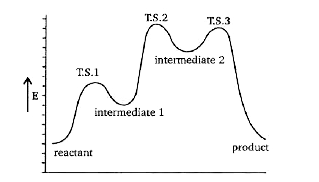
Transition state 2 is structurally most likely as :

A

intermediate 1

B

transition state 3

C

intermediate 2

D

product

Text Solution

Verified by Experts

The correct Answer is:
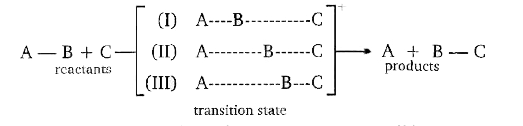
C

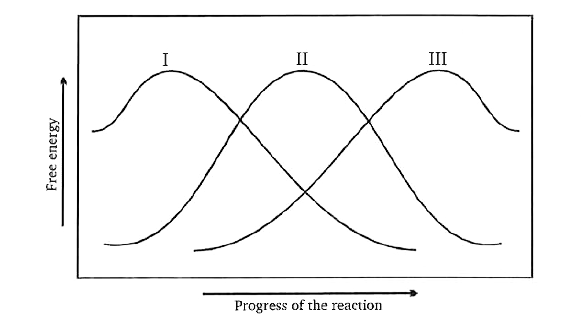
Knowing something about the structure of a transition state is important when you are trying to predict the products of a reaction. The structure of the transition state lies between the structure ofthe reactants and the structure ofthe products. Butwhat do we mean by"between"? Does the structure ofthe transition state lie exactlyhalfwaybetween the structures of the reactants and products (as in 11, below), or does it resemble the reactants more closely than it resembles the products (as in I), or is it more like the products than the reactants (as in Ill)?

According to the Hammond postulate, the transition statewill be more similarinstructure to the species that it is more similar to in energy. In the case ofan exergonic reaction, the transition state is more similar in energy to the reactant than to the product. (curve I). Therefore, the structure ofthe transition state will more closely resemble the structure of the reactantthanthatofthe transition statewill more closelyresemble the structure ofthe reactantthanthatofthe product. In anendergonicreaction (curve III), thetransitionstate is more similar in energy to the product, so the structure ofthe transition state will more closely resemble the structure of the product. Only when the reactant and the product have identical energies (curve Il) would we expect the structure ofthe transition state to be halfway between the structures ofthe reactant and the product.

Nowwe can understand whythe tert-butyl cation is formed faster than the isobutyl cation when 2-methylpropene reacts with HC!. Of the two possible products, the tert-butyl cation (a tertiary carbocation) is more stable than the isobutyl cation (a primary carbocation). Because formation ofa carbocation is an endergonic reaction, the structure ofthe transition state will resemble the structure ofthe carbocation product. This means thatthe transition statewill have a significant amountofpositive charge on a carbon. The same factors that stabilize the positively charged product will stabilize the partially positively charged transition state. Therefore, the transition state leading to the tert-butyl cation is more stable than the transition state leading to the isobutyl cation, so the tert-butyl cation will be formed faster. It is important to keep in mind thatthe amount of positive charge inthe transitionstateis notas greatas the amountofpositive charge inthe transitionstateis notas great as the amountofpositive charge inthe carbocationproduct, so the difference in the stabilities of the two transition states is not as great as the difference in the stabilities ofthe two carbocation products.
Promotional Banner

Topper's Solved these Questions

  • ALKYL HALIDES (SUBSTITUTION REACTIONS)

    MS CHOUHAN|Exercise LEVEL-2|41 Videos
  • ALKYL HALIDES (ELIMINATION REACTION)

    MS CHOUHAN|Exercise LEVEL-2|25 Videos
  • AMINES

    MS CHOUHAN|Exercise Level-2|1 Videos

Similar Questions

Explore conceptually related problems

Transition state structure of the substate formed during an enzymatic reaction is

E + Srarr[ ES ] rarr[ EP ] rarr E + P Formation of transition state structure in the above reaction occurs at this stage

In a communication system, noise is most likely to affect the signal

The most common oxidation state of first transition series is +2 . Explain.

The most common oxidation state of first transition series is +2 . Explain.

Discuss the cage like structure of ice

Discuss the cage like structure of ice.

An alkene is most likely to reach with

MS CHOUHAN-ALKYL HALIDES (SUBSTITUTION REACTIONS)-LEVEL-2
  1. Transition state 2 is structurally most likely as :

    Text Solution

    |

  2. The order of the nucleophilicity of F^(-) ,Cl^(-), Br^(-) and I^(-) in...

    Text Solution

    |

  3. Statement - 1 : CH(3) - CH(2) - Cl + NaI("Acetone") rarr CH(3) - CH(2)...

    Text Solution

    |

  4. Encircle whichever of the following:

    Text Solution

    |

  5. Encircle whichever of the following: undergoes and S(N^2) reaction m...

    Text Solution

    |

  6. Encircle whichever of the following: undergoes and S(N^1) reaction m...

    Text Solution

    |

  7. Encircle whichever of the following: undergoes an E2 reaction to giv...

    Text Solution

    |

  8. Encircle whichever of the following: reacts with Nal to give (Z) - 1...

    Text Solution

    |

  9. Encircle whichever of the following: undergoes and S(N^(1)) reaction...

    Text Solution

    |

  10. Encircle whichever of the following : undergoes and S(N^2) reaction ...

    Text Solution

    |

  11. Encircle whichever of the following : undergoes an E1 reaction more ...

    Text Solution

    |

  12. Encircle whichever of the following : undergoes an S(N^1) reaction m...

    Text Solution

    |

  13. Encircle whichever of the following : undergoes an S(N^2) reaction m...

    Text Solution

    |

  14. Encircle whichever of the following : undergoes an E2 reaction more ...

    Text Solution

    |

  15. Match the column :

    Text Solution

    |

  16. Matrix :

    Text Solution

    |

  17. Encircle whichever of the following : undergoes an S(N^2) reaction m...

    Text Solution

    |

  18. Encircle whichever of the following : undergoes an S(N^1) reaction m...

    Text Solution

    |

  19. Encircle whichever of the following : undergoes an S(N^1) reaction m...

    Text Solution

    |

  20. Reativity : Circle the reaction that reacts FASTER by S(N^2) in each p...

    Text Solution

    |

  21. Consider the potential energy diagram given below (X) Name the po...

    Text Solution

    |