Home
Class 12
CHEMISTRY
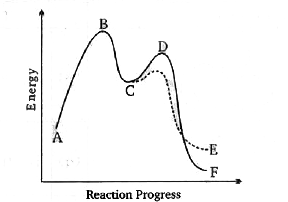
Consider the potential energy diagram gi...

Consider the potential energy diagram given below

(X) Name the positions A-D
(Y) Answer the following quesitons :
(i) Both reacti0n pathways are :
(ii) Which step is the determining step (RDS) ?
(iii) Which product is most stable ?
(iv) In accordance with Hammonds postulate, exothermic reactions tend to have

A

early transition states that are reactant - like

B

late transition states that are reactant - like

C

early transition states that are product - like

D

late transition states that are product- like.

Text Solution

Verified by Experts

The correct Answer is:

A, B, C, D

Basic information
Promotional Banner

Topper's Solved these Questions

  • ALKYL HALIDES (SUBSTITUTION REACTIONS)

    MS CHOUHAN|Exercise LEVEL-2|41 Videos
  • ALKYL HALIDES (ELIMINATION REACTION)

    MS CHOUHAN|Exercise LEVEL-2|25 Videos
  • AMINES

    MS CHOUHAN|Exercise Level-2|1 Videos

Similar Questions

Explore conceptually related problems

In a locality, there is a man road along North-South direction. The man is given below. With the help of the picture answer the following questions. (i) What is the 3rd object on the left side in street no 3? (ii) Find the name of the 2nd house which is in right side of street 2. (iii) Locate the position of Mr. K's house. (iv) How do you describe the position of the post office. (v) How do you describe the location of the hospital?

The equation of Schroedinger for the hydrogen atom in the time-independet, non-relativistic form is a partial differential equation involving the position coordinates (x, y and z). The potential energy term for the proton-electron system is spherically symmetric of the form -1//4pi in_(0) xx (e^(2)//r) . THus it is advantages to change over from the cartesian coordinates (x,y and z) to the spherical polar coordinates, (r, theta and phi ). In this form the equation become separable in the radial part involving r and the angular part involving theta and phi . The probability of locating the electron within a volume element d tau = 4pi r^(2)dr is then given |Psi|^(2)(4pir^(2)dr) , where Psi is a function of r, theta and phi . With proper conditions imposed on Psi , the treatment yields certain functions, Psi , known as atomic orbitals which are solutions of the equations. Each function Psi correspods to quantum number n, l and m, the principal, the azimuthal and the magnetic quantum number respectively, n has values 1, 2, 3,...., l has values 0, 1, 2, ....(n-1) for each value of n and m (n-1) for each value of n and m (m_(l)) has values =1, +(l+1),...1,0,-1,-2...-l i.e., (2l+1) values for each value of l. In addition a further quantum number called pin had to be introduced with values +-1//2 . Any set of four values for n, l , m and s characterizes a spin orbital. Pauli.s exclusion principle states that a given spin orbital can accomodate not more than electron. Further the values l = 0, l=1, l=2, l=3 are designated s,p,d and f orbitals respectively. Which of the following diagrams corresponds to the 2s orbital ?

The equation of Schroedinger for the hydrogen atom in the time-independet, non-relativistic form is a partial differential equation involving the position coordinates (x, y and z). The potential energy term for the proton-electron system is spherically symmetric of the form -1//4pi in_(0) xx (e^(2)//r) . THus it is advantages to change over from the cartesian coordinates (x,y and z) to the spherical polar coordinates, (r, theta and phi ). In this form the equation become separable in the radial part involving r and the angular part involving theta and phi . The probability of locating the electron within a volume element d tau = 4pi r^(2)dr is then given |Psi|^(2)(4pir^(2)dr) , where Psi is a function of r, theta and phi . With proper conditions imposed on Psi , the treatment yields certain functions, Psi , known as atomic orbitals which are solutions of the equations. Each function Psi correspods to quantum number n, l and m, the principal, the azimuthal and the magnetic quantum number respectively, n has values 1, 2, 3,...., l has values 0, 1, 2, ....(n-1) for each value of n and m (n-1) for each value of n and m (m_(l)) has values =1, +(l+1),...1,0,-1,-2...-l i.e., (2l+1) values for each value of l. In addition a further quantum number called pin had to be introduced with values +-1//2 . Any set of four values for n, l , m and s characterizes a spin orbital. Pauli.s exclusion principle states that a given spin orbital can accomodate not more than electron. Further the values l = 0, l=1, l=2, l=3 are designated s,p,d and f orbitals respectively. It is a basic fact that any two electrons are indistinguishable. 3 electrons are to be accomodated in the spin orbitals included under the designated 2p, conforming to the Pauli principle. Calculate the number of ways in which this may be done.

The equation of Schroedinger for the hydrogen atom in the time-independet, non-relativistic form is a partial differential equation involving the position coordinates (x, y and z). The potential energy term for the proton-electron system is spherically symmetric of the form -1//4pi in_(0) xx (e^(2)//r) . THus it is advantages to change over from the cartesian coordinates (x,y and z) to the spherical polar coordinates, ( r, theta and phi ). In this form the equation become separable in the radial part involving r and the angular part involving theta and phi . The probability of locating the electron within a volume element d tau = 4pi r^(2)dr is then given |Psi|^(2)(4pir^(2)dr) , where Psi is a function of r, theta and phi . With proper conditions imposed on Psi , the treatment yields certain functions, Psi , known as atomic orbitals which are solutions of the equations. Each function Psi correspods to quantum number n, l and m, the principal, the azimuthal and the magnetic quantum number respectively, n has values 1, 2, 3,...., l has values 0, 1, 2, ....(n-1) for each value of n and m (n-1) for each value of n and m (m_(l)) has values =1, +(l+1),...1,0,-1,-2...-l i.e., (2l+1) values for each value of l. In addition a further quantum number called pin had to be introduced with values +-1//2 . Any set of four values for n, l , m and s characterizes a spin orbital. Pauli.s exclusion principle states that a given spin orbital can accomodate not more than electron. Further the values l = 0, l=1, l=2, l=3 are designated s,p,d and f orbitals respectively. How many spin orbitals are there corresponding to n = 3?

Which of the following situations correctly describe the similarity between an angiospermic egg and a human egg? (I) Eggs of both are formed only once in a lifetime (II) Both the angiosperm egg and human egg are stationary (III) Both the angiosperm egg and human egg are motile transported (IV) Syngamy in both results in the formation of zygote Choose the correct answer from the options given below

Which of the following statements, support the view that elaborate sexual reproductive process appeared much later in the organic evolution. (I) Lower groups of organisms have simpler body design (II) Asexual reproduction is common is lower groups (III) Asexual reproduction is common in higher groups of organisms. (IV) The high incidence of sexual reproduction in angiosperms and vertebrates Choose the correct answer from the options given below

MS CHOUHAN-ALKYL HALIDES (SUBSTITUTION REACTIONS)-LEVEL-2
  1. Encircle whichever of the following : undergoes an S(N^1) reaction m...

    Text Solution

    |

  2. Reativity : Circle the reaction that reacts FASTER by S(N^2) in each p...

    Text Solution

    |

  3. Consider the potential energy diagram given below (X) Name the po...

    Text Solution

    |

  4. Select whether the following combinations of reactants will react by s...

    Text Solution

    |

  5. Select whether the following combinations of reactants will react by s...

    Text Solution

    |

  6. Select whether the following combinations of reactants will react by s...

    Text Solution

    |

  7. Select whether the following combinations of reactants will react by s...

    Text Solution

    |

  8. Select whether the following combinations of reactants will react by s...

    Text Solution

    |

  9. Select whether the following combinations of reactants will react by s...

    Text Solution

    |

  10. Select whether the following combinations of reactants will react by s...

    Text Solution

    |

  11. Examine the ten structural formulas shown in fig. & select that satify...

    Text Solution

    |

  12. Select which reaction from the following reaction pairs will occur fas...

    Text Solution

    |

  13. Select which reaction from the following reaction pairs will occur fas...

    Text Solution

    |

  14. Select which reaction from the following reaction pairs will occur fas...

    Text Solution

    |

  15. Select which reaction from the following reaction pairs will occur fas...

    Text Solution

    |

  16. Select which reaction from the following reaction pairs will occur fas...

    Text Solution

    |

  17. Tick your answer in the given box.

    Text Solution

    |

  18. Match the column :

    Text Solution

    |

  19. Text Solution

    |

  20. Text Solution

    |
