Two benzyne intermediates are likely to be formed equally. Reaction with amide ion can occur in two different directions with each benzyne, giving three possible products. They are formed in a 1:2:1 ratio. Asterisk (*) refers to `""^14 C` .
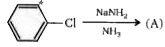 Product major, product (A) is :
Two benzyne intermediates are likely to be formed equally. Reaction with amide ion can occur in two different directions with each benzyne, giving three possible products. They are formed in a 1:2:1 ratio. Asterisk (*) refers to `""^14 C` .
Product major, product (A) is :
Product major, product (A) is : A
B
C
D
Text Solution
Verified by Experts
The correct Answer is:
B




Topper's Solved these Questions
Similar Questions
Explore conceptually related problems
Statement: 1 For the change occuring during roasting of sphalerite, the entropy change is negtive Statement-2. Two different compounds of Zine are formed during roasting
The products of bond breaking, shown below, are not stable, and cannot be isolated for prolonged study. Such species are referred to as reactive intermediate, and are belived to be transient intermediates in many reactions. The general structures and names of four such intermediates are, Charged Intermediates Uncharged Intermediates Carbocations (called carbonium ions in the older literature) are electrophiles and carbananions are nucleophiles. Carbenes have only a valence shell sextet of electrons and are therefore electron deficient. In this sense they are elecrophiles, but the non-bonding electron pair also gives carbenes nucleophilic character. As a rule, the electrophilic character dominates carbene reactivity. Carbon radicals have only seven valence electrons, and may be considered electron deficient, however, they do not in general bond to nucleophilic electron pair, so their chemistry exhibits differences from that of conventional electrophiles. Radical intermediates are often called free radicals. Intermediates are in general stabilised with conjugation, electron donating and electron with drawing groups. Which of the following is relatively an unstable intermediate compared to rest ?
The products of bond breaking, shown below, are not stable, and cannot be isolated for prolonged study. Such species are referred to as reactive intermediate, and are belived to be transient intermediates in many reactions. The general structures and names of four such intermediates are, Charged Intermediates Uncharged Intermediates Carbocations (called carbonium ions in the older literature) are electrophiles and carbananions are nucleophiles. Carbenes have only a valence shell sextet of electrons and are therefore electron deficient. In this sense they are elecrophiles, but the non-bonding electron pair also gives carbenes nucleophilic character. As a rule, the electrophilic character dominates carbene reactivity. Carbon radicals have only seven valence electrons, and may be considered electron deficient, however, they do not in general bond to nucleophilic electron pair, so their chemistry exhibits differences from that of conventional electrophiles. Radical intermediates are often called free radicals. Intermediates are in general stabilised with conjugation, electron donating and electron with drawing groups. Which of the following carbo cations is more stable?
The products of bond breaking, shown below, are not stable, and cannot be isolated for prolonged study. Such species are referred to as reactive intermediate, and are belived to be transient intermediates in many reactions. The general structures and names of four such intermediates are, Charged Intermediates Uncharged Intermediates Carbocations (called carbonium ions in the older literature) are electrophiles and carbananions are nucleophiles. Carbenes have only a valence shell sextet of electrons and are therefore electron deficient. In this sense they are elecrophiles, but the non-bonding electron pair also gives carbenes nucleophilic character. As a rule, the electrophilic character dominates carbene reactivity. Carbon radicals have only seven valence electrons, and may be considered electron deficient, however, they do not in general bond to nucleophilic electron pair, so their chemistry exhibits differences from that of conventional electrophiles. Radical intermediates are often called free radicals. Intermediates are in general stabilised with conjugation, electron donating and electron with drawing groups. R-N^(+) equiv N" "Cl^(-) rarr R^(+)+N_(2)+Cl^(-) based on the above, which of the following from R^(+) most readily
The products of bond breaking, shown below, are not stable, and cannot be isolated for prolonged study. Such species are referred to as reactive intermediate, and are belived to be transient intermediates in many reactions. The general structures and names of four such intermediates are, Charged Intermediates Uncharged Intermediates Carbocations (called carbonium ions in the older literature) are electrophiles and carbananions are nucleophiles. Carbenes have only a valence shell sextet of electrons and are therefore electron deficient. In this sense they are elecrophiles, but the non-bonding electron pair also gives carbenes nucleophilic character. As a rule, the electrophilic character dominates carbene reactivity. Carbon radicals have only seven valence electrons, and may be considered electron deficient, however, they do not in general bond to nucleophilic electron pair, so their chemistry exhibits differences from that of conventional electrophiles. Radical intermediates are often called free radicals. Intermediates are in general stabilised with conjugation, electron donating and electron with drawing groups. R-N^(+) equiv N" "Cl^(-) rarr R^(+)+N_(2)+Cl^(-) based on the above, which of the following from R^(+) most readily
Two chemical reactions are described below. (i) Nitrogen and hydrogen react to form ammonia., give A) The valence of each of the atoms involved in the reaction., B) The Lewis structure of the product that is formed.
Two chemical reactions are described below.(ii) Carbon and hydrogen bond together to form a molecule of methane (CH4). give A) The valence of each of the atoms involved in the reaction.,B) The Lewis structure of the product that is formed.
(A) 2-Bromobutane on reaction with sodium ethoxide in ethanol gives 1-butene as a major product (R) 1-Butene is more stable than 2-butene
An acid (A) which is an important constituent of vinegar, on reaction with red P_4 and Br_2 gives a monobromoderivative (B) which on reaction with NH_3 gives a white solid (C). However, ethanal on reaction with a mixture of ammonium chloride and sodium cyanide undergoes strecker synthes is to give a product which on acidic hydrolysis gives another high melting solid (D). The dipolar ion is formed by
A catalyst alters the rate of a reaction by leading of increasing the energy of activation, In Heterogeneus catalysis adrosption mechanism occurs and Hemogeneus. Catalysis intermediate formation occurs. In auto catalysis one of the products acts on catalyst. The DeltaH of a reaction A + B to C is d -20 KJ mol^(-1) . When a catalyst is used. What is DeltaH for the reaction without catalyst (magnitude)
MS CHOUHAN-AROMATIC COMPOUNDS -LEVEL-2 (SUBJECTIVE PROBLEMS)
- Two benzyne intermediates are likely to be formed equally. Reaction wi...
Text Solution
|
- Double bond equivalent of D is :
Text Solution
|
- How many isomers 'X' of C(8)H(10) given only aromatic dicarboxylic aci...
Text Solution
|
- How many groups are op director in the electrophilic aromatic substitu...
Text Solution
|