Home
Class 12
CHEMISTRY
Devise a series of reactions to convert ...

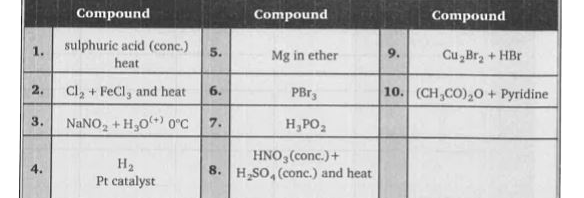
Devise a series of reactions to convert benzene into meta - chlorobromobenzene. Select reagents and conditions from the following table, listing them in the order of use.

A

1 then 2 then 6

B

2 then 8 then 4 then 3 then 9

C

8 then 4 then 10 then 2 then 3 then 9

D

8 then 2 then 4 then 3 then 9

Text Solution

Verified by Experts

The correct Answer is:

D

Promotional Banner

Topper's Solved these Questions

  • AROMATIC COMPOUNDS

    MS CHOUHAN|Exercise LEVEL-2 (COMPREHENSION)|16 Videos
  • AROMATIC COMPOUNDS

    MS CHOUHAN|Exercise LEVEL-2 (SUBJECTIVE PROBLEMS)|3 Videos
  • AROMATIC COMPOUNDS

    MS CHOUHAN|Exercise LEVEL-2 (SUBJECTIVE PROBLEMS)|3 Videos
  • AMINES

    MS CHOUHAN|Exercise Level-2|1 Videos
  • BIOMOLECULES

    MS CHOUHAN|Exercise LEVEL - 2|5 Videos

Similar Questions

Explore conceptually related problems

Which of the following reaction is useful to convert benzene into toluene ?

Which of the following reagents and conditions convert benzene to cholorobenzene?

Which of the following reagents can be used to convert benzenediazonium chloride to benzene ?

What are the reagent and reaction conditions used for converting ethyl chloride to ethyl nitrite (as the major product) ?

Consider the following four conditions (a-d) and select the correct pair of them as adaptations to environment in desert lizards The conditions : a) burrowing in soil to escape high temperature b) losing heat rapidly from the body during high temperature c) bask in sun when temperature is low d) insulating body due to thick fatty dermis

For a spontaneous reaction, the free energy change must be negative. DeltaG=DeltaH-TDeltaS is the enthalpy change during the reaction. T is absolute temperature, and AS is the change in entropy during the reaction. Consider a reaction such as the formation ofan oxide . M+O_(2) MO Dloxygen is used wp in the course of this reaction. Gases have a more random structure (less ordered) than liquid or solids consequently gases have a higher entropy than liquids and solids, in this reaction (entropy or randomness) decreases, hence is negative. Thus, the temperature is raised the DeltaS becomes more negative. Since, TDeltaS is subtracted in the equation, then SG becomes less negative. Thus, the free energy changes increases with the increase in temperature. The free energy changes that occur when one mole of common reactant in this case dioxygen) is we may e plotted graphically against temperature for a number of reactions of metals to their oxides. The following plot is called an Ellingham diagram for metal oxide. Understanding of Ellingham diagram is extremely important for the efficient extraction of metals. Free energy change of Hg and Mg for the convertion to oxides the slope of DeltaG . T has been changed above the boiling points of the given metal because

Olefins can be halogenated in the allylic position by number of reagents of which N-bromo succinimide (NBS) is the most common. When this reagent is used the reaction is known as WohlZiegler bromination. Other N-bromoamides have also been used. To a much lesser extent allylic chlorination has been carried out with N-chloro-succinimide. N-Chloro-N-cyclohexyl benzene sulphonamide or t-hypochlorite when the allylic radical intermediate is unsymmetrical allylic rearrangement takes place so that the mixture of both possible products is obtained. CH_3 - CH_2 -CH = CH_2underset(hv)overset(NBS)(to) CH_3 - CH = CH - CH_2 - Br + CH_3 - undersetoverset(|)(Br)(C ) - CH = CH_2 NBS is also a highly regioselective brominating agent at other positions, including positions a to a carbonyl group. Which of the following is allylic chlorinating agent ?

Numerous forms of the periodic table have been devised from time to time. A modern version which is most convenient and widely used is the long or extended from of periodic table. The aufbau principle and the electronic configuration of atoms provide a theoretical foundation for the periodic classification. The horizontal rows are called periods. There are altogether seven periods. The first period consists of 2 elements. The subsequent periods consists of 8, 8,18, 18 and 32 elements respectively. The seventh period is incomplete and like the sixth period would have maximum of 32 elements. Elements having similar outer electronic configurations in their atoms are grouped in vertical columns. These are referred to as groups or families. According to the recommendations of IUPAC, the groups are numbered 1 to 18 replacing the older notation of groups 0, IA, IIA, ....VIIA, VIII, IB.....VIIB. Each successive period in the periodic table is associated with the filling up next higher principal energy level following aufbau sequence. The number of elements in each period is twice the number of atomic orbitals available in the energy level that is being filled. All the elements are classified into four blocks, i.e., s-block, p-block, d-block, and f-block depending on the type of atomic orbitals that are being filled with electrons. What is the position of the element in the periodic table satisfying the electronic configuration (n-1)d^1 ns^2 for n=4 ?

