Home
Class 12
CHEMISTRY
Examine the ten structural formulas show...

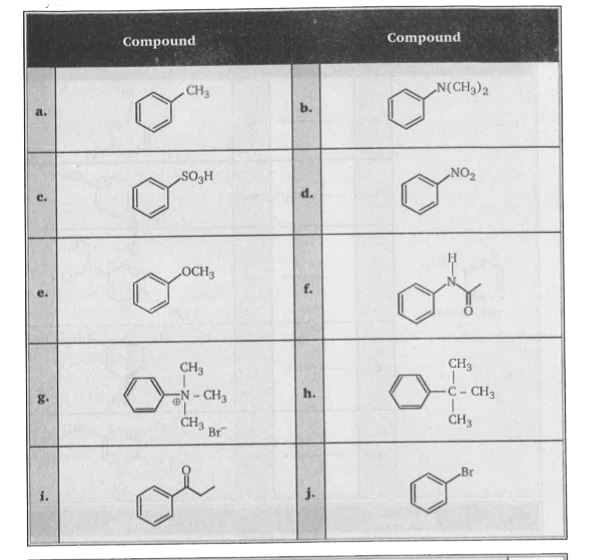
Examine the ten structural formulas shown below and select those that satisfy each of the following conditions. Enter one or more letters (a through j) in each answer box, reflecting your choice for each.

Which compounds give meta substitution under electrophilic bromination conditions ?

Text Solution

Verified by Experts
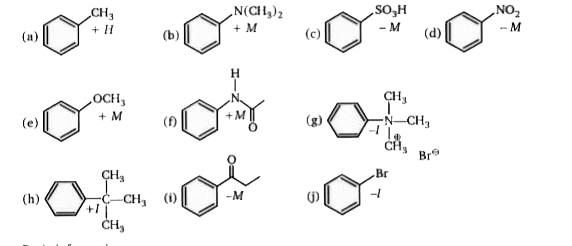
Electrophilic aromatic substitution.
Examine the ten structural formulas shown at the bottom of this page, and select those that satisfy each of the following conditions. Enter one or more letters (a through j) in each answer box, reflecting your choice for each.
Which compounds give meta substitution under electrophilic bromination conditions ? d, g, i
Promotional Banner

Topper's Solved these Questions

  • AROMATIC COMPOUNDS

    MS CHOUHAN|Exercise LEVEL-2 (SUBJECTIVE PROBLEMS)|3 Videos
  • AROMATIC COMPOUNDS

    MS CHOUHAN|Exercise LEVEL-2|11 Videos
  • AMINES

    MS CHOUHAN|Exercise Level-2|1 Videos
  • BIOMOLECULES

    MS CHOUHAN|Exercise LEVEL - 2|5 Videos

Similar Questions

Explore conceptually related problems

The necessary condition for a molecule to exhibit optical isomerism is dissymmetry or chiral. Thus all organic compounds which contain one assymetric carbon atom are chiral and exist in two stereoisomers. Although the two forms have the same structure, they have different arrangements of groups about the assymmetric carbon. In fact, they represent assymetric molecules. They do not have a plane of symmetry. They are related to each other as an object to its miror image and are non superimposable. The two structures actually stand for dextro or (+) and leavo or (-) isomers. Since they are related each other as mirror images, they are commonly called enantiomers. Consider the following structers A,B,C,D Which of the following statements is not correctConsider the following structers A,B,C,D Which of the following statements is not correct

The necessary condition for a molecule to exhibit optical isomerism is dissymmetry or chiral. Thus all organic compounds which contain one as symetric carbon atom are chiral and exist in two stereoisomers. Although the two forms have the same structure, they have different arrangements of groups about the as symmetric carbon. In fact, they represent as symetric molecules. They do not have a plane of symmetry. They are related to each other as an object to its mirror image and are non superimposable. The two structures actually stand for dextro or (+) and leavo or (-) isomers. Since they are related each other as mirror images, they are commonly called enantiomers. Consider the following structures A,B,C,D Which of the following statements is not correct

The necessary condition for a molecule to exhibit optical isomerism is dissymmetry or chiral. Thus all organic compounds which contain one as symetric carbon atom are chiral and exist in two stereoisomers. Although the two forms have the same structure, they have different arrangements of groups about the as symmetric carbon. In fact, they represent as symetric molecules. They do not have a plane of symmetry. They are related to each other as an object to its mirror image and are non superimposable. The two structures actually stand for dextro or (+) and leavo or (-) isomers. Since they are related each other as mirror images, they are commonly called enantiomers. Which of the following statements is correct regarding compounds I to III

The necessary condition for a molecule to exhibit optical isomerism is dissymmetry or chiral. Thus all organic compounds which contain one assymetric carbon atom are chiral and exist in two stereoisomers. Although the two forms have the same structure, they have different arrangements of groups about the assymmetric carbon. In fact, they represent assymetric molecules. They do not have a plane of symmetry. They are related to each other as an object to its miror image and are non superimposable. The two structures actually stand for dextro or (+) and leavo or (-) isomers. Since they are related each other as mirror images, they are commonly called enantiomers. Which of the following compounds is optically inactive

