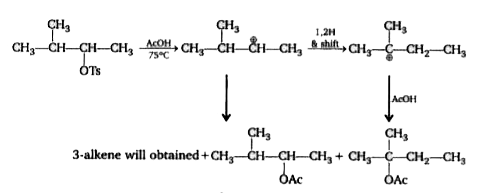
In solvolysis of 1, 2-dimethyl propyl p-toluene sulfonate in acetic acid at `75^@`C, (alkene + substitution products) will be formed by mechanism?
A
`S_(N^2) , E_2`
B
`S_(N^2),E_1`
C
`S_( N^1),E_2`
D
`S_(N^1) , E_1`
Text Solution
Verified by Experts
Topper's Solved these Questions
ALCOHOL,ETHERS AND EPOXIDES
MS CHOUHAN|Exercise LEVEL-2|24 Videos
ALCOHOL,ETHERS AND EPOXIDES
MS CHOUHAN|Exercise SUBJECTIVE PROBLEMS|1 Videos
5C ALKYL HALIDES
MS CHOUHAN|Exercise LEVEL-2 (SUBJECTIVE PROBLEMS)|1 Videos
ALDEHYDES AND KETONES
MS CHOUHAN|Exercise LEVEL-2|20 Videos
Similar Questions
Explore conceptually related problems
When acetic acid is heated with P_2 O_5 then which compound will be formed ?
When I mole of pure ethyl alcohol (C_(2)H_(5)OH) is mixed with 1 mole of acetic acid at 25^(@)C with one lit volume, the equilibrium mixture contains 2//3 mole each of ester and water. CH_(2)OH_((l)) +CH_(3)COOH_((l)) harr CH_(3)COOC_(2)H_(5(l))+H_(2)O_((l)) The DeltaG^(@) for the reaction at 298 K is:
The standard oxidation potential of Ni//Ni^(2+) electrode is 0.236 V . If this is combined with a hydrogen electrode in acid solution , at what pH of this solution will be measured e.m.f be zero at 25^@ C ? Assume that [Ni^(2+)] = 1M and P_(H_2) = 1 atm
In the addition of HBr to 1, 3-buta diene, one product is called the kinetic product and the other is called the thermodynamic product. Which of the following description applies to kinetic product? a) 1, 2 product b) 1, 4 product c) most stable d) least stable e) formed slowest f) formed fastest g) formed at low pressure h) formed at high temperature i) most substituted alkene j) least substituted alkene k) bromide attack at most substituted site l) bromide attack at least substituted site
Assertion (A): The pH of a buffer solution containing equal moles of acetic acid and sodium acetate is 4.8 ( pK_(a) of acetic acid is 4.8). Reasons (R): The ionic product of water at 25^(circ)C is 10^(-14) mol^(2)L^(-2) . The correct answer is
1) The -=C-H unit of an alkyne is more acidic than a C – H unit of an alkene or alkane, allowing acetylene and terminal alkynes to be converted to their conjugate bases -= C . 2) Unlike alkenes, alkynes are reduced by metals, especially Li, Na and K. 3) Unlike alkenes, alkynes can undergo nucleophilic as well as electrophilic addition. Which of the following best describes what happens in the first step in the mechanism of the reaction shown? CH_3 CH_2CH_2CHBr_2 + 3NaNH_2 overset(NH_3)to CH_3CH_2C -=CNa +2NaBr +3NH_3
1) The -=C-H unit of an alkyne is more acidic than a C – H unit of an alkene or alkane, allowing acetylene and terminal alkynes to be converted to their conjugate bases -= C . 2) Unlike alkenes, alkynes are reduced by metals, especially Li, Na and K. 3) Unlike alkenes, alkynes can undergo nucleophilic as well as electrophilic addition. Which of the following best describes what happens in the first step in the mechanism of the hydrogen - deuterium exchange reaction shown? CH_3 -= CD underset(NH_3)overset(NaNH_2)to CH_3C -= CH
MS CHOUHAN-ALCOHOL,ETHERS AND EPOXIDES-SUBJECTIVE PROBLEMS