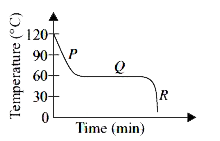
Dhairya, a Class 9 student heated a solid 'X' beyond its melting point. Then, he allowed the hot liquid to cool slowly and recorded the temperature at regular time intervals until it cooled to `20^(@)C`. He obtained the given cooling curve. The parts of graph where 'X' exists in solid state, in liquid state and in both solid and liquid states are respectively
A
Q, P and R
B
P, Q and R
C
R, P and Q
D
R, Q and P
Text Solution
Verified by Experts
The correct Answer is:
C
Topper's Solved these Questions
NSO QUESTION PAPER 2016 SET B
SCIENCE OLYMPIAD FOUNDATION |Exercise ACHIEVERS SECTION|2 Videos
NSO QUESTION PAPER 2016 SET A
SCIENCE OLYMPIAD FOUNDATION |Exercise ACHIEVERS SECTION|2 Videos
NSO QUESTION PAPER 2017 SET A
SCIENCE OLYMPIAD FOUNDATION |Exercise ACHIEVERS SECTION|1 Videos
Similar Questions
Explore conceptually related problems
A substance 'X' having low melting point, does not conduct electricity in both solid and liquid state. 'X' can be :
X’ melts at low temperature and is a bad conductor of electricity in both liquid and solid state. X is:
A solid substance is at 30^(@)C . To this substance heat energy is supplied at a constant rate. Then temperature versus time graph is as shown in the figure. The substance is in liquid state for the portion (of the graph)
As a physicist, you put heat into a 500 g solid sample at the rate of 10.0 kJ//min , while recording its temperature as a function of time. You plot your data and obtain the graph shown in figure. . (a) What is the latent heat of fusion for this solid? (b) What is the specific heat of solid state of the material?
SCIENCE OLYMPIAD FOUNDATION -NSO QUESTION PAPER 2016 SET B-ACHIEVERS SECTION