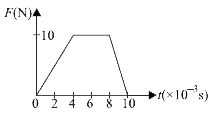
A particle of mass 70 g, moving at 50 cm `s^(-1)`, is acted upon by a variable force opposite to its direction of motion. The force F is shown as a function of time. After the force stops acting, the particle moves with a speed of
A
50 cm `s^(-1)` in reverse direction
B
100 cm `s^(-1)` in reverse direction
C
150 cm `s^(-1)` in original direction
D
100 cm `s^(-1)` in original direction.
Text Solution
Verified by Experts
The correct Answer is:
A
Topper's Solved these Questions
NSO QUESTION PAPER 2016 SET B
SCIENCE OLYMPIAD FOUNDATION |Exercise ACHIEVERS SECTION|2 Videos
NSO QUESTION PAPER 2016 SET A
SCIENCE OLYMPIAD FOUNDATION |Exercise ACHIEVERS SECTION|2 Videos
NSO QUESTION PAPER 2017 SET A
SCIENCE OLYMPIAD FOUNDATION |Exercise ACHIEVERS SECTION|1 Videos
Similar Questions
Explore conceptually related problems
A particle of mass m , initially at rest , is acted upon by a variable force F for a brief interval of time T . It begins to move with a velocity u after the forrce stops acting . F is shown in the graph as a function of time. The curve is a semicircle.
A particle of mass 2 kg moving with a velocity of 3 m//s is acted upon by a force which changes its direction of motion by an angle of 90^(@) without changing its speed. What is the magnitude of impulse experienced by the particle?
SCIENCE OLYMPIAD FOUNDATION -NSO QUESTION PAPER 2016 SET B-ACHIEVERS SECTION