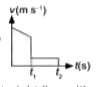
To solve the question regarding the speed-time graph of a parachutist's descent, we need to analyze the motion of the parachutist in different phases of the jump. Here’s a step-by-step breakdown:
### Step 1: Initial Jump
When the parachutist jumps out of the plane, his initial speed is zero. This is the starting point of the graph.
**Hint:** The speed starts at zero when the parachutist jumps.
### Step 2: Acceleration Phase
After jumping, the parachutist accelerates downwards due to gravity. This means that the speed increases steadily over time. The graph during this phase will be a straight line with a positive slope, indicating constant acceleration.
**Hint:** Look for a straight line with a positive slope after the jump.
### Step 3: Opening the Parachute
At time `t1`, the parachutist opens the parachute. This action creates a significant increase in air resistance, which opposes the downward motion. As a result, the speed of the parachutist will begin to decrease. This phase will show a downward slope on the graph.
**Hint:** The graph will show a downward slope at `t1` when the parachute opens.
### Step 4: Steady Speed
After some time, the parachutist reaches a steady speed (terminal velocity) where the force of gravity is balanced by the air resistance. At this point, the speed remains constant, and the graph will show a horizontal line.
**Hint:** Look for a horizontal line indicating constant speed after the initial decrease.
### Step 5: Hitting the Ground
Finally, at time `t2`, the parachutist hits the ground. The speed at this moment will be the terminal velocity, and the graph will end here.
**Hint:** The graph will stop at `t2`, showing the final speed just before hitting the ground.
### Conclusion
Based on the analysis, the correct speed-time graph should start at zero, show a positive slope (acceleration), a downward slope (deceleration when the parachute opens), and then a horizontal line (steady speed) until it reaches the point of impact.
### Final Answer
The correct option that represents this motion is **Option A**, which shows the described characteristics of the speed-time graph.