Home
Class 8
PHYSICS
A body brought into the sea from the sur...

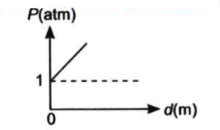
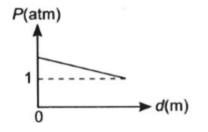
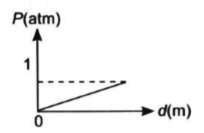
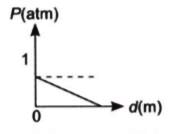
A body brought into the sea from the surface. Which of the following graphs represents correctly the variation of the pressure P on the body with increase in the depth d? [1 atmospheric pressure `~~ 10^(5) Nm^(-2)`]

A

B

C

D

Text Solution

AI Generated Solution

The correct Answer is:

To solve the question regarding the variation of pressure \( P \) on a body with an increase in depth \( d \) in the sea, we can follow these steps: ### Step 1: Understand the relationship between pressure and depth The pressure \( P \) at a certain depth \( d \) in a fluid is given by the formula: \[ P = P_0 + \rho g d \] where: - \( P_0 \) is the atmospheric pressure at the surface (approximately \( 10^5 \, \text{N/m}^2 \)), - \( \rho \) is the density of the fluid (for water, approximately \( 1000 \, \text{kg/m}^3 \)), - \( g \) is the acceleration due to gravity (approximately \( 9.81 \, \text{m/s}^2 \)), - \( d \) is the depth below the surface. ### Step 2: Identify the initial pressure at the surface At the surface of the sea (where \( d = 0 \)), the pressure \( P \) is equal to the atmospheric pressure \( P_0 \). Therefore, when \( d = 0 \): \[ P = P_0 \approx 10^5 \, \text{N/m}^2 \] ### Step 3: Analyze how pressure changes with depth As the depth \( d \) increases, the term \( \rho g d \) increases linearly with \( d \). This means that the pressure \( P \) increases linearly as well. ### Step 4: Sketch the graph - On the Y-axis, we plot the pressure \( P \). - On the X-axis, we plot the depth \( d \). - At \( d = 0 \), \( P = P_0 \). - As \( d \) increases, \( P \) increases linearly due to the linear relationship established by the formula. ### Step 5: Determine the shape of the graph The graph will start at \( P_0 \) when \( d = 0 \) and will rise linearly as \( d \) increases. This indicates that the graph is a straight line with a positive slope. ### Conclusion The correct graph representing the variation of pressure \( P \) with an increase in depth \( d \) is a straight line starting from \( P_0 \) at \( d = 0 \) and increasing linearly. ### Final Answer The correct option is the one that shows a linear increase in pressure starting from atmospheric pressure as depth increases. ---

To solve the question regarding the variation of pressure \( P \) on a body with an increase in depth \( d \) in the sea, we can follow these steps: ### Step 1: Understand the relationship between pressure and depth The pressure \( P \) at a certain depth \( d \) in a fluid is given by the formula: \[ P = P_0 + \rho g d \] ...
Promotional Banner

Topper's Solved these Questions

  • FORCE AND PRESSURE

    SCIENCE OLYMPIAD FOUNDATION |Exercise ACHIEVERS SECTIONS (HOTS)|5 Videos
  • FRICTION

    SCIENCE OLYMPIAD FOUNDATION |Exercise Achievers Section (HOTS) |3 Videos

Similar Questions

Explore conceptually related problems

Which of the following x-t graphs represents the distance-time variation of a body released from the top of a buiding?

Which of the following graphs represents correctly the variations of 0.5 mv_("max")^(2) with the intensity of incident radiations of a constant frequency ?

Which of the following graphs shows the variation of acceleration due to gravity g with depth h from the surface of the earth ?

A body moves from rest with a constant ac- celeration. Which of the following graphs represents the variation of its kinetic energy (E) with distance travelled (x)?

A body moves from rest with a constant acceleration. Which one of the following graphs represents the variation of its kinetic energy K with the distance travelled x?

What is the absolute pressure on a swimmer 10 m below the surface of a lake? Take atmospheric pressure 1xx10^(5)N//m^(2)

Which of the following graph represents the variation of amount of chemisorption of a gas by a solid with temperature under constant pressure?

Which of the following graphs correctly represents the variation of beta= -((dV)/(dP))//V with P for an ideal gas at constant temperature
