Home
Class 8
PHYSICS
When a manometer is connected to a gas o...

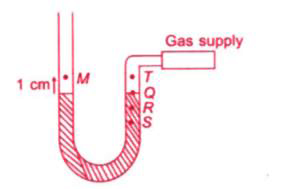
When a manometer is connected to a gas of pressure P above atmospheric pressure, the level in the left hand limb rises 1 cm to point Mas shown in the diagram. What is likely the level in the right hand limb if a new gas pressure is P below atmospheric pressure?

A

T

B

Q

C

R

D

S

Text Solution

Verified by Experts

The correct Answer is:

A

When the pressure of the gas decreases, the mercury level in the left limb will decrease 1 cm below the original level (or 2 cm below point M). Hence, the mercury level in the right limb will be pushed upwards.
Promotional Banner

Topper's Solved these Questions

  • FORCE AND PRESSURE

    SCIENCE OLYMPIAD FOUNDATION |Exercise ACHIEVERS SECTIONS (HOTS)|5 Videos
  • FRICTION

    SCIENCE OLYMPIAD FOUNDATION |Exercise Achievers Section (HOTS) |3 Videos

Similar Questions

Explore conceptually related problems

When one limb of a manometer is connected to a container filled with a gas, the level of the mercury in the other limb rises by 'h' cm. Then the pressure of the gas in the container is 76+h cm of Hg.

A gas is collected in the flask shown here. What is the pressure exerted by the gas is the atmospheric pressure is 735 mmHg?

The pressure and volume of a gas changed as shown in the P-V diagram in this figure. The temperature of the gas will

One of the limbs of a mercury manometer is connected to a gas cylinder. The mercury level in the limb connected to the gas cylinder is 10 cm higher than that in the other limb. Then the gauge pressure of the gas is _______ cm of Hg.

A manometer is connected to a gas containing bulb. The level of mercury in open arm is 2.6 cm lower than that in the other arm of the manometer. What is the pressure of the gas if the atmospheric pressure is 752 mm Hg?

A manometer reads the pressure of a gas in an enclosure as shown in the figure. The absolute and gauge pressure of the gas in cm of mercury is (take atmospheric pressure =76 cm of mercury)

The arms of a U shaped tube are vertical. The arm on right side is closed and other arm is closed by light movable piston. There is mercury in the tube and initially the level of the mercury in the arms is the same. Above the mercury, there is an air column of height h in each arm, and initial pressure is the same as atmospheric pressure in both arms. Now pistion is slowly pushed down by a distance of h//2 (see figure) Let x is the displacement of mercury level in one of the stem and P_(1) is pressure in left column of air after compression, P_(2) is pressure in right column of air after compression and P_(0) is atmospheric pressure then
