Home
Class 10
PHYSICS
A converging set of rays, travelling fro...

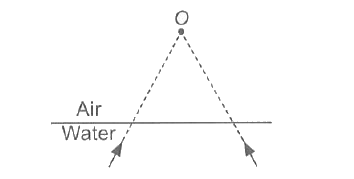
A converging set of rays, travelling from water (with refractive index 4/3 to air) is incident on a plane interface, the rays would have converged to a point o, 40 cm above the interface. However, due to refraction the rays will bend. At what distance above the interface will the rays actually converge?

A

53.3 cm

B

25 cm

C

30 cm

D

10 cm

Text Solution

Verified by Experts

The correct Answer is:
C

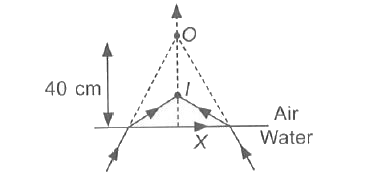
A ray of light travels from water across the interface through air and converges to form an image at I. Here, medium 1 is water and medium 2 is air.

`d_(1) = + 40 cm, mu_(1) = (4)/(3), mu_(2) = 1`
As, `(mu_(2))/(mu_(1)) = ("Real depth "(d_(2)))/("Apparent depth "(d_(1)))`
So, `(mu_(1))/(d_(1)) = (mu_(2))/(d_(2))" or "d_(2) = (mu_(2))/(mu_(1)) d_(1)`, we get `d_(2) = + 30` cm
Thus, the image is formed 30 cm above the interface.
Promotional Banner

Topper's Solved these Questions

  • LIGHT - REFLECTION AND REFRACTION

    SCIENCE OLYMPIAD FOUNDATION |Exercise ACHIEVERS SECTION (HOTS)|5 Videos
  • MAGNETIC EFFECTS OF ELECTRIC CURRENT

    SCIENCE OLYMPIAD FOUNDATION |Exercise QUESTIONS|19 Videos

Similar Questions

Explore conceptually related problems

A converging set of ray, traveling from water to air, is incident on a plane interface. In the absence of the interface, the rays would have converged to a point O, 60 cm above the interface. However, dur to refraction the rays will bend. At what distance above the interface will the rays actually converge?

A converging bundle of rays travel from water (refractive index 4//3 ) to glass (refractive index 1.5) through a convex interface of radius 16cm. In the absence of the interface, The rays would have converged to a point 32 cm from the pole of the interface. Where will the rays actually meet after refraction?

A light ray moving in medium-I (of refractive index n_(1) ) is incident on interface of two media and it is totally internally reflected at the interface. Now, refractive index n_(2) of medium-II is decreased, then

A ray of light travelling inside a rectangular glass block of refractive index sqrt 2 is incident on the glass-air surface at an angle of incidence of 45^(@) . The refractive index of air is one. Under these conditions the ray will

In the given figure rasy incident on an interface would converge 10cm below the interface if they continues to move in straight lines without bending. But due to refraction, the rays will bend and meet some where else. Find the distance of meeting point of refracted rasy below the interface, assuming the rays to be making small angles with the normal to the interface.

A ray of light travelling inside a rectangular galss block of refractive index sqrt2 is incident glass-air suface at an angle of incidence of 45^@ . The refractive index of air is one. Under these conditions, the ray

A ray of light travelling inside a rectangular glass block of refractive index sqrt(2) is incident on the glass–air surface at an angle of incidence of 45^(@) . The refractive index of air is 1. Under these conditions the ray

A converging beam of light rays incident on a glasa-air interface as shown in figure. Find where these rays will meet after refraction.

