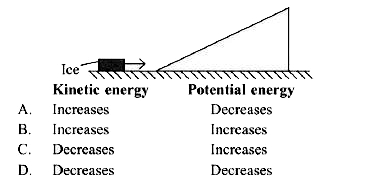
A block of ice is sliding at a constant speed before moving up a smooth slope as shown in figure, Which of the following options is true about its energy as it is sliding up the slope?
Text Solution
Verified by Experts
The correct Answer is:
C
When the block of ice is at the base of the slope it has kinetic energy only. But as the block slides up part of its energy is converted into potential energy (i.e., energy due to its position). Hence its kinetic energy decreases and potential energy increases as the block slides up.
Topper's Solved these Questions
NSO QUESTION PAPER 2017-18 SET A
SCIENCE OLYMPIAD FOUNDATION |Exercise ACHIEVERS SECTION|1 Videos
NSO MODEL TEST PAPER 02
SCIENCE OLYMPIAD FOUNDATION |Exercise ACHIEVERS SECTION|2 Videos
NSO QUESTION PAPER 2017-18 SET B
SCIENCE OLYMPIAD FOUNDATION |Exercise ACHIEVERS SECTION|2 Videos
Similar Questions
Explore conceptually related problems
A block of mass m is moving in a circle of radius R with speed v inside a smooth cone as shown in figure. Choose the wrong options
A particle is moving with constant speed v in xy plane as shown in figure. The magnitude of its angular velocity about point O is
A block of mass m sliding down an inclined at constant speed is initial at a height h shown the ground as shown in the figure above . The coefficient of kinetic friction between the mass and the inclined is mu . If the mass constinues to slide down the inclined at a constant speed how much energy is displaced by friction by the time the mass reaches the bottom of the incline?
A block of mas M is resting on an inclined plane as shown in the figure. The inclination of the plane to the horizontal is gradually increased. It is found that when the angle of inclination is theta the block just begins to slide down the plane. What is the minimum force F applied parallel to the plane that would just make the block move up the plane ?
A slider of mass 1 kg is sliding on a horizontal smooth guide as shown in figure. Speed of slider is 3m/s. Then magnitude of reaction force which the guide exerts on the slide just before A and at B are : (g = 10 m//s^(2))
A block of mass 30 kg is pulled up by a rope as shown in Fig. with a constant speed by applying a force of 200 N parallel to the slope. A and B are initial and the final positions of the block. Calculate: (a) the work done by the force in moving the block A to B, (b) the potential energy gained by the block, (c) account for the difference in work done the force and the increase in potential energy of the block.
A block is dragged on a smooth plane with the help of a rope which moves with a velocity v as shown in figure. The horizontal velocity of the block is :
A block of mass m is pressed against a wall which is moving with an acceleration a as shown in figure If the block is pulled at an angle theta with downward vertical by a force F and it does not slide relative to the wall . Find the a. friction force between the block and wall b.inimum magnitude of F so as to cayse a relative sliding between the block and wall
SCIENCE OLYMPIAD FOUNDATION -NSO QUESTION PAPER 2017-18 SET A-ACHIEVERS SECTION