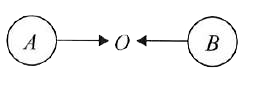
Two identical metal balls A and B moving in opposite directions hit each other at point O as shown in the figure. Changes are most likely to appear in their
A
Shapes and speeds
B
Speeds and directions
C
Directions and volumes
D
Volumes and shapes
Text Solution
Verified by Experts
The correct Answer is:
B
Due to collision of two identical metal balls, changes are most likely to appear in their speeds and directions.
Topper's Solved these Questions
NSO MODEL TEST PAPER 02
SCIENCE OLYMPIAD FOUNDATION |Exercise ACHIEVERS SECTION|2 Videos
NSO MODEL TEST PAPER 01
SCIENCE OLYMPIAD FOUNDATION |Exercise ACHIEVERS SECTION|2 Videos
NSO QUESTION PAPER 2017-18 SET A
SCIENCE OLYMPIAD FOUNDATION |Exercise ACHIEVERS SECTION|1 Videos
Similar Questions
Explore conceptually related problems
Two identical bodies moving in opposite direction with same speed, collide with each other. If the collision is prefectly elastic then
A circular metal loop is heated at point O as shown in figure. In which direction would heat flow in the loop ?
When two identical balls are moving with equal speed in opposite direction, which of the following is true ? For the system of two bodies.
Two identical balls moving in opposite directions in free space collide head on. How they will move after the impact, is decided by coefficient of restitution. For different coeffecients of restiution, few possible outcomes are shown in the following figures. Which of the above outcomes are physically possible for a collision?
Two ball bearings of mass m each moving in opposite directions with each speeds v collide head on with each other . Predict the outcome of the collision , assuming it to the perfectly elastic.
Two identical harmonic pulses travelling in opposite directions in a taut string approach each other. At the instant when they completely overlap, the total energy of the string will be .
Two particles A and B are moving , as shown in the figure . Their total angular momentum about the point O is
Two small particles of equal masses stant moving in opposite direction from a point A in a burtizonetal circule orbic their tangention velocity are V and 2V , respectively as shown in the figure between collsions , the particals move with constant speed After making how many elastic collition , other the then that at A these two partical will again reach the point A ?
SCIENCE OLYMPIAD FOUNDATION -NSO MODEL TEST PAPER 02-ACHIEVERS SECTION