Home
Class 9
CHEMISTRY
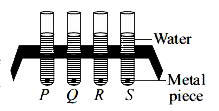
Abhinav, a class 9 student arranged the ...

Abhinav, a class 9 student arranged the given experimental set-up to study the reactivity of some metals with water.
He summarised his observations as follows:
I. In test tube P, there was no reaction in cold water but when the test tube was heated for a while, bubbles of gas were seen.
II. In test tube Q, bubbles of gas were formed only after boiling the water.
III. In test tube R, no gas was produced even on boiling the water.
IV. In test tube S, reaction occurred vigorously.
The metals present in test tubes P, Q, R and S could be respectively

A

Na, Mg, Zn and Fe

B

Mg, Zn, Cu and Na

C

Na, Mg, Al and Cu

D

Mg, Zn, Fe and Al

Text Solution

Verified by Experts

The correct Answer is:
B
Promotional Banner

Topper's Solved these Questions

  • NSO QUESTION PAPER 2017 SET A

    SCIENCE OLYMPIAD FOUNDATION |Exercise ACHIEVERS SECTION|1 Videos
  • NSO QUESTION PAPER 2016 SET B

    SCIENCE OLYMPIAD FOUNDATION |Exercise ACHIEVERS SECTION|1 Videos
  • NSO QUESTION PAPER 2017 SET B

    SCIENCE OLYMPIAD FOUNDATION |Exercise ARCHIEVERS SECTION|1 Videos

Similar Questions

Explore conceptually related problems

Write the reaction involved in test tube A?

A student while heating solid lead nitrate taken in a test tube would observe :

Equal lengths of Mg ribbon are taken in test tubes A and B. Hydrochloric acid is added to test tube A. While acetic acid is added to test tube B. In which case the reaction would occur more vigorously and why? Write the chemical equations for reactions in test tube A and B.

Study the following experimental set-up and answer the following questions. What changes will you observe in test tube A?

A VI class student was given an experiment, to collect hydrogen gas from the reaction of calcium metal and cold water. He conducted the experiment and collected the hydrogen gas in boiling tube. Which process is involved in collection of hydrogen gas?

Study the following experimental set-up and answer the following questions. What will happen if copper sulphate solution in test tube A is replaced by magnesium nitrate solution?
