Home
Class 9
CHEMISTRY
Ankita tested the solubility of four dif...

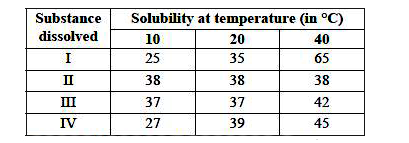
Ankita tested the solubility of four different substances (I-IV) at different temperatures and collected the data as given in the table.

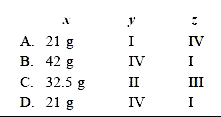
Fill in the blanks by selecting the correct option. __(x)___ of substance III would be needed to produce a saturated solution of it in 50 grams of water at `40^@C`. ___(y)___ has the highest solubility at `20^@C` while ___(z)___ has the least solubility at `10^@C`.

Text Solution

Verified by Experts

The correct Answer is:

D
Promotional Banner

Topper's Solved these Questions

  • NSO QUESTION PAPER 2018 SET A

    SCIENCE OLYMPIAD FOUNDATION |Exercise ACHIEVERS SECTION|1 Videos
  • NSO QUESTION PAPER 2019 SET A

    SCIENCE OLYMPIAD FOUNDATION |Exercise ACHIEVERS SECTION|1 Videos

Similar Questions

Explore conceptually related problems

Pragya tested the solubility of three different substances at different temperatures and collected the data as given below (results are given in the following table, as grams of substance dissolved in 100 grams of water to form a saturated solution). (a) What mass of potassium nitrate would be needed to produce a saturated solution of potassium nitrate in 50 grams of water at 313 K ? (b) Pragya makes a saturated solution of potassium chloride in water at 353 K and leaves the solution to cool at room temperature. What would she observe as the solution cools ? Explain. (c ) Find the solubility of each salt at 293 K . Which salt has the highest solubility at this temperature ? (d) What is the effect of change of temperature on the solubility of a salt ?

Pargya tested the solubility of four different substances at different temperatures and collected the data as given below (results are given in the following table as grams of substance dissolved in 100 grams of water to from a saturated solutin). (a) What mass of potassium nitrate would be needed to procuce a strurated solution of potassium nitrate in 50 grams of water at 313 K ? (b) Pragya makes a saturated solution of potassium chloride in water at 353 K and leaves the solution to cool at room temperature. What would she observe as the solution cools ? Explain. (c ) Find the solubility of each salt at 293 K. Which salt has the highest solubility at this twmperature? (d) What is the effect of change in temperature on the solubility of a salt ?

A student , determined the solubility of four substabces ,potassium nitrate ,sodium , sodim choride ,potassium choride and ammonium choride in a water at five different temperatures of 10^(@)C, 20^(@(C 40^(@)C,60^(@) C and 80^(@)C and obtained the following data : (a) what mass of potassium nitrate woulds be needed to make a satured solution of potassium nitrate in 50 grams of water at 40^(@)C ? (b) what would be observed if a saturated solution of potassium choride at 80^(@)C is left to cool to the room temperature ? ( c) what is the solubilty of each salt at 20^(@) C ? which salt has the highest solubility at this temperature ? (d) what is the effect of change of temperature on the solbubility of a salt as shown by the above date?

Solubility of two substances, I and II at 45°C and 80^@ C is given in the following table : If the temperature of solutions X and Y is dropped to 45^@ C, then amount of substance I and substance II crystallised out will be respectively
