A solid cylinder of height, cross sectional area A and density `1.40 xx 10^3 "kg m"^(-3)` is immersed completely in a mixture of liquid such that it floats with its axis vertical at the liquid-liquid interface with length 3h/4 in lesser dense liquid as shown in the figure. The lesser dense liquid is open to atmospheric pressure `P_0`. If the density of lesser dense liquid is `1.0xx10^3 "kg m"^(-3)`, then the density of denser liquid will be
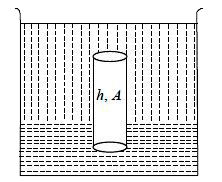
A solid cylinder of height, cross sectional area A and density `1.40 xx 10^3 "kg m"^(-3)` is immersed completely in a mixture of liquid such that it floats with its axis vertical at the liquid-liquid interface with length 3h/4 in lesser dense liquid as shown in the figure. The lesser dense liquid is open to atmospheric pressure `P_0`. If the density of lesser dense liquid is `1.0xx10^3 "kg m"^(-3)`, then the density of denser liquid will be
A
`1.5 xx 10^3 "kg m"^(-3)`
B
`2.0xx10^3 "kg m"^(-3)`
C
`2.6xx10^3 "kg m"^(-3)`
D
`3.2xx10^3 "kg m"^(-3)`
Text Solution
Verified by Experts
The correct Answer is:
C



Topper's Solved these Questions
Similar Questions
Explore conceptually related problems
A homogeneous solid cylinder of length L(LltH/2), cross-sectional area A/5 is immersed such that it floats with its axis vertical at the liquid-liquid interface with length L/4 in the denser liquid as shown in the figure. The lower density liquid is open to atmosphere having pressure P_0 . Then density D of solid is given by
The speed of sound in a liquid is 1500 ms^(-1) .The density of the liquid is 1.0xx10^(3) kg m^(-3) .Determine the bulk modulus of elasticity of the liquid.
A container of large uniform cross-sectional area A resting on a horizontal surface, holds two immiscible, non-viscous and incompressible liquids of densities d and 2d, each of height H/2 as shown in the figure. The lower density liquid is open to the atmosphere having pressure P_0 . (a) A homogeneous solid cylinder of length L(LltH//2) , cross-sectional area A//5 is immersed such that it floats with its axis vertical at the liquid-liquid interface with length L//4 in the denser liquid. Determine: (i) the density D of the solid and (ii) the total pressure at the bottom of the container. (b) The cylinder is removed and the original arrangement is restored. A tiny hole of area s(slt ltA) is punched on the vertical side of the container at a height h(hltH//2) . Determine: (i) the initial speed of efflux of the liquid at the hole, (ii) the horizontal distance x travelled by the liquid initially, and (iii) the height h_m at which the hole should be punched so that the liquid travels the maximum distance x_m initially. Also calculate x_m .
A container of large uniform cross-sectional area A resting on a horizontal surface, holes two immiscible, non-viscon and incompressible liquids of densities d and 2d each of height H//2 as shown in the figure. The lower density liquid is open to the atmosphere having pressure P_(0) . A homogeneous solid cylinder of length L(LltH//2) and cross-sectional area A//5 is immeresed such that it floats with its axis vertical at the liquid-liquid interface with length L//4 in the denser liquid, The cylinder is then removed and the original arrangement is restroed. a tiny hole of area s(sltltA) is punched on the vertical side of the container at a height h(hltH//2) . As a result of this, liquid starts flowing out of the hole with a range x on the horizontal surface. The density D of the material of the floation cylinder is
A container of large uniform cross-sectional area A resting on a horizontal surface, holes two immiscible, non-viscon and incompressible liquids of densities d and 2d each of height H//2 as shown in the figure. The lower density liquid is open to the atmosphere having pressure P_(0) . A homogeneous solid cylinder of length L(LltH//2) and cross-sectional area A//5 is immeresed such that it floats with its axis vertical at the liquid-liquid interface with length L//4 in the denser liquid, The cylinder is then removed and the original arrangement is restroed. a tiny hole of area s(sltltA) is punched on the vertical side of the container at a height h(hltH//2) . As a result of this, liquid starts flowing out of the hole with a range x on the horizontal surface. The total pressure with cylinder, at the bottom of the container is
A container of large uniform cross-sectional area A resting on a horizontal surface, holes two immiscible, non-viscon and incompressible liquids of densities d and 2d each of height H//2 as shown in the figure. The lower density liquid is open to the atmosphere having pressure P_(0) . A homogeneous solid cylinder of length L(LltH//2) and cross-sectional area A//5 is immeresed such that it floats with its axis vertical at the liquid-liquid interface with length L//4 in the denser liquid, The cylinder is then removed and the original arrangement is restroed. a tiny hole of area s(sltltA) is punched on the vertical side of the container at a height h(hltH//2) . As a result of this, liquid starts flowing out of the hole with a range x on the horizontal surface. The initial speed of efflux without cylinder is
A container of large uniform cross-sectional area A resting on a horizontal surface, holes two immiscible, non-viscon and incompressible liquids of densities d and 2d each of height H//2 as shown in the figure. The lower density liquid is open to the atmosphere having pressure P_(0) . A homogeneous solid cylinder of length L(LltH//2) and cross-sectional area A//5 is immeresed such that it floats with its axis vertical at the liquid-liquid interface with length L//4 in the denser liquid, The cylinder is then removed and the original arrangement is restroed. a tiny hole of area s(sltltA) is punched on the vertical side of the container at a height h(hltH//2) . As a result of this, liquid starts flowing out of the hole with a range x on the horizontal surface. The initial value of x is
A liquid of mass 1 kg is filled in a flask as shown in figure. The force exerted by the flask on the liquid is (g=10m//s^(2)) [Neglect atmospheric pressure]: