Home
Class 11
PHYSICS
If the ratio of lengths, radii and Young...

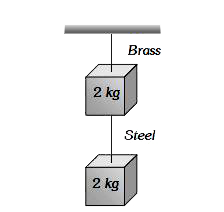
If the ratio of lengths, radii and Young's modulus of steel and brass wires shown in the figure are a, b and c, respectively. The ratio between the increase in lengths of brass and steel wires would be

A

`(b^(2)a)/(2c)`

B

`(bc)/(2a^(2))`

C

`(ba^(2))/(2c)`

D

`(a)/(2b^(2)c)`

Text Solution

Verified by Experts

The correct Answer is:

D

`(l_(1))/(l_(2))= a, (r_(1))/(r_(2)) = b and (Y_(1))/(Y_(2))=c`
`(Delta l_(1))/(Delta l_(2))= (F_(1)l_(1))/(A_(1) Y_(1)) xx (A_(2)Y_(2))/(F_(2) l_(2))`
`= (2g xx l_(1))/(pi r_(1)^(2) xx Y_(1)) xx (pi r_(2)^(2) xx Y_(2))/(4g xx l_(2))`
`rArr (Delta l_(1))/(Delta l_(2))= (a)/(2b^(2)c)`
Promotional Banner

Topper's Solved these Questions

  • ELASTICITY

    ERRORLESS|Exercise NCERT BASED QUESTIONS (Work Done in Stretching a Wire)|13 Videos
  • ELASTICITY

    ERRORLESS|Exercise NCERT BASED QUESTIONS (Bulk Modulus)|11 Videos
  • BASIC MATHEMATICS AND VECTORS

    ERRORLESS|Exercise Assertion & Reason|15 Videos
  • FLUID MECHANICS

    ERRORLESS|Exercise ASSERTION AND REASON|23 Videos

Similar Questions

Explore conceptually related problems

If the ratio of lengths, radii and Young's moduli of steel and brass wires in the figure are a, b and c respectively then the corresponding ratio of increase in their lengths is

If the ratio of lengths, radii and Young's moduli of steel and brass wires in the figure are a,b and c repectively then the corresponding ratio of increase in their lengths is

If the ratio of lengths, radii and young's modulii of steel and brass wires in the figure are a,b and c, respectively. Then, the corresponding ratio of increase in their lengths would be

If the ratio of diameters,lengths and Young's moduli of steel and brass wires shown in the figure are p, q and r respectively . Then the corresponding ratio of increase in their lenghts would be

If the ratio of diameter, lengths and Young's modulus of steel and brass wires shown in figure are 2 : 1, 2 : 1 and 2 : 1 respectively, then the corresponding ratio of increase in their lengths would be

If the ratio of lengths, radii and youngs's modulus of steel and and brass wires in figure are 2:1,2:1,3:1 respectively. Then corresponding ratio of increases in their would be. (Neglect the mass of the wire and take g=10m//s^(2) )

If the ratio of lenghts, radi and Young's moduli of steel and brass wires are a,b and c respectively their respective loads are in the ratio 3:2 then the corresponding ratio of increases in their lenghts would be

Wires A and B are connected with blocks P and Q, as shown, the ratio of lengths radii and Young's modulus of wires A and B are r, 2r and 3r respectively (r is a constant). Find the mass of block P if ratio of increase in their corresponding length is (1)/(6r^2) . The mass of the block Q is 3M

The radii and Young's moduli of two uniform wires A and B are in the ratio 2:1 and 1:2 respectively. Both wires are subjected to the same longitudinal force. If the increase in leangth of the wire A is one percent, the percentage increae in length of the wire B is

The stress strain curves for brass, steel and rubber are shown in the figure. The lines A, B and C are for
