Home
Class 11
PHYSICS
Two masses m(1) and m(2) are connected b...

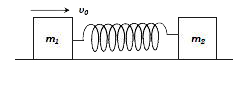
Two masses `m_(1)` and `m_(2)` are connected by a massless spring of spring constant k and unstreched length l. The masses are placed on a frictionless straight channel – which we consider our x-axis. They are initially at rest at x = 0 and x = l, respectively. At t = 0, a velocity of v0 is suddenly imparted to the first particle. At a later time t0, the centre of mass of the two masses is at-

A

`x=(m_(2)l)/(m_(1)+m_(2))`

B

`x=(m_(1)l)/(m_(1)+m_(2))+(m_(2)v_(0)t)/(m_(1)+m_(2))`

C

`x=(m_(2)l)/(m_(1)+m_(2))+(m_(2)v_(0)t)/(m_(1)+m_(2))`

D

`x=(m_(2)l)/(m_(1)+m_(2))+(m_(1)v_(0)t)/(m_(1)+m_(2))`

Text Solution

Verified by Experts

The correct Answer is:
D


`V_(com)=(m_(1)v_(0)+0)/(m_(1)+m_(2)),X_(icom)=(m_(1)(0)+m_(2)(l))/(m_(1)+m_(2))`
Also `X_(com)=((m_(2)l)/(m_(1)+m_(2)))+(m_(1)v_(0)t)/(m_(1)+m_(2))`
Promotional Banner

Topper's Solved these Questions

  • ROTATIONAL MOTION

    ERRORLESS|Exercise NCERT BASED QUESTIONS (Angular Displacement, Velocity and Acceleration)|34 Videos
  • ROTATIONAL MOTION

    ERRORLESS|Exercise NCERT BASED QUESTIONS (Moment of Inertia)|139 Videos
  • NEWTON'S LAWS OF MOTION

    ERRORLESS|Exercise ASSERTION & REASON |18 Videos
  • SIMPLE HARMONIC MOTION

    ERRORLESS|Exercise Assertion & Reason|15 Videos

Similar Questions

Explore conceptually related problems

Two masses m_(1) and m_(2) are connected by a massless spring of spring constant k and unstretched length l. The masses are placed on a frictionless straight channel, which are consider our x-axis. They are initially at x = 0 and x = l respectively. At t = 0, a velocity v_(0) is suddenly imparted to the first particle. At a later time t, the centre of mass of the two masses is at :

Two masses m_(1) and m_(2) connected by a spring of spring constant k rest on a frictionless surface. If the masses are pulled apart and let go, the time period of oscillation is-

Two blocks of masses m_(1) and m_(2) are connected by a massless spring and placed on smooth surface. The spring initially stretched and released. Then :

Two blocks of masses m_(1) =1kg and m_(2) = 2kg are connected by a spring of spring constant k = 24 N/m and placed on a frictionless horizontal surface. The block m_(1) is imparted an initial velocity v_(0) = 12cm/s to the right. The amplitude of osciallation is

Two masses m_1 and m_2 re connected by a spring of spring constnt k and are placed on as frictionless horizontal surface. Initially the spring is tretched through a distance x_0 when the system is released from rest. Find the distance moved by the tow masses before they again come to rest.

Two blocks of mass m_(1) and m_(2) , resting on a frictionless table, are connected by a stretched spring and then released -

A particle of mass m is fixed to one end of a massless spring of spring constant k and natural length l_(0) . The system is rotated about the other end of the spring with an angular velocity omega ub gravity-free space. The final length of spring is

A block of mass m is connected to another .block of mass M by a massless spring of spring constant k. A constant force f starts action as shown in figure, then:

Two blocks m_(1) and m_(2) are connected by a spring of force constant K and are placed on a frictionless horizontal surface. Initially the spring is given extension x_(0) when the sysetem is released from rest, find the distance moved by two blocks before they again comes to rest.

Two blocks A and B of mass 2 m and m respectively are connected to a massless spring of spring constant K. if A and B moving on the horizontal frictionless surface with velocity v to right. If A collides with C of mass m elastically and head on, then the maximum compressions of the spring will be

ERRORLESS-ROTATIONAL MOTION-Assertion & Reason
  1. Two masses m(1) and m(2) are connected by a massless spring of spring ...

    Text Solution

    |

  2. Statement-1 : The centre of mass of a two particle system lies on the ...

    Text Solution

    |

  3. Statement-1 : The centre of mass of a system of n particles is the wei...

    Text Solution

    |

  4. Assertion : The centre of mass of an isolated system has a constant ve...

    Text Solution

    |

  5. Statement-1: The center of mass of body may lie where there is no mass...

    Text Solution

    |

  6. Assertion : A particle is moving on a straight line with a uniform vel...

    Text Solution

    |

  7. Statement-1 : The centre of mass of a proton and an electron, released...

    Text Solution

    |

  8. Statement-1 : The position of centre of mass of a body does not depend...

    Text Solution

    |

  9. Assertion : A shell at rest, explodes. The centre of mass of fragments...

    Text Solution

    |

  10. Assertion: A judo fighter in order to throw his opponent onto the matt...

    Text Solution

    |

  11. Assertion: The centre mass of an electron and proton, when released mo...

    Text Solution

    |

  12. Assertion : At the centre of earth, a body has centre of mass , but no...

    Text Solution

    |

  13. Assertion: When a body dropped from a height explodes in mid air, its ...

    Text Solution

    |

  14. Statement -1: It is harder to open and shut the door if we apply force...

    Text Solution

    |

  15. Statement-1 : Moment of inertia of a particle is same, whatever be the...

    Text Solution

    |

  16. Assertion : Inertia and moment of inertia are same quantities. Reaso...

    Text Solution

    |

  17. If earth shrink (without change in mass) to half it's present size. Le...

    Text Solution

    |

  18. Statement -1: Torque due to force is maximum when angle between vec r ...

    Text Solution

    |

  19. Statement-1 : Radius of gyration of a body is a constant quantity. ...

    Text Solution

    |

  20. Assertion: A ladder is more apt to slip, when you are high up on it th...

    Text Solution

    |

  21. Statement -1 : Torque is equal to rate of change of angular momentum ....

    Text Solution

    |

