Home
Class 11
PHYSICS
Two non-mixing liquids of densities rho ...

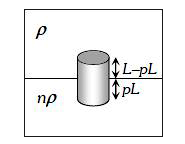
Two non-mixing liquids of densities `rho` and `(n gt1)` are put in a container. The height of each liquid is `h`. A solid cylinder of length `L` and density `d` is put in this container. The cylinder floats with its axis vertical and length `pL(p lt 1)` in the denser liquid. The density `d` is equal to :

A

`{1+(n+1)p}rho`

B

`{(2+(n+1)p}rho`

C

`{2+(n-1)p}rho`

D

`{1+(n-1)p}rho`

Text Solution

Verified by Experts

The correct Answer is:
D

Weight of body = up thrust by the two liquid
if A = area of section
`(dAL)g = [rho A(L-rho L) + n rho A p L]g`
`d= rho[(1 -p)+np]`
`=rho[1+(n-1)p]`.
Promotional Banner

Topper's Solved these Questions

  • FLUID MECHANICS

    ERRORLESS|Exercise ASSERTION AND REASON|23 Videos
  • FLUID MECHANICS

    ERRORLESS|Exercise NCERT BASED QUESTIONS(FLUID FLOW)|51 Videos
  • ELASTICITY

    ERRORLESS|Exercise ASSERTION & REASON |10 Videos
  • FRICTION

    ERRORLESS|Exercise ASSERTION & REASON |8 Videos

Similar Questions

Explore conceptually related problems

Liquid of density rho in a container exerts pressure P given by (height of liquid h and area A)

If equal masses of two liquids of densities d_(1) and d_(2) are mixed together, the density of the mixture is

A container of a large uniform cross-sectional area A resting on a horizontal surface holds two immiscible, non viscous and incompressible liquids of densities d and 2d , each of height H//2 as shown in figure. The lower density liquid is open to atmosphere. A homogeneous solid cylinder of length L(L lt (H)/(2)) , cross-sectional area A//5 is immersed such that it floats with its axis vertical of the liquid-liquid interface with length L//4 denser liquid. Determine (a) density D of the solid and (b) the total pressure at the bottom of the container. (Atmospheric pressure = P_0 ). .

Fluids at rest exert a normal force to the walls of the container or to the sruface of the Body immersed in the fluid. The pressure exerted by this force at a point inside the liqid is the sum of atmospheric pressure and a factor which depends on the density of the liquid, the acceleration due to gravity and the height of the liquid, above that point. The upthrust acting on a body immersed in a stationary liquid is the net force acting on the body in the upward direction. A number of phenomenon of liquids in motion can be explain by Bernoulli's theorem which relates the pressure, flow speed and height for flow of an ideal incompressible fluid. A container of large uniform corss sectional area. A resting on a horizontal surface holds two immiscible, non viscous and incompressile liquids of densities d and 2d , each of height H//2 as shown in the figure. The lower density liquid is open to the atmosphere having pressure P_(0) . Situation I: A homogeneous solid cylinder of length L(LltH//2) . cross sectional area A//5 is immersed such that it floats with its axis vertical at liquid -liquid interface with lenght L//4 in the denser liquid. The density of the solid is

A container of large uniform cross-sectional area A resting on a horizontal surface, holes two immiscible, non-viscon and incompressible liquids of densities d and 2d each of height H//2 as shown in the figure. The lower density liquid is open to the atmosphere having pressure P_(0) . A homogeneous solid cylinder of length L(LltH//2) and cross-sectional area A//5 is immeresed such that it floats with its axis vertical at the liquid-liquid interface with length L//4 in the denser liquid, The cylinder is then removed and the original arrangement is restroed. a tiny hole of area s(sltltA) is punched on the vertical side of the container at a height h(hltH//2) . As a result of this, liquid starts flowing out of the hole with a range x on the horizontal surface. The density D of the material of the floation cylinder is

A container of large uniform cross-sectional area A resting on a horizontal surface, holes two immiscible, non-viscon and incompressible liquids of densities d and 2d each of height H//2 as shown in the figure. The lower density liquid is open to the atmosphere having pressure P_(0) . A homogeneous solid cylinder of length L(LltH//2) and cross-sectional area A//5 is immeresed such that it floats with its axis vertical at the liquid-liquid interface with length L//4 in the denser liquid, The cylinder is then removed and the original arrangement is restroed. a tiny hole of area s(sltltA) is punched on the vertical side of the container at a height h(hltH//2) . As a result of this, liquid starts flowing out of the hole with a range x on the horizontal surface. The total pressure with cylinder, at the bottom of the container is

A container of large uniform cross-sectional area A resting on a horizontal surface, holes two immiscible, non-viscon and incompressible liquids of densities d and 2d each of height H//2 as shown in the figure. The lower density liquid is open to the atmosphere having pressure P_(0) . A homogeneous solid cylinder of length L(LltH//2) and cross-sectional area A//5 is immeresed such that it floats with its axis vertical at the liquid-liquid interface with length L//4 in the denser liquid, The cylinder is then removed and the original arrangement is restroed. a tiny hole of area s(sltltA) is punched on the vertical side of the container at a height h(hltH//2) . As a result of this, liquid starts flowing out of the hole with a range x on the horizontal surface. The initial speed of efflux without cylinder is

A container of large uniform cross-sectional area A resting on a horizontal surface, holes two immiscible, non-viscon and incompressible liquids of densities d and 2d each of height H//2 as shown in the figure. The lower density liquid is open to the atmosphere having pressure P_(0) . A homogeneous solid cylinder of length L(LltH//2) and cross-sectional area A//5 is immeresed such that it floats with its axis vertical at the liquid-liquid interface with length L//4 in the denser liquid, The cylinder is then removed and the original arrangement is restroed. a tiny hole of area s(sltltA) is punched on the vertical side of the container at a height h(hltH//2) . As a result of this, liquid starts flowing out of the hole with a range x on the horizontal surface. The initial value of x is

