Home
Class 11
PHYSICS
A lead shot of a 1mm diameter falls thro...

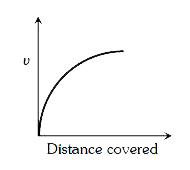
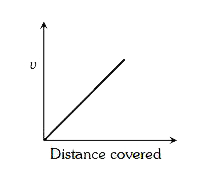
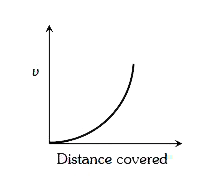
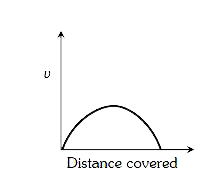
A lead shot of a 1mm diameter falls through a long column of glycerine.The variation of its velocity `v` with distance covered is represented by,

A

B

C

D

Text Solution

Verified by Experts

The correct Answer is:

A

Note: After Travelling certain distance the net force on lead shot is zero.
The velocity of falling lead shot goes on increasing due to the effective force acting downwards on the ball.
The layer of glycerine in contact with lead shot tends to move with velocity of lead shot, a stage is finally reached when the opposing viscous force becomes equal to the effective force driving the ball.
The net force on the shot is now zero and lead shot attains a constant velocity called the terminal velocity.
Promotional Banner

Topper's Solved these Questions

  • FLUID MECHANICS

    ERRORLESS|Exercise ASSERTION AND REASON|23 Videos
  • FLUID MECHANICS

    ERRORLESS|Exercise NCERT BASED QUESTIONS(FLUID FLOW)|51 Videos
  • ELASTICITY

    ERRORLESS|Exercise ASSERTION & REASON |10 Videos
  • FRICTION

    ERRORLESS|Exercise ASSERTION & REASON |8 Videos

Similar Questions

Explore conceptually related problems

A lead shot of a 1mm diameter falls through a long column of glycerine.The variation of its velocity v with distance coverd is represented by,

A lead shot of 1 mm diameter falls through a long colummn of glycerine. The variation of the velocity v with distance covered (s) is represented by

A narrow tunnel is dug across a planet diametrically and a small body is dropped from a large height, so that it falls into the tunnel. The variation of its kinetic energy (KE) with distance (r) from the centre is represented by

For a body moving with uniform acceleration along straight line, the variation of its velocity (v) with position (x) is best represented by

A spherical ball of iron of radius 2 mm is falling through a column of glycerine. If densities of glycerine and iron are respectively 1.3 xx 103 "kg/m"^(3)" and" 8 xx 103 "kg/m"^(3) . eta for glycerine = 0.83 "Nm"^(–2) sec, then the terminal velocity

find the terminal velocity of a steel ball 2mm in diameter falling through glycerine. Relative density of steel =8, relative density of glycerine =1.3 and viscosity of glycerine=8.3 poise.

A ball bearing of radius of 3mm made of iron of density 7.85g cm^(-3) is allowed to fall through a long column of glycerine of density 1.25gcm^(-3) . It is found to attain a terminal velocity of 2.20cms^(-1) . Determine the viscosity of glycerine in centipoise. ( Take g=10m//s^(2))

A spherical steel ball released at the top of along column of glycerin of length l falls through a distance l//2 with accelerated motion and the remaining distance l//2 with uniform velocity let t_(1) and t_(2) denote the times taken to cover the first and second half and w_(1) and w_(2) are the work done against gravity in the two halves, then compare times and work done.

A body freely falling from the rest has velocity v after it falls through a height h the distance it has to fall down for its velocity to become double is

A ball bearing of radius 1.5 mm mode of iron of density 7.85 g cm^(-3) is allowed to fall through a long columu of glycerice of density 1.25 g cm ^(-3) lt is found to attain a terminal velocity of 2.25 cms^(-1) .Determine the viscosity of glycerine in centipoise .
