Home
Class 12
CHEMISTRY
Statement-I: Optically active 2-idoibuta...

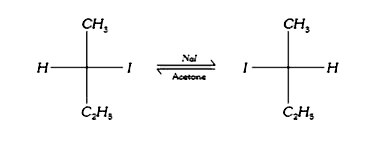
Statement-I: Optically active 2-idoibutane on treatment with `NaI` in acetone undergoes racemisation.
Because Statement-II: Repeated Walden inversions on the reactant and its product evantually gives a racemic mixure.

A

If both assertion and reason are true and the reason is the correct explanation of the assertion

B

If both assertion and reason are true but reason is not the correct explanation of the assertion.

C

If assertion is true but reason is false.

D

If the assertion and reason both are false

Text Solution

Verified by Experts

The correct Answer is:
A

`I^(-)` is a strong nucleophile and acetone is aprotic polar solvent. Hence the `2^@` alkyl halide will prefer `S_N^2` mechanism and inversion will take place.

The formed product will again invert and an equilibrium will reach and eventually form a racemic mixture.
Promotional Banner

Topper's Solved these Questions

  • HELOALKANES AND HALOARENES

    ERRORLESS|Exercise PAST YEARS QUESTIONS|30 Videos
  • GENERAL PRINCIPLES & PROCESSES OF ISOLATION OF ELEMENTS

    ERRORLESS|Exercise ASSERTION & REASON|8 Videos
  • ORGANIC COMPOUNDS CONTAINING NITROGEN

    ERRORLESS|Exercise Assertion and Reason|15 Videos

Similar Questions

Explore conceptually related problems

(A) Optically active 2-iodobutane on treatment with NaI in acetone undergoes recemization. (R) Reaction imvolves multiple Walden inversion and the product contains mixture of dextro and laevo isomer.

Optically active 2-iodo burtane on treatment with NaI in acetone gives a product which does not show optical activity. Explain briefly.

Statement-I : A reactant that is entirely consumed when a reaction goes to completion is known as limiting reactant. Because Statement-II : The amount of reactant limits the amount of product formed.

Statement-I : The balancing of chemical equations is based on law of consevation of mass. Because Statement-II : Total mass of reactants is equal to total mass of products.

Statement-I: Nucleophilic substitution reaction on an optically active alkyl halide gives a mixture of enantiomers. Because Statement-II: The reaction occurs by S_(N^(1)) mechanism.

Statement-I : Addition of HBr to 1- butene gives two optical isomers. Because Statement-II : The product contains one asymmetric carbon.

