A
B
C
D
Text Solution
Verified by Experts
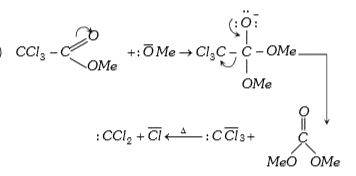
The correct Answer is:



Topper's Solved these Questions
GENERAL ORGANIC CHEMISTRY
ERRORLESS|Exercise NCERT BASED QUESTIONS (Organic Reactions and their Mechanism )|46 VideosGENERAL ORGANIC CHEMISTRY
ERRORLESS|Exercise NCERT BASED QUESTIONS (Structural and Stereo Isomerism )|99 VideosGENERAL ORGANIC CHEMISTRY
ERRORLESS|Exercise ASSERTION AND REASON|14 VideosENVIRONMENTAL CHEMISTRY
ERRORLESS|Exercise ASSERTION & REASON|7 VideosHYDROCARBONS
ERRORLESS|Exercise ASSERTION & REASON|18 Videos
Similar Questions
Explore conceptually related problems
ERRORLESS-GENERAL ORGANIC CHEMISTRY -NCERT BASED QUESTIONS (Dipole Moment, Resonance and Reaction Intermediates )
- Strongest nucleophile is
Text Solution
|
- CH(3)CH(2)Cl undergoes homolytic fission, produces
Text Solution
|
- A nucleophile must have :
Text Solution
|
- Carbocation which is most stable
Text Solution
|
- Convalent bond can undergo fission in two different ways. The correct ...
Text Solution
|
- Which one of the following will be the most easiliy attacked by an ele...
Text Solution
|
- Reactivity towards nucleophilic additions reaction of (I) IHCHO (II), ...
Text Solution
|
- Least active electrophile is :
Text Solution
|
- The correct order of leaving group ability in a nucleophilic substitut...
Text Solution
|
- Among the following compounds which can be dehydrated very easily is:
Text Solution
|
- Which of the following compounds are not arranged in order of decreasi...
Text Solution
|
- Which one of the following behaves both as a nucleophile and an electr...
Text Solution
|
- Electrophilic additions reactions proceed in two steps. The first step...
Text Solution
|
- The additions of HCl to an alkene proceeds in two steps. The first ste...
Text Solution
|
- The correct order for homolytic bond dissociation energies (Delta H in...
Text Solution
|
- Among the following the strongest nucleophilic is
Text Solution
|
- For an electrophilic aromatic substitution reaction
Text Solution
|
- Which one of the following has the most nucleophilic nitrogen?
Text Solution
|
- The reaction of methyl trichloroacetate (Cl(3)"CC"O(2)Me) with sodium ...
Text Solution
|
- Which of the following compounds prossesses the C-H bonds with the low...
Text Solution
|