Home
Class 12
BIOLOGY
The figure below shows the structure of ...

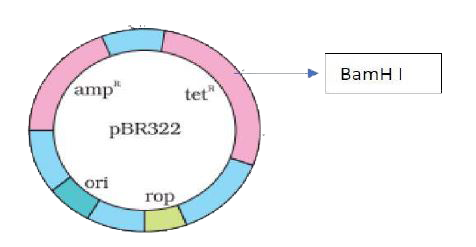
The figure below shows the structure of a plasmid.
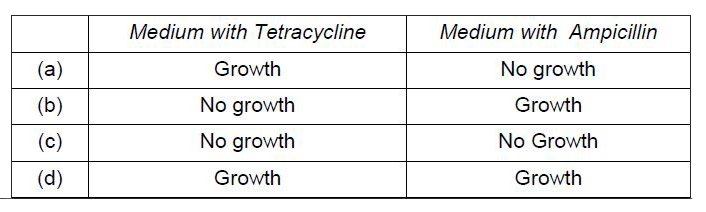
A foreign DNA was ligated at BamH1. The transformants were then grown in a medium containing antibiotics tetracycline and ampicillin. Choose the correct observation for the growth of bacterial colonies from the given table
Promotional Banner

Topper's Solved these Questions

  • SAMPLE PAPER 2023 TERM I

    CBSE MODEL PAPER|Exercise SECTION - B|7 Videos
  • SAMPLE PAPER 2023 TERM I

    CBSE MODEL PAPER|Exercise SECTION - C|15 Videos
  • SAMPLE PAPER 2022 TERM II

    CBSE MODEL PAPER|Exercise SECTION C|2 Videos
  • SAMPLE PAPER 2024

    CBSE MODEL PAPER|Exercise Question|2 Videos

Similar Questions

Explore conceptually related problems

Read the passage given below and answer the question: The transition metals when exposed to oxygen at low and intermediate temperatures form thin, protective oxide films of up to some thousands of Angstroms in thickness. Transition metal oxides lie between the extremes of ionic and covalent binary compounds formed by elements from the left or right side of the periodic table. They range from metallic to semiconducting and deviate by both large and small degrees from stoichiometry. Since d- electron bonding levels are involved, the cations exist in various valence states and hence give rise to a large number of oxides. The crystal structures are often classified by considering a cubic or hexagonal close-packed lattice of one set of ions with the other set of ions filling the octahedral or tetrahedral interstices. The actual oxide structures, however, generally show departures from such regular arrays due in part to distortions caused by packing of ions of different size and to ligand field effects. These distortions depend not only on the number of d-electrons but also on the valence and the position of the transition metal in a period or group. (source: Smeltzer, W. W., & Young, D. J. (1975). Oxidation properties of transition metals. Progress in Solid State Chemistry, 10, 17-54.) In the following question, a statement of assertion followed by a statement of reason is given. Choose the correct answer out of the choices on the basis of the above passage. Assertion : Transition metals form protective oxide films. Reason: Oxides of transition metals are always stoichiometric.

Read the passage given below and answer the question: The transition metals when exposed to oxygen at low and intermediate temperatures form thin, protective oxide films of up to some thousands of Angstroms in thickness. Transition metal oxides lie between the extremes of ionic and covalent binary compounds formed by elements from the left or right side of the periodic table. They range from metallic to semiconducting and deviate by both large and small degrees from stoichiometry. Since d- electron bonding levels are involved, the cations exist in various valence states and hence give rise to a large number of oxides. The crystal structures are often classified by considering a cubic or hexagonal close-packed lattice of one set of ions with the other set of ions filling the octahedral or tetrahedral interstices. The actual oxide structures, however, generally show departures from such regular arrays due in part to distortions caused by packing of ions of different size and to ligand field effects. These distortions depend not only on the number of d-electrons but also on the valence and the position of the transition metal in a period or group. (source: Smeltzer, W. W., & Young, D. J. (1975). Oxidation properties of transition metals. Progress in Solid State Chemistry, 10, 17-54.) In the following question, a statement of assertion followed by a statement of reason is given. Choose the correct answer out of the choices on the basis of the above passage. Assertion: Cations of transition elements occur in various valence states Reason: Large number of oxides of transition elements are possible.

Two different liquids of same mass are kept in two identical vessels, which are placed in a freezer that extracts heat from them at the same rate causing each liquid to transform into a solid. The schematic figure below shows the temperature T vs time t plot for the two materials. We denote the specific heat in the liquid status to be C_(L1) and C_(L2) for materials 1 and 2 respectively, and latent heats of fusion U_(1) and U_(2) respectively. Choose the correct option.

Read the passage given below and answer the question: The transition metals when exposed to oxygen at low and intermediate temperatures form thin, protective oxide films of up to some thousands of Angstroms in thickness. Transition metal oxides lie between the extremes of ionic and covalent binary compounds formed by elements from the left or right side of the periodic table. They range from metallic to semiconducting and deviate by both large and small degrees from stoichiometry. Since d- electron bonding levels are involved, the cations exist in various valence states and hence give rise to a large number of oxides. The crystal structures are often classified by considering a cubic or hexagonal close-packed lattice of one set of ions with the other set of ions filling the octahedral or tetrahedral interstices. The actual oxide structures, however, generally show departures from such regular arrays due in part to distortions caused by packing of ions of different size and to ligand field effects. These distortions depend not only on the number of d-electrons but also on the valence and the position of the transition metal in a period or group. (source: Smeltzer, W. W., & Young, D. J. (1975). Oxidation properties of transition metals. Progress in Solid State Chemistry, 10, 17-54.) In the following question, a statement of assertion followed by a statement of reason is given. Choose the correct answer out of the choices on the basis of the above passage. Assertion: Crystal structure of oxides of transition metals often show defects. Reason: Ligand field effect cause distortions in crystal structures.

