Home
Class 12
MATHS
Consider equation x^(4)-6x^(3)+8x^(2)+4a...

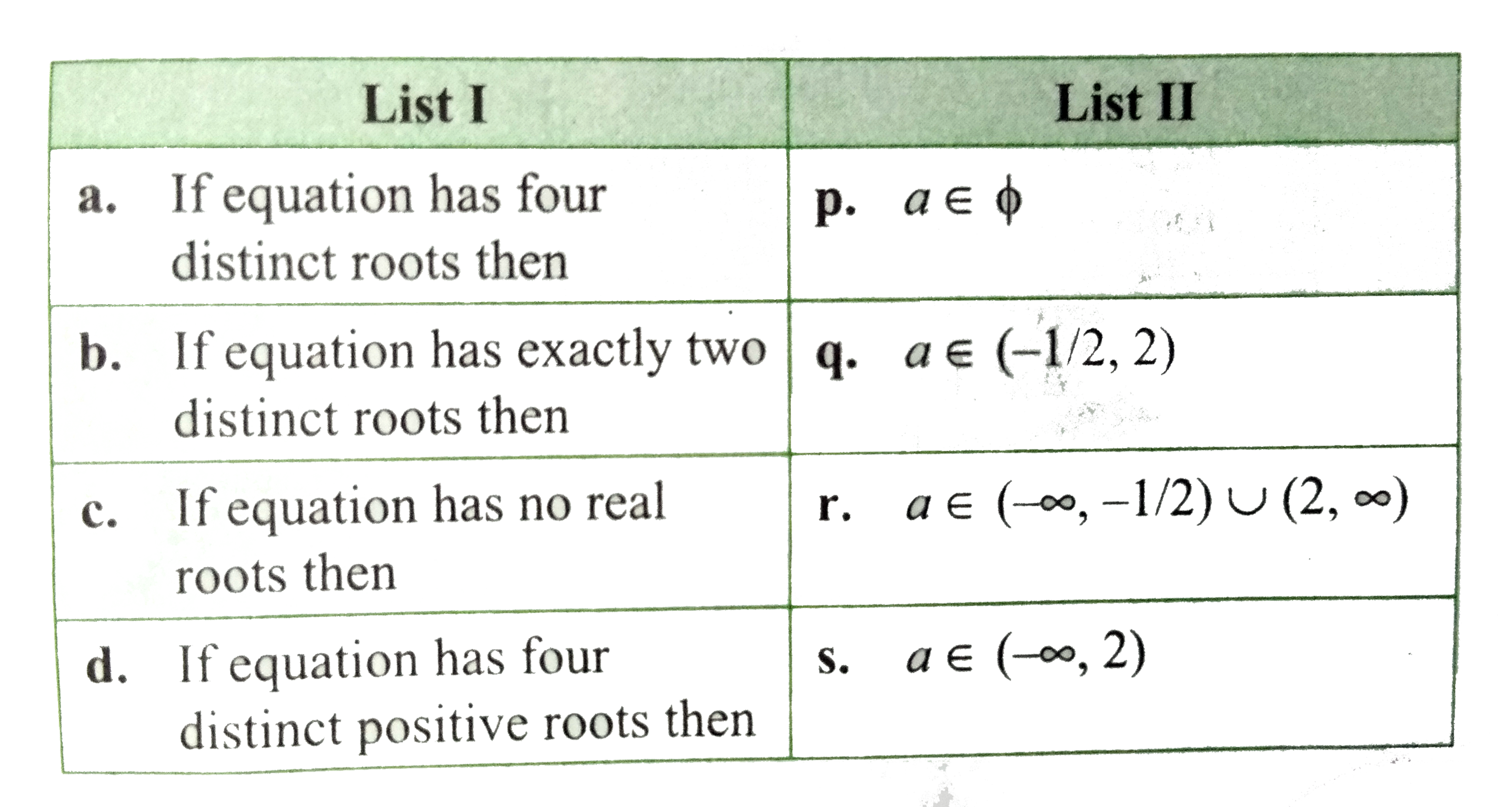
Consider equation `x^(4)-6x^(3)+8x^(2)+4ax-4a^(2)=0,ainR`. Then match the following lists:

A

`{:(,a,b,c,d),((1),q,s,s,r):}`

B

`{:(,a,b,c,d),((2),r,s,q,p):}`

C

`{:(,a,b,c,d),((3),q,s,r,p):}`

D

`{:(,a,b,c,d),((4),q,r,p,p):}`

Text Solution

Verified by Experts

The correct Answer is:

4

`(x^(2)-2x-2a)(x^(2)-4x+2a)=0`
`impliesx^(2)-2x-2a=0" "....(1)` or
`x^(2)-4x+2a=0" "....(2)`
Discrtiminant of eq. (1) is: `D_(1)=4+8a`
Discriminant of eq. (2) is: `D_(2)=16-8a`
(a) If equation has exactly two distinct roots then
(1) `D_(1)gt0implies4+8agt0impliesagt-1//2` and
`D_(2)implies16-8agt0impliesalt2`
`:.ain(-1//2,2)`
(b) If equation has exactly two distinct roots then (i) `D_(1)gt0andD_(2)lt0`
`impliesain(2,oo)`
(ii) `D_(1)lt0andD_(2)gt0`
`impliesain(-oo,-1//2)`
(c) If equation has no real roots then
`D_(1)lt0andD_(2)lt0`
`impliesainphi`
(d) Clearly, rquation cannot have four roots positive.
Promotional Banner

Topper's Solved these Questions

  • THEORY OF EQUATIONS

    CENGAGE|Exercise Exercise (Numerical)|43 Videos
  • THEORY OF EQUATIONS

    CENGAGE|Exercise JEE Main Previous Year|7 Videos
  • THEORY OF EQUATIONS

    CENGAGE|Exercise Exercise (Comprehension)|37 Videos
  • STRAIGHT LINES

    CENGAGE|Exercise JEE Advanced Previous Year|4 Videos
  • THREE DIMENSIONAL GEOMETRY

    CENGAGE|Exercise Question Bank|20 Videos

Similar Questions

Explore conceptually related problems

The equation (x^(2)-6x+8)+lambda (x^(2)-4x+3)=0, lambda in R has

x^(4)-4x^(3)+6x^(2)-4x+1=0 The roots of the equation are

The equation x^(2)-6x+8+lambda(x^(2)-4x+3)=0,AA lambda in R-{-1} has

The function f(x)=2+4x^(2)+6x^(4)+8x^(6) has

((6x^(4)+8x^(3)+27x^(2)+7)/(3x^(2)+4x+1))

If alpha, beta, gamma are the roots of the equation x^(4)+Ax^(3)+Bx^(2)+Cx+D=0 such that alpha beta= gamma delta=k and A,B,C,D are the roots of x^(4)-2x^(3)+4x^(2)+6x-21=0 such that A+B=0 The value of C/A is

If alpha, beta, gamma are the roots of the equation x^(4)+Ax^(3)+Bx^(2)+Cx+D=0 such that alpha beta= gamma delta=k and A,B,C,D are the roots of x^(4)-2x^(3)+4x^(2)+6x-21=0 such that A+B=0 The correct statement is

Roots of the equation (x^(2)-4x+3)+lambda(x^(2)-6x+8)=0lambda in R will be

Solve 3x^(4) -8x^(3) -6x^(2) + 8x + 3 = 0 .

Find the number of integral value(s) of a for which the equation (x^(4)+4x^(2)+4)-(a+4)(x^(4)+6x^(2)+8)-(a+5)(x^(4)+8x^(2)+16)=0 has atleast one real solution
