Home
Class 11
CHEMISTRY
Primary alkyl halide C(4)H(9)Br (a) reac...

Primary alkyl halide `C_(4)H_(9)Br` (a) reacted with alcoholic KOH to give compound (b). Compound (b) is reacted with HBr to give (c) which is an isomer of (a). When (a) is reacted with sodium metal it gives compound (d), `C_(8)H_(18)` which is different from the compound formed when n-butyl bromide is reacted with sodium. Give the structural formula of (a) and write the equations for all the reactions.

Text Solution

Verified by Experts
According to the question ,

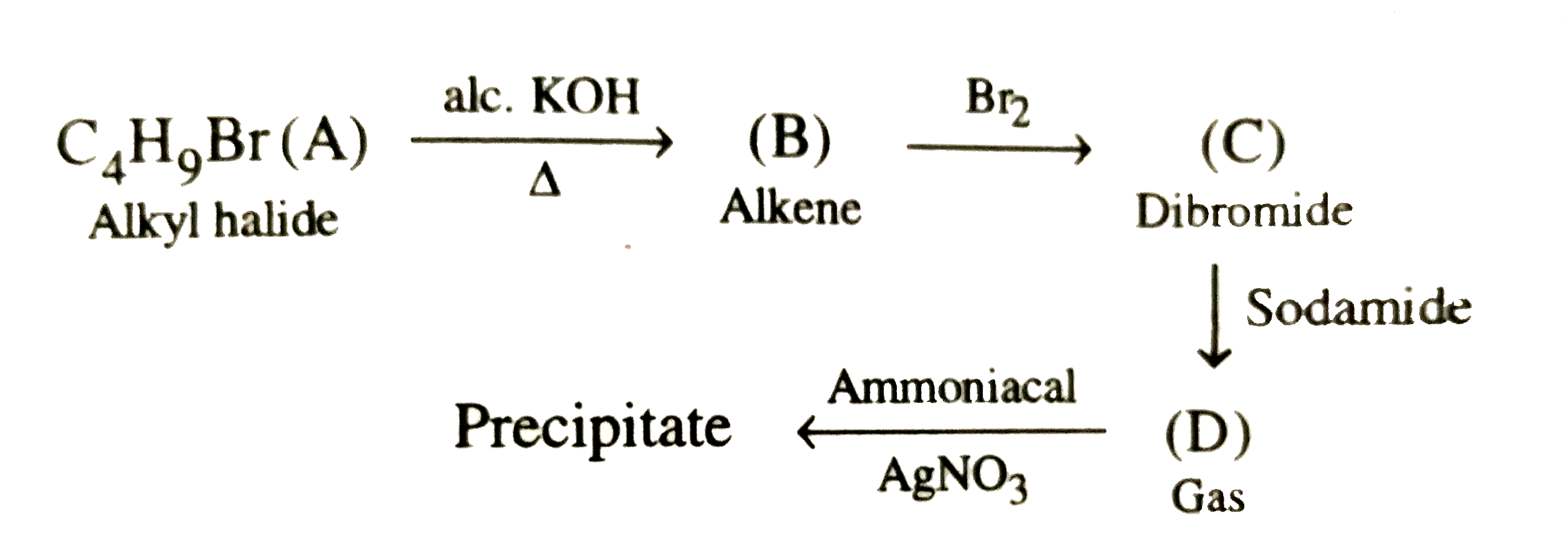
(i)Since the alkyl halide , `C_4H_9Br` (A) on treatment with alcoholic KOH gives an alkene (B) which on subsequent treatment with `Br_2` gives the dibromide (C ) , therefore , the molecular formula of alkene (E) must be `C_4H_8` and that of dibromide (C ) must be `C_4H_8Br_2`.
Now since the dibromide , `C_4H_8Br_2` (C ) on treatment with sodamide gives the gas (D), (D) must be an alkyne with the molecular formula , `C_4H_6`.
Further since the alkyne `C_4H_6` (D) gives precipitate with ammoniacal silver nitrate solution, it must be a terminal alkyne. The only terminal alkyne possible for the molecular formula, `C_4H_6` is 1-butyne , i.e., `underset"1-Butyne (D)"(CH_3CH_2-C-=CH)`
(ii)Since 1-butyne (D) is obtained by dehydrobromination of dibromide (C ) with sodamide, (C) must be 1,2-dibromobutane i.e.,
`underset"1,2-Dibromobutane (C)"(CH_3-CH_2-CHBr-CH_2Br)`
(iii)Since the dibromide (C ) is obtained by addition of `Br_2` to alkene (B), (B) must 1-butene, i.e.,
`underset"1-Butene (B)"(CH_3-CH_2-CH=CH_2)`
(iv)Since 1-butene is obtained by dehydrobromination of alkyl halide (A) with alcoholic KOH , (A) must be 1-bromobutane or n-butyl bromide , i.e.,
`underset"1-Bromobutane (A)"(CH_3-CH_2-CH_2-CH_2-Br)`
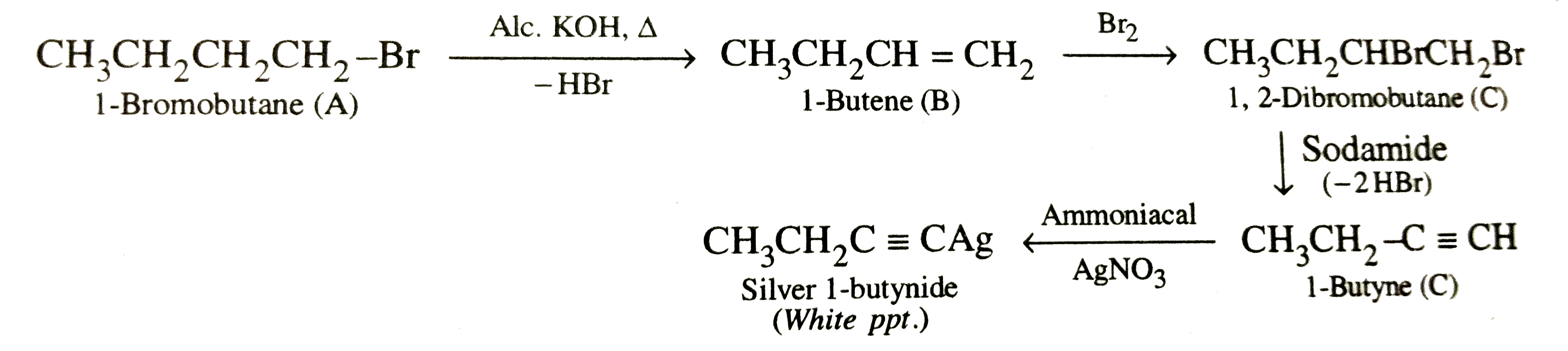
(v) All the reactions cited in the question may now be explained as follows :

Thus , (A) is 1-bromobutane, (B) is 1-butene, (C) is 1,2-dibromobutane and (D) is 1-butyne.
Promotional Banner

Topper's Solved these Questions

  • HYDROCARBONS

    PRADEEP|Exercise PROBLEMS FOR PRACTICE|3 Videos
  • HYDROCARBONS

    PRADEEP|Exercise TEST YOUR GRIP (MULTIPLE CHOICE )|26 Videos
  • HYDROCARBONS

    PRADEEP|Exercise CURIOSITY QUESTIONS|4 Videos
  • EQUILIBRIUM IN PHYSICAL AND CHEMICAL PROCESSES

    PRADEEP|Exercise Competition Focus (Jee(Main and advanced)/Medical Entrance) VIII. ASSERTION - REASON TYPE QUESTIONS (TYPE - II)|10 Videos
  • HYDROGEN

    PRADEEP|Exercise COMPETITION FOCUS (Assertion-Reason Type Questions) Type 2|15 Videos

Similar Questions

Explore conceptually related problems

An organic compound A reacts with PCl_(5) to give compound B. Compound B reacts with Na/ether to give n-butane. What are compounds A and B ?

The organic compound (A) and (B) reacts with sodium metal and release H_2 gas. Then (A) and (B) reacts each other to give methly propanoate . The compound (A) and (B) are