Home
Class 12
MATHS
Prove that: sin^(-1)(12)/(13)+cos^(-1)4/...

Prove that: `sin^(-1)(12)/(13)+cos^(-1)4/5+tan^(-1)(63)/(16)=pi`

Text Solution

Verified by Experts
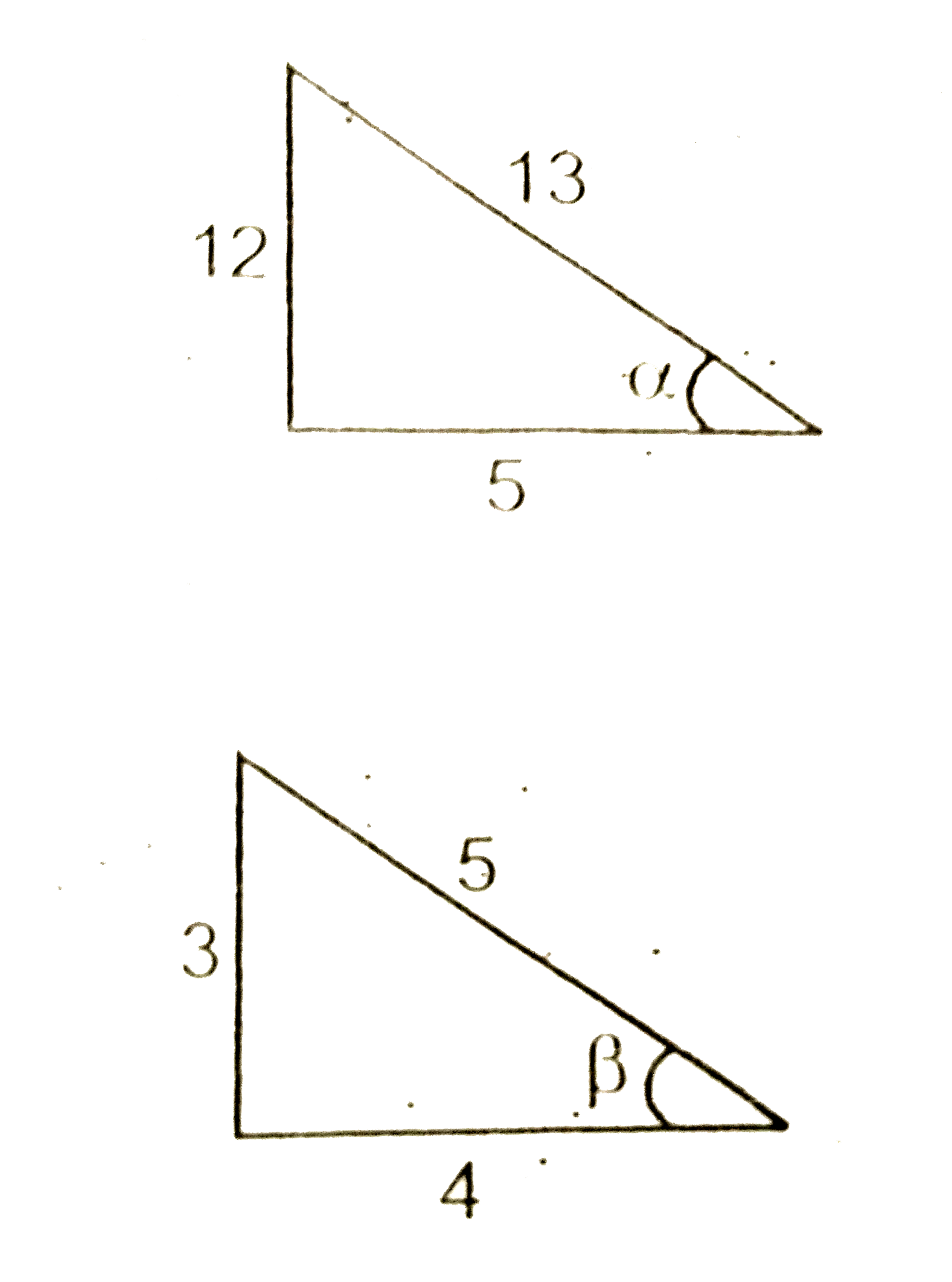
Let `sin^(-1)(12/13)=alpha,cos^(-1)(4/5)=beta,tan^(-1)(63/16)=gamma`
`rArrsinalpha=12/13,cosbeta=4/5,tangamma=63/16`
`rArr tanalpha=12/5`
`and tanbeta=3/4`
Now, `alpha=tan^(-1)(12/5)&beta=tan^(-1)(3/4)`
Here, `xy=12/5xx3/4=9/5 gt1`
`:.` We cannot use `tan^(-1)x +tan^(-1)y=tan^(-1)((x+y)/(1-xy)),xygt1`
Consider, `tan(alpha+beta)=(tanalpha+tanbeta)/(1-tanalphatanbeta)`
`=(12/5+3/4)/(1-12/5xx3/4)`
`=(48+15)/(20-36)`
`=(-63)/16`
`=-tany`

`:' tanalpha =12/5&tanbeta=3/4`
`rArrtanalphatanbetagt1`
`(sinalphasinbeta)/(cosalphacosbeta)gt1`
`rArrsinalphasinbeta gt cosalphacosbeta ("as "cosalphacosbetagt0)`
`rArr cos(alpha- beta) lt0`
`pi/2ltalpha+betaltpi`
`:. tan(alpha+beta)=-tangamma`
`alpha+beta ne -gamma "as "alpha+beta in(pi/2,pi)`
`rArrtan(alpha+beta)=tan(pi-gamma)`
`rArralpha+beta=pi-gamma`
`rArralpha+gamma+beta=pi`
`rArr sin^(-1)(12/13)+cos^(-1)(4/5)+tan^(-1)(63/16)=pi`
Promotional Banner

Topper's Solved these Questions

  • INVERSE TRIGONOMETRIC FUNCTIONS

    AAKASH INSTITUTE|Exercise TRY YOURSELF|21 Videos
  • INVERSE TRIGONOMETRIC FUNCTIONS

    AAKASH INSTITUTE|Exercise ASSIGNMENT (SECTION - A)(OBJECTIVE TYPE QUESTIONS (ONE OPTION IS CORRECT))|45 Videos
  • INTEGRALS

    AAKASH INSTITUTE|Exercise Try yourself|50 Videos
  • LIMITS AND DERIVATIVES

    AAKASH INSTITUTE|Exercise Section - j|3 Videos

Similar Questions

Explore conceptually related problems

Show that (sin^(-1)(12))/(13)+(cos^(-1)4)/(5)+(tan^(-1)(63))/(16)=pi

Show that sin^(-1)'5/13+cos^(-1)'3/5=tan^(-1)'63/16 .

Prove that: sin^(-1)((5)/(13))+cos^(-1)((4)/(5))=(1)/(2)sin^(-1)((3696)/(4225))

Prove that sin^(-1)(5/13)+sin^(-1)(16/65)=cos^(-1)(4/5)

Prove that cos^(-1) ((5)/(13))+cos^(-1) (-7/25)+sin^(-1) (36)/(325)=pi

Prove that: cos^(-1)((12)/(13))+sin^(-1)((3)/(5))=sin^(-1)((56)/(65))

Let alpha=2tan^(-1)((1)/(2))+(sin^(-1)3)/(5) and beta=sin^(-1)((12)/(13))+cos^(-1)((4)/(5))+cos^(-1)((16)/(63)) be such that2sin alpha and cos beta are roots of the equation x^(2)-px+q=0, then (p-q) is

Prove that: sin^(-1)((3)/(5))+cos^(-1)((12)/(13))=sin^(-1)((56)/(65))

sin^(-1)(5/13)+tan^(-1)(12/5)=

Prove that :tan^(-1)(63)/(16)=sin^(-1)(5)/(13)+cos^(-1)(3)/(5)

