Home
Class 10
PHYSICS
State Ohm's law. Draw a labelled circuit...

State Ohm's law. Draw a labelled circuit diagram to verify this law in the laboratory. If you draw a graph between the potential difference and current flowing through a metallic conductor, what kind of curve will you get? Explain how would you use this graph to determine the resistance of the conductor.

Text Solution

Verified by Experts

Ohm's law states that the electric current, through a conductor, is directly proportional to the potential difference across its two ends when, other physical condition like temperature, etc., remain constant.
`V prop I`
`or (V)/(I) = "Constant" = R`
`or V = IR`
Thus, the ratio V : I is a constant. This constant is called the resistance (R) of the conductor.
Circuit diagram for Ohm's law:
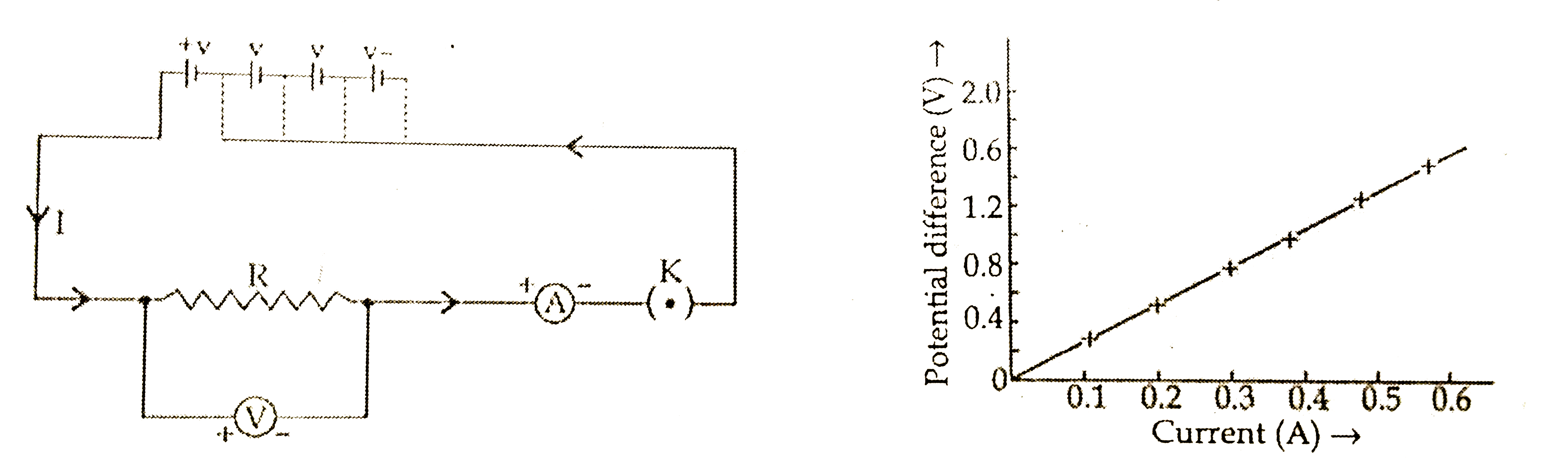
Explanation. If a graph is drawn between the potential difference (V) and current (I), the graph is found to be a straight line passing through the origin. This shows current is directly proportional to the potential difference. Thus the ratio `(V)/(I)` remains constant. This constant is called the resistance of the conductor. The gradient of the straight ling graph is related to the resistance (R) of the conductor.

Promotional Banner

Topper's Solved these Questions

Similar Questions

Explore conceptually related problems

If V is the potential difference between the ends of conductor and l is the current through it, then ohm's law states that

The rate of Joule heat is given by P =V xx I where V is the potential difference across the ends of a conductor and I is the current flowing through it. Does this relation hold for a condutor that does not obey Ohm's law?

What would be the resistance of a conductor if the current flow through it is 0.35 A when the potential difference across is 1.4 V?

A resistor of 4 ohm resistance and an electric lamp of 20 ohm resistance are connected in series across a 6 volt battery. Draw a lebelled circuit diagram by using the symbols for ohm and volt. Calculate: (a) total resistance of the circuit. (b) current flowing through the circuit. (c) potential difference across the resistor. (d) potential difference across the electric lamp.

(a) What is the ratio of potential difference and current known as? (b) The values of potential difference V applied across a resistor and the corresponding values of current I flowing in the resistor are given below: {:("Potential difference"V("in volts"),:,2.5,5.0,10.0,15.0,20.0,25.0),("Current,I"("in amperes"),:,0.1,0.2,0.4,0.6,0.8,1.0):} Plot a graph between V and I, and calculate the resistance of the resistor. (c) Name the law which is illustrated by the above V-I graph. (d) Write down the formula which states the relations between potential difference, current and resistance. (d) The potential difference between the terminals of an electric iron is 240V and the current is 5.0A. What is the resistance of the electric iron?
