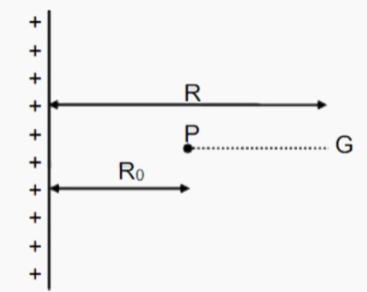
A charge particle `q` is released at a distance `R_(@)` from the infinite long wire of linear charge density `lambda`. Then velocity will be proportional to (At distance `R` from the wire)
Electric field at a point of distance r from a uniformly charged wire of infinite length having linear charge density lambda is directly proportional to
An electric dipole of moment p is kept at a distance r form an infinte long charged wire of linear charge density lambda as shown.Find the force acting on the dipole?
The electric field intensity due to a thin infinity long straight wire of uniform linear charge density lambda at O is-
The electric field at a distance r from a long wire having charge per unit length lambda is
A point charge q is placed at a distance r from a very long charged thread of unoform linear charge density lambda . Find out total electric force experienced by the line charge due to the point charge. (Neglect gravity).
A point charge q is placed at a distance r from a very long charged thread of unoform linear charge density lambda . Find out total electric force experienced by the line charge due to the point charge. (Neglect gravity).
Let E_1(r) , E_2(r) and E_3(r) be the respectively electric field at a distance r from a point charge Q , an infinitely long wire with constant linear charge density lambda , and an infinite plane with uniform surface charge density sigma . If E_1(r_0)=E_2(r_0)=E_3(r_0) at a given distance r_0 , then
The magnetic induction at a distance r from a straight, infinitely long wire in air and carrying a current I is given by
An infinite line charge produces a field of 4.5xx10^(4) N//C at a distance 2 m from it. The linear charge density is