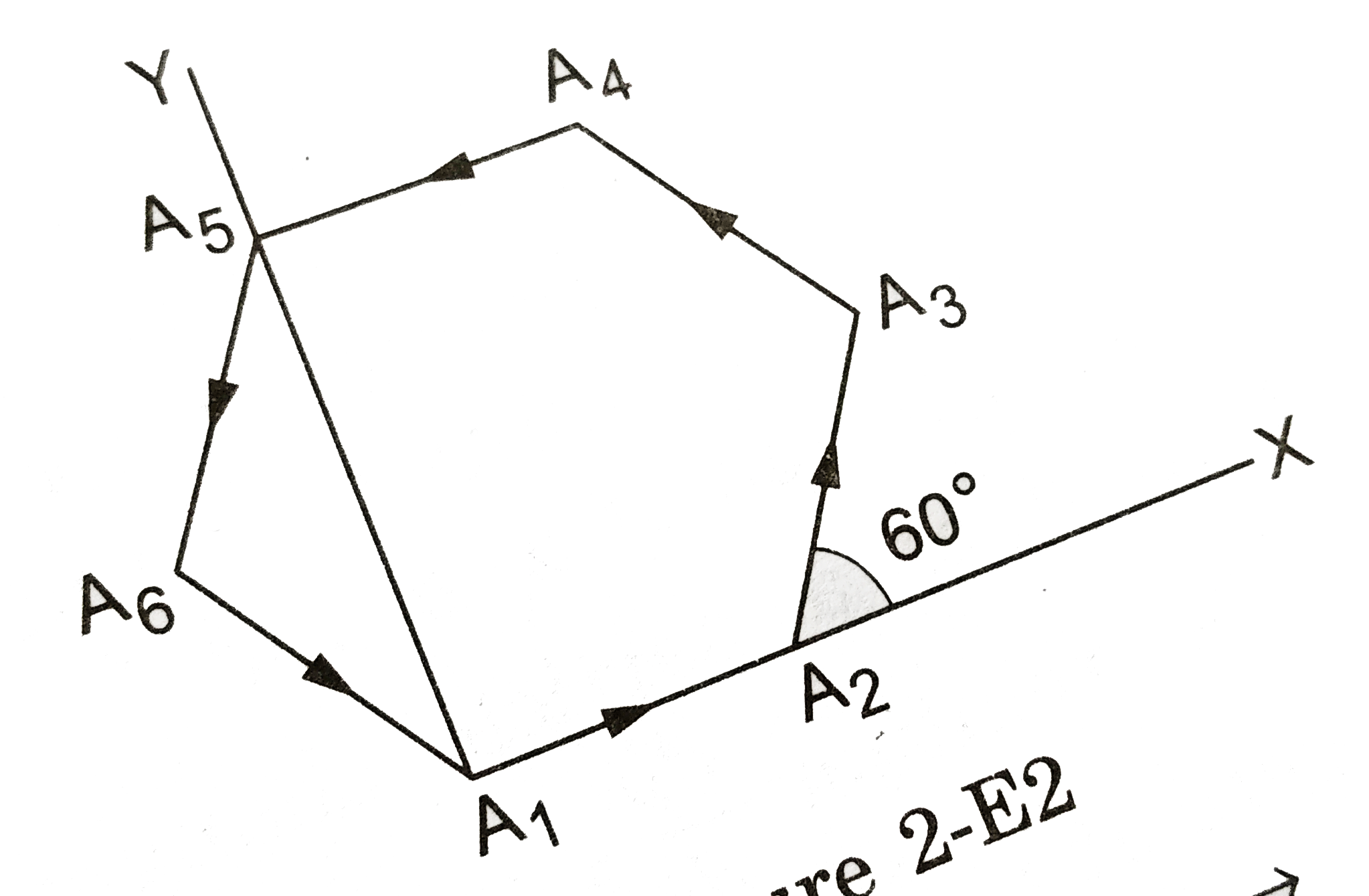
 .
.Text Solution
Verified by Experts
 [Note: Similarly it can be proved that `sin 0+ sin pi/3+sin (2pi)/3+sin(3pi)/3+sin(4pi)/3


Topper's Solved these Questions
Similar Questions
Explore conceptually related problems
HC VERMA-PHYSICS AND MATHEMATICS-Exercises
- Suppose veca is a vector of magnitude 4.5 unit due north. What is the ...
Text Solution
|
- Two vectors have magnitudes 2 m and 3m. The angle between them is 60^0...
Text Solution
|
- Let A1 A2 A3 A4 A5 A6 A1 be a regular hexagon. Write the x-components ...
Text Solution
|
- Let veca=2veci+3vecj+4veck and vecb=3veci+4vecj+5veck. Find the angle ...
Text Solution
|
- Prove that vecA.(vecAxxvecB)=0
Text Solution
|
- If vecA=2veci+3vecj+4veck and vecB=4veci+3vecj+2veck, find vecAxxvecB.
Text Solution
|
- If vecA,vecB,vecC are mutually perpendicular show that vecCxx(vecAxxve...
Text Solution
|
- A particle moves on a given straight line with a constant speed v. At ...
Text Solution
|
- The force on as charged particle due to electric and magnetic fields i...
Text Solution
|
- Give an example for which vecA.vecB=vecC.vecB but vecA!=vecC.
Text Solution
|
- A curve is represented by y=sinx. If x is changed from pi/3 to pi/3+pi...
Text Solution
|
- The electric curren in a charging R-C circuit is given by i=i0e^(-t/RC...
Text Solution
|
- The electric current in a discharging R-C circuit is given by i=i0e^(-...
Text Solution
|
- Find the area bounded under the curve y=3x^2+6x+7 X-axis with the orid...
Text Solution
|
- Find the area enclosed the curve y=sin x and the X-axis between x=0 an...
Text Solution
|
- Find the area bounded by the curve y=e^(-x) the X-axis and the Y-axis.
Text Solution
|
- A rod of length L is placed along the X-axis between x=0 and x=L. The ...
Text Solution
|
- The momentum p of a particle changes with the t according to the relat...
Text Solution
|
- The changes ina function y and the independent variable x are related ...
Text Solution
|
- Write the number of significant digits in a 1001, b. 100.1, c.100.10 d...
Text Solution
|