Home
Class 11
PHYSICS
Three particles A, B and C are situated ...

Three particles A, B and C are situated at the vertices of an equilateral triangle ABC of side d at time `t=0.` Each of the particles moves with constant speed v. A always has its velocity along AB, B along BC and C along CA. At what time will the particles meet each other?

Text Solution

Verified by Experts
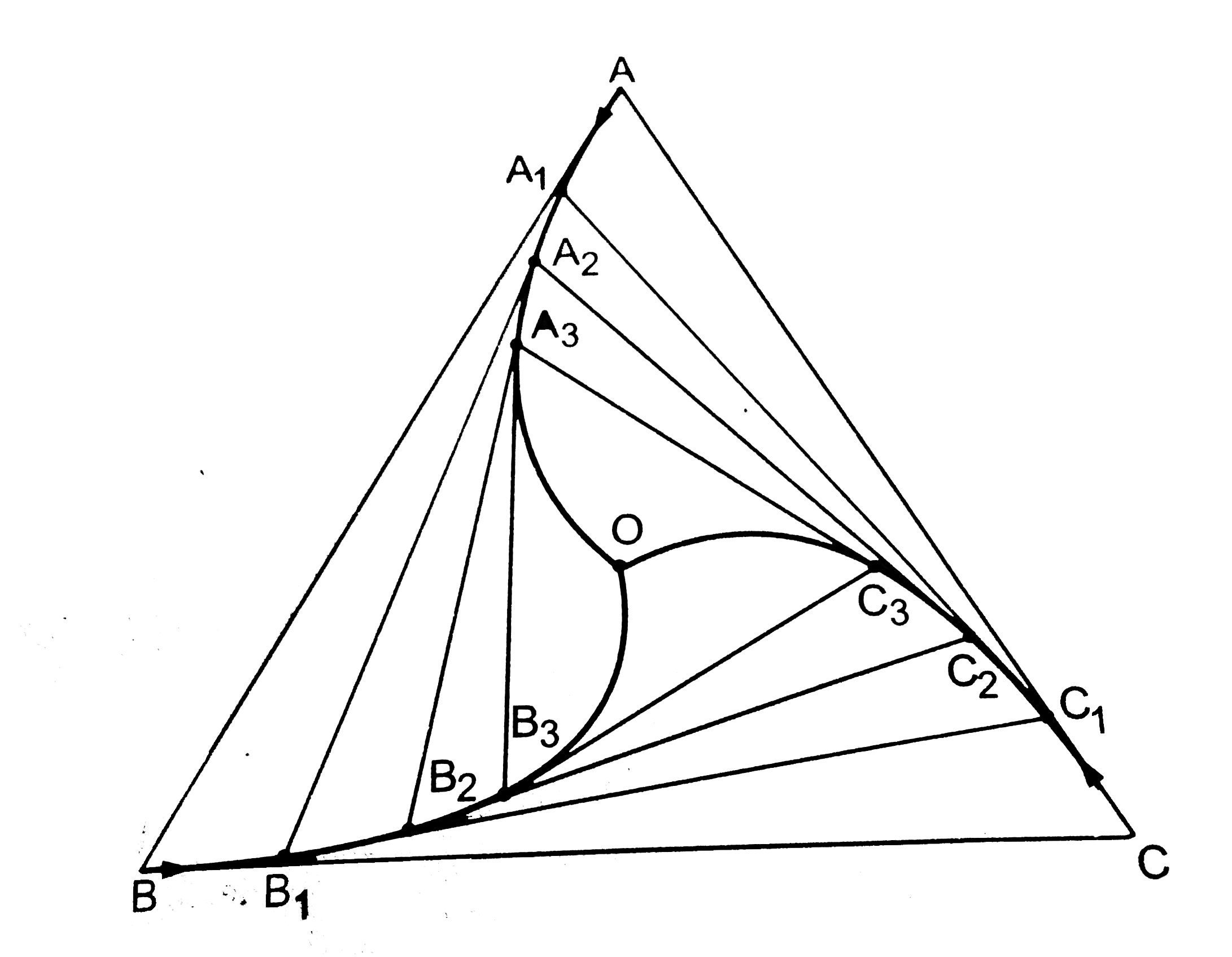
The motion of the particles is roughly sketched in ure. By symmetry they will meet at the centroid O of the triangle. At any instnt the particles will form an equilatgeral triangel ABC with the same centroid O. Concentrate on the motion of any one particle say A. At any instant its velocity makes angle `30^0` with AO.

The component of this velocity along AO is v cos 30^0`. This component is the rate of decrease of the distasnce AO.
Initially,
`AO=2/3 sqrt(d^2-(d/2)^2)=d/sqrt3`
There the time taken for AO to become zero
`=(dsqrt(3))/(v cos 30^0)=(2d)/(sqrt(3 vxxsqrt3)=(2d)/(3v)`
AlterN/Atively : Velocity of A is v along AB. The velocity of B is along BC. Its component along BA is`v cos 60^0 =v/2`. Thus, the speration AB decreases at the rate
`v+v/2=(3v)/2`
Since this rate is constant, the time taken in reducing the separation AB from d to zero is
t= d/(3v)/2 = (2d)/(3v)`.
Promotional Banner

Topper's Solved these Questions

  • REST AND MOTION : KINEMATICS

    HC VERMA|Exercise Short Answer|14 Videos
  • REST AND MOTION : KINEMATICS

    HC VERMA|Exercise Objective 1|13 Videos
  • REST AND MOTION : KINEMATICS

    HC VERMA|Exercise Exercises|51 Videos
  • PHYSICS AND MATHEMATICS

    HC VERMA|Exercise Exercises|34 Videos
  • ROTATIONAL MECHANICS

    HC VERMA|Exercise Exercises|86 Videos

Similar Questions

Explore conceptually related problems

Three particles A,B and C and situated at the vertices of an equilateral triangle ABC of side of length l at time t=0 ,Each of the particles move with constant speed u . A always has its velocity along AB, B along BC and C along CA .

Four particles A, B, C and D are situated at the cornerst of a square ABCD of side a at t-0 . Each of particles moves with constant speed (v). A always has its velocity along AB, B along BC, C along CB~ and D along DA . At what time will these particles meet each other ?

Three boys A,B and C are situated at the vertices of an equilateral triangle of side d at t=0. Each of the boys moves with constant speed v. A always moves towards C and C towards A, At what time and where they meet each other?

Three particles A, B, Care located at the comers of an equilateral triangle as shown in figure. Each of the particle is moving with velocity v. Then at the instant shown, the relative angular velocity of

Three particles each of mass m are palced at the corners of an equilateral triangle of side b . The gravitational potential energy of the system of particle is

Three insects A,B and C are situated at the vertices of an equillateral triangle of side 1. the insect A heads towards B,B towards C,C towards A with constant speeds v such that they always remain at the vertices of an equilateral triangle. Find the (a) time of their meeting (b) equation of path traced by one insect relative to the other.

Three particles A, B and C situated at vertices of an equilateral triangle, all moving with same constant speed such that A always move towards B, B always towards C and C always towards A . Initial seperation between each of the particle is a. O is the centroid of the triangle. Distance covered by particle A when it completes one revolution around O is

Three identical particles are located at the vertices of an equilateral triangle. Each particle moves along a meridian with equal speed towards the centroid and collides inelastically.

Three particle A, B and C situated at the vertices of an equilateral triangle starts moving simultaneously at a constant speed "v" in the direction of adjacent particle, which falls ahead in the anti-clockwise direction. If "a" be the side of the triangle, then find the time when they meet

HC VERMA-REST AND MOTION : KINEMATICS-Worked Out Examples
  1. A man at a speed of 6 km/hr for 1 km and 8 km/hr for the next 1 km. Wh...

    Text Solution

    |

  2. The I.Sc lecture theatre of a college is 40 ft wide and has door at a ...

    Text Solution

    |

  3. The position of a particle moving on X-axis is given by x=At^3+Bt^2+...

    Text Solution

    |

  4. From the veloicty time graph of a particle given in figure describe th...

    Text Solution

    |

  5. A particle starts from rest with a constant aceleration. At a time t s...

    Text Solution

    |

  6. A boy stretches a stone against the rubber tape of a catapult or gulel...

    Text Solution

    |

  7. A police inspector in a jeepis chasing a pickpocket on a straightroad....

    Text Solution

    |

  8. A car is moving at a constant speed of 40 km/h along a straight road w...

    Text Solution

    |

  9. A ball is dropped from a height of 19.6 m above the ground. It rebound...

    Text Solution

    |

  10. A stone is dropped from a balloon going up with a uniform velocity of ...

    Text Solution

    |

  11. A football ils kicked with a velocity of 20 m/s at an angle of 45^0 wi...

    Text Solution

    |

  12. A helicopter on flood relief mission, flying horizontally with a speed...

    Text Solution

    |

  13. A particle is projected horizontally with a speed u from the top of pl...

    Text Solution

    |

  14. A projectile is fired with a speed u at an angle theta with the horizo...

    Text Solution

    |

  15. A bullet is fired horizontally aiming at an object which starts fallin...

    Text Solution

    |

  16. A man can swim in still water ast a speed of 3 km/h. He wants to cross...

    Text Solution

    |

  17. A man can swim at a speed of 3 km/h in still water. He wants t cross a...

    Text Solution

    |

  18. A man standing on a road has to hold his umbrella at 30^0 with the vee...

    Text Solution

    |

  19. A man running on the horizontal road at 8 km h^(-1) find the rain app...

    Text Solution

    |

  20. Three particles A, B and C are situated at the vertices of an equilate...

    Text Solution

    |
