Home
Class 12
PHYSICS
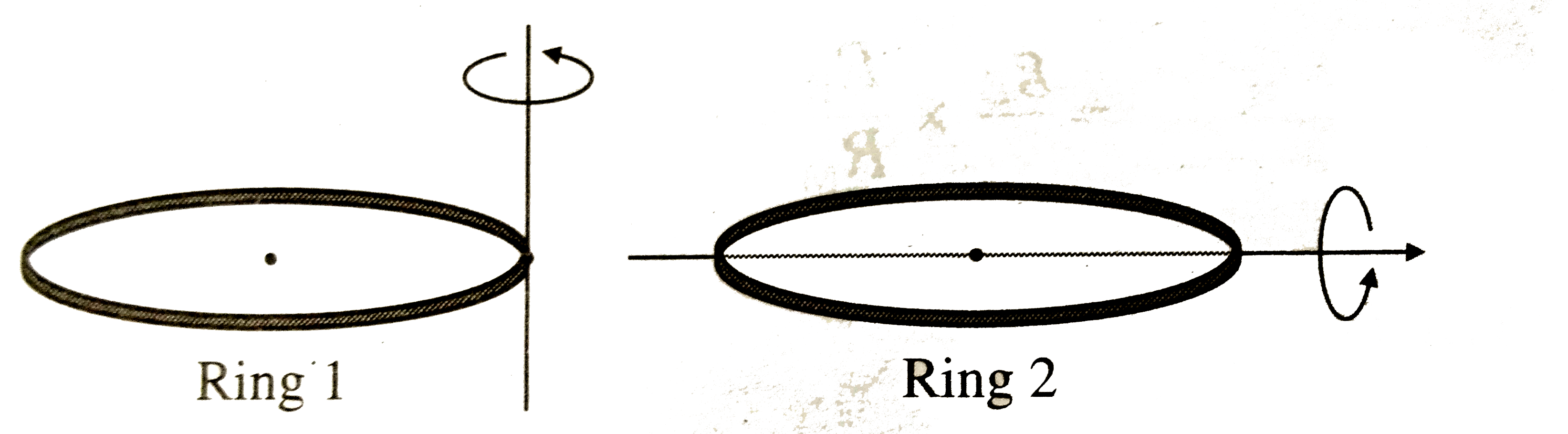
Two identical rings, 1 and 2 are rotated...

Two identical rings, 1 and 2 are rotated about a transverse tangent and a diameter as shown by applying torques `tau_(1) and tau_(2)`, respectively. If they have the same (in magnitude) angular accelerations.

A

`tau_(1)=4tau_(2)`

B

`tau_(1)=2tau_(2)`

C

`tau_(1)=tau_(2)`

D

`4tau_(1)=tau_(2)`

Text Solution

Verified by Experts

The correct Answer is:

A

`I_(1)=2MR^(2) and I_(2)=(1)/(2)MR^(2)`
`prop=(tau_(1))/(I_(1))=(tau_(2))/(I_(2))" "therefore(tau_(1))/(tau_(2))=(I_(1))/(I_(2))=4`
Promotional Banner

Topper's Solved these Questions

  • MULTIPLE CHOICE QUESTIONS

    NAVNEET PUBLICATION - MAHARASHTRA BOARD|Exercise Oscillations|5 Videos
  • MULTIPLE CHOICE QUESTIONS

    NAVNEET PUBLICATION - MAHARASHTRA BOARD|Exercise Elasticity|5 Videos
  • MULTIPLE CHOICE QUESTIONS

    NAVNEET PUBLICATION - MAHARASHTRA BOARD|Exercise Gravitation|8 Videos
  • MODEL QUESTION PAPER FOR PRACTICE

    NAVNEET PUBLICATION - MAHARASHTRA BOARD|Exercise SECTION-D|5 Videos
  • QUESTION BANK 2021

    NAVNEET PUBLICATION - MAHARASHTRA BOARD|Exercise Semiconductors Devices (Long Answer ( LA) ( 4 marks Each) )|3 Videos

Similar Questions

Explore conceptually related problems

Two identical rings A and B are acted upon by torques tau_(A) and tau_(B) respectively. A is rotating about an axis passing through the centre of mass and perpendicular ot the plane of the ring. B is rotating about a chord at a distance 1/(sqrt(2)) times the radius of the ring. If the angular acceleration of the ring is the same, then

Does a body rotating about a fixed axis have to be perfectly rigid for all points on the body to have the same angular velocity and the same angular acceleration ?Explain.

Two discs A and B are in contact and rotating with angular velocity with angular velocities omega_(1) and omega_(2) respectively as shown. If there is no slipping between the discs, then

A hollow cylinder of mass M and radius R is rotating about its axis of symmetry and a solid sphere of same mass and radius is rotating about an axis passing through its centre. It torques of equal magnitude are applied to them, then the ratio of angular acclerations produced is

A toruque tau produces an angular acceleration in a body rotating about an axis of rotation. The moment of inertia of the body is increased by 50% by redistributing the masses, about the axis of rotation. To maintain the same angular acceleration, the torque is changed to tau' . What is the relation between tau and tau' ?

Two identical masses are connected to a horizontal thin massless rod as shown in the figure. When their distance from the pivot is x , a torque produces an angular acceleration alpha_(1) . If the masses are now repositioned so that they are at distance 2x each from the pivot, the same torque will produce an angular acceleration alpha_(2) such that ,

If two disc of moment of inertia l_(1) and l_(2) rotating about collinear axis passing through their centres of mass and perpendicular to their plane with angular speeds omega_(1) and omega_(2) respectively in opposite directions are made to rotate combinedly along same axis, then the magnitude of angular velocity of the system is

Two uniform spheres of mass M have radii R and 2 R . Each sphere is rotating about a fixed axis through a diameter, the rotational kinetic energies of the sphere are identical. What is the ratio of the magnitude of the angular momentum of these spheres gt That is, (L_(2 R))/(L_( R)) =

Two circular loops of radii R and r (R > > r) have same cenre and carry currents I and i respectively. Find the maximum torque and maximum angular acceleration of smallar loop, if it is free to rotate about y axis where as the bigger loop is fixed. (Neglect the inductance of the system). The mas of the smaller loop is m.
