Home
Class 12
PHYSICS
Show that all harmonics are present on a...

Show that all harmonics are present on a stretched string between two rigid supports.

Text Solution

Verified by Experts
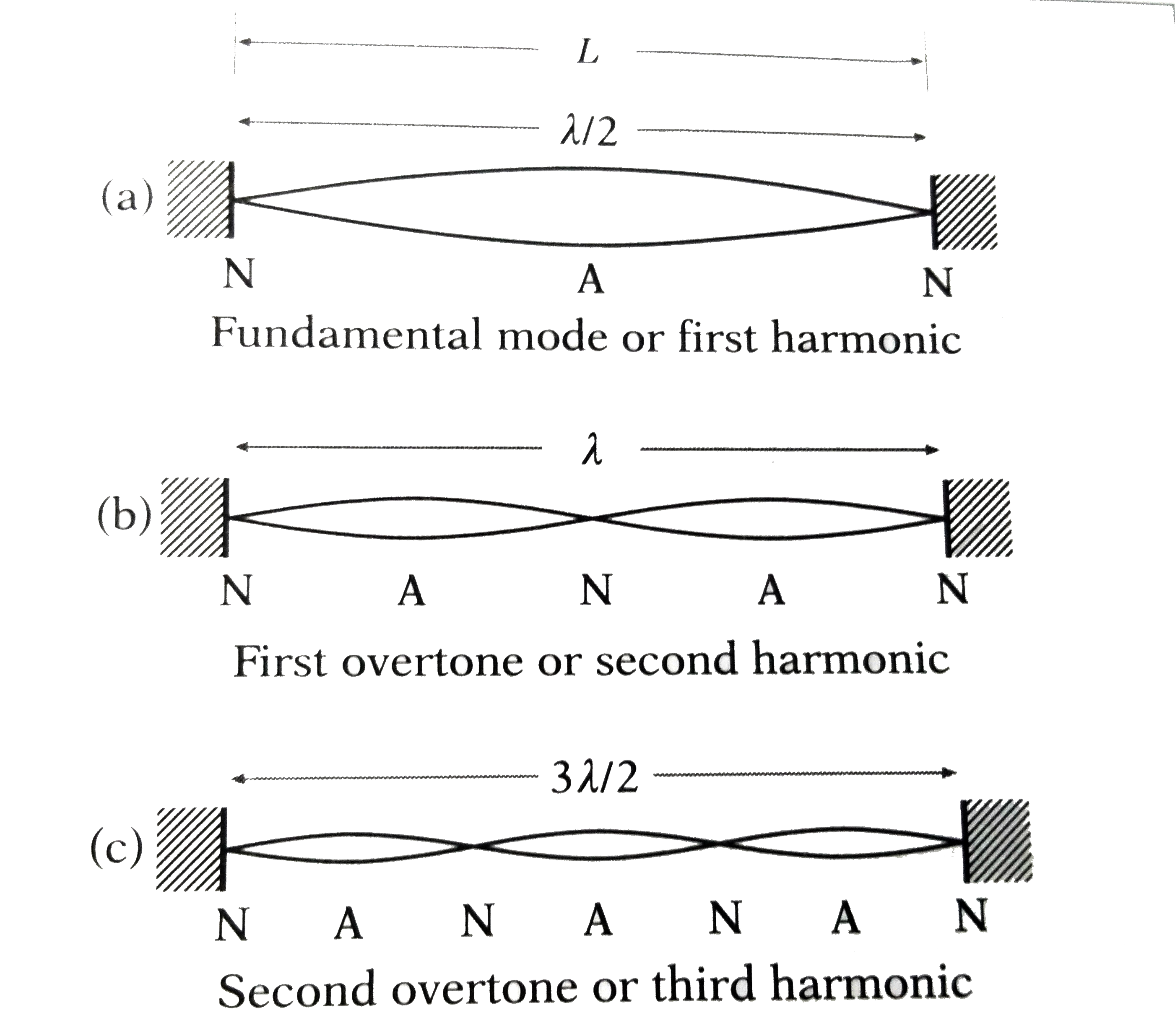
Consider a string of linear density m stretched between two rigid supports a distance L apart. Let T be the temsion in the string
Stationary waves set up on the string are suhjected to two boundary conditions the displacement y=0 at x=0 and at x=L all times. That is. there must be a node at each fixed end. These two boundary conditions limit the possible modes of vibration to a discrete set of frequencies such that there are an integral number q of loops between the two fixed ends

Since the length of one loop (the distane between consecutive nodes) corresponds to half a wavelenth `(lamda)`
`(L)/(q)=(lamda)/(2)`
`therefore lamda =(2L)/q` ... (1)
The speed of a transverse wave on a stretched string is
`v=nlamda=sqrt(t//m)` ... (2) Therefore, from Eqs. (1) and (2), the allowed frequencies are given by
`n=(q)/(2L)sqrt((T)/(m))` (q 1, 2, 3, ..) ..(3)
In the simplest mode of vibration, only one loop (q 1) is formed [Fig. (a)]. The corresponding lowest allowed frequency,
`n=(1)/(2L)sqrt((T)/(m))` ...(4)
is called the fundamental frequency or the first harmonic. The possible modes of vibration with frequencies higher than the fundamental are called the overtones.
In the first overtone, two loops are formed (q=2) (Fig. (b) Its frequency, `n_1=(2)/(2L)sqrt((t)/(m))=2n` ...(5)
is twice the fundamental and is, therefore, the second harmonic.
In the second overtone, three loops are formed (q=3) [Fig. (c)]. Its frequency, `n_2=(3)/(2L)sqrt((t)/(m))=3n` ..(6)
is the third harmonic.
Therefore, in general, the frequency of the pth overtone (p =1, 2, 3, ..) is `n_p=(p+1)n` ...(7) i.e., the pth overtone corresponds to the (p + 1)th harmonic.
Equation (3) gives the set of discrete frequencles for the normal modes of vibration of a stretched string. Equation (7) shows that for a stretched string all the harmonics are present as overtones.
Promotional Banner

Topper's Solved these Questions

  • EXPLANATION, CHARACTERISTICS AND PROPERTIES

    NAVNEET PUBLICATION - MAHARASHTRA BOARD|Exercise Kinetic Theory of Gases and Radiation|4 Videos
  • EXPLANATION, CHARACTERISTICS AND PROPERTIES

    NAVNEET PUBLICATION - MAHARASHTRA BOARD|Exercise Wave Theory of light|3 Videos
  • EXPLANATION, CHARACTERISTICS AND PROPERTIES

    NAVNEET PUBLICATION - MAHARASHTRA BOARD|Exercise Wave Motion|2 Videos
  • EXPERIMENTS AND DIAGRAMS

    NAVNEET PUBLICATION - MAHARASHTRA BOARD|Exercise ATOMS, MOLECULES AND NUCLEI|1 Videos
  • INSTRUMENTS : CONSTRUCTION AND WORKING

    NAVNEET PUBLICATION - MAHARASHTRA BOARD|Exercise Semiconductors|6 Videos

Similar Questions

Explore conceptually related problems

A second harmonic has to be generated in a string of length l stretched between two rigid supports. The point where the string has to be plucked and touched are

A wire having a linear density of 0.05 kg/m is stretched between two rigid supports. The tension in the wire is 4.5xx10^7 dyne . If the observed that the wire resonates at a frequency of 420 Hz and the next higher frequency at which the wire resonates is 490 Hz, then the length of the wire would be

Two strings of same material are joined to form a large string and is stretched between rigid supports. The diameter of the second string is twice that of the first. It was observed in an experiment that the whole string was oscillating in 4 loops with a node at the joint. Find the possible lengths of the second string if the length of first string is 90 cm.

In Fig. 16-13, two strings have been tied together with a knot and then stretched between two rigid supports. The strings have linear densities mu_(1) = 1.4 xx 10^(-4)" kg/m "and mu_(2)=2.8. xx 10^(-4)"kg/m". Their lengths are L_1= 3.0 m and L_2=2.0m, and string 1 is under a tension of 400 N. Simultaneously, on each string a pulse is sent from the rigid support end, toward the knot. Which pulse reaches the knot first. Figure 18-13 Two strings, of lengths L_1 and L_2 , tied together with a knot and stretched between two rigid supports.

A wire having a linear density of 10^(-3) kg/m is stretched between two rigid supports. The tension in the wire is 25.6N . If the observed that the wire resonates at a frequency of 480 Hz and the next harmonic is found to be 640 Hz, then the length of the wire will be

A wire having a linear density of 0.05 gm//c is stretched between two rigid supports with a tension supports with a tension of 4.5 xx 10^(7) dynes. It is oberserved that the wire resonates at a frequency of 420 "cycles"//"sec" . the next higher frequency at which the same wire resonates is 490 "cycles"//"sec" . Find the possible mode of vibration of string initially :

A wire having a linear density of 0.05 gm//c is stretched between two rigid supports with a tension supports with a tension of 4.5 xx 10^(7) dynes. It is oberserved that the wire resonates at a frequency of 420 "cycles"//"sec" . the next higher frequency at which the same wire resonates is 490 "cycles"//"sec" . Find the possible mode of vibration of string initially :

A wire having a linear density of 0.05 g//cm is stretched between two rigid supports with a tension of 450N. It is observed that the wire resonates at a frequency of 420 Hz. The next higher frequency at which the same wire resonates is 490 Hz. Find the length of the wire.

