Concept of a capacitor : The surface of an isolated charged conductor is an equipotential surface with a potential V with respoet some arbitrary zero reference level, usually the ground. `Vgt 0` , i.e., positive if the charge on the conductor is positive, while `V lt 0`, i.e., negative if charge on the conductor is negative. If the charge Q on the conductor is increased, V increases in the same proportion. The proportionality constant C is called the capacity of the conducto `|Q|=C|V|`
Any conductor can be used to store charges, however, its capacity can be increased by keeping a grounded conductor near it. This is the principle of capacitor.
Consider a metal plate A whose potential is raised to V by depositing a charge +Q on it, so that its capacity is C=Q/V. Now, if an uncharged metal plate B is brought close to plate A, then negative bound charge -Q will be induced on the surface of B near A and positive free charge +Q on the other side of B, Fig. (a).
If plate B is grounded, i.e., connected to the Earth, the free charge on it resist will escape to the Earth, Fig. (b). The bound charge (-Q) thus remaining on B will lower the potential of A, as if superimposing a potential `-v_1` on the potential V of plate A. The resultant potential of A will become V-V, and its capacity will be Q/(V - V). Keeping plate B very wire To Earth close to A, V-V, can be made very small, so that the capacity of the
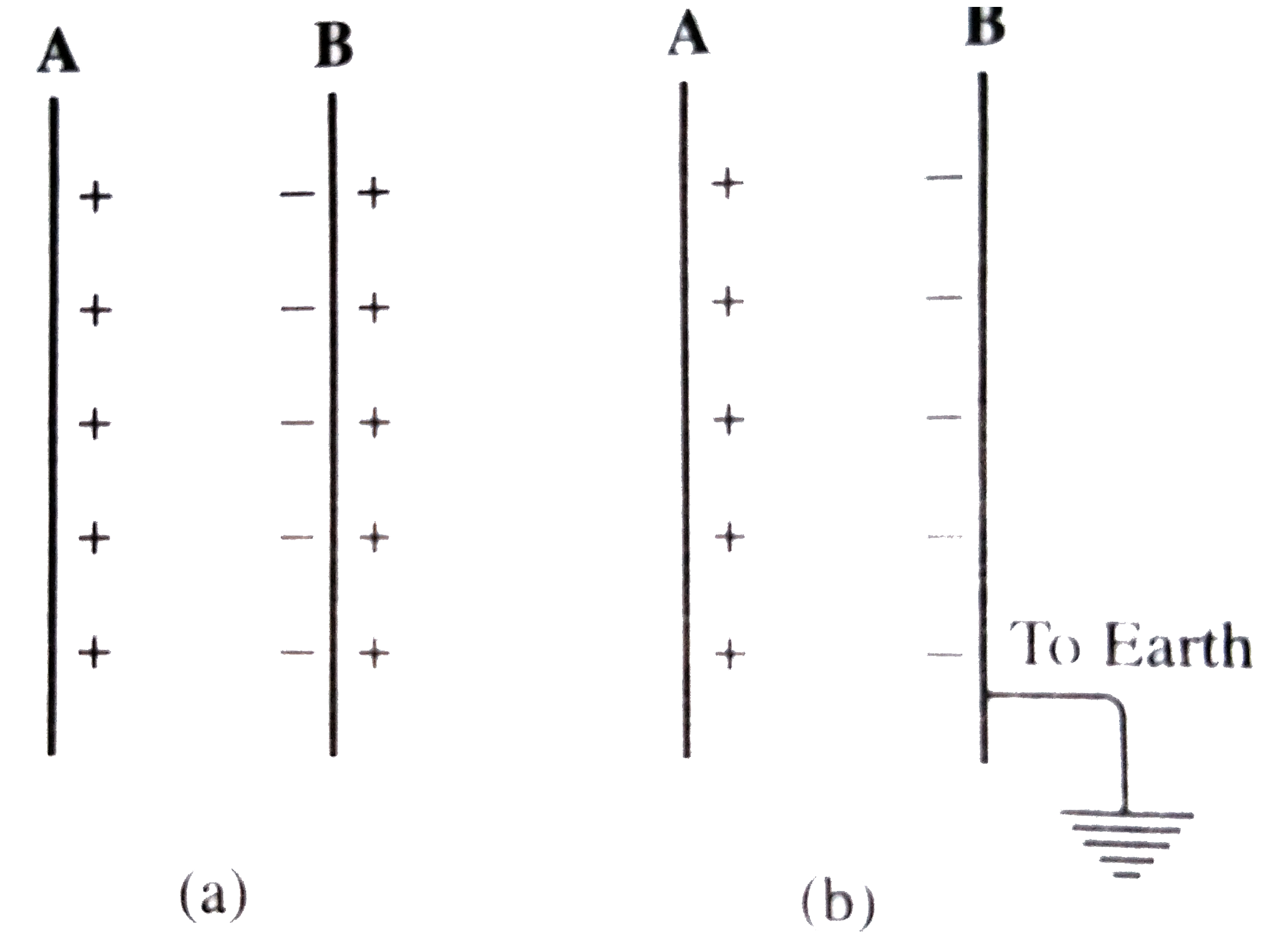
combination can become very much greater than the capacity of conductor A alone.


