Home
Class 12
PHYSICS
When light passes from a denser medium t...

When light passes from a denser medium to a rarer medium

Text Solution

Verified by Experts
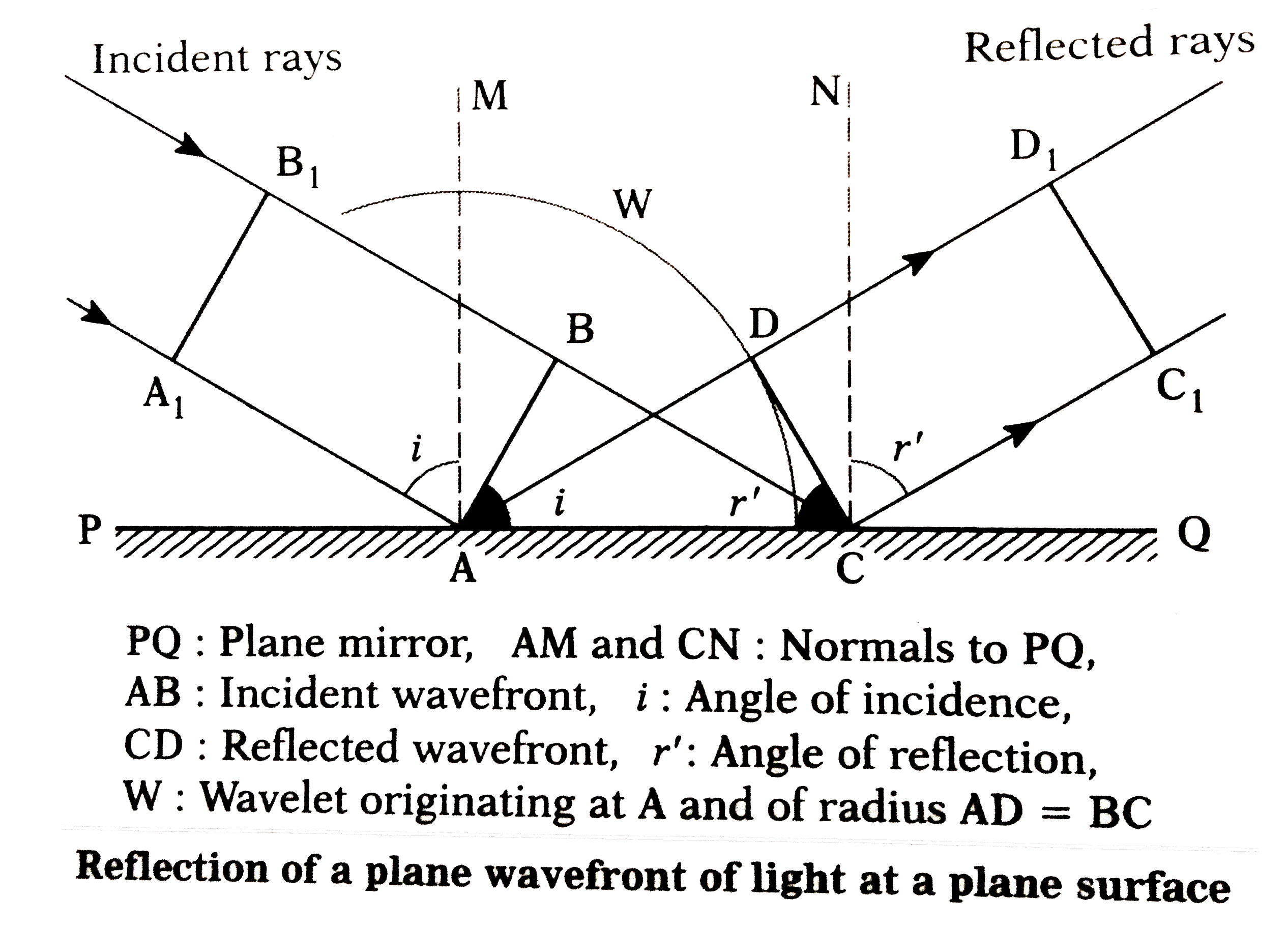
Consider a plane wavefront of monochromatic light incident obliquely on a plane mirror PQ. `A_(1)B_(1)` and AB are the successive positions of the incident wavefront one wavelength apart, `A_(1)A and B_(1)B` are the corresponding incident rays of light.
When the wavefront AB is incident on the mirror, at first, point A becomes a secondary source and emits secondary waves in the same medium. Let v be the speed of light in the medium.

If t is the time taken by the incident wavefront to travel from B to C, then BC= vt. During this time secondary waves originating at A cover the same distance, so that the secondary spherical wavelet has a radius vt.
With A as the centre, draw a hemisphere of radius vt, to represent the secondary wavelet originating from A. Draw a tangent CD to the secondary wavelet.
As all points on CD are in the same phase of wave motion, CD represents the reflected wavefront. It travels parallel to itself taking successive positions `C_(1)D_(1)`, etc. one wavelength apart. Therefore, `AD_(2) and C C_(2)` represent the reflected rays. If a normal AN is drawn to PQ, `angle A_(1)AM=i=` angle of incidence and `angle MAD=r'=`angle of reflection.
In `triangle ABC and triangle ADC, AC` is common, AD = BC = vt and
`angle ABC = angle ADC =90^(@)`
`therefore triangle ABC and triangle ADC` are congruent.
`therefore angle BAC =angle DCA " " `...(1)
From the figure, `angle A_(1)AM+angle MAB=90^(@) and angle MAB +angleBAC=90^(@)`
`therefore angle BAc=angle A_(1)AM=i " "` ...(2)
Also, `angle MAD +angle DAC =90^(@) and angle DAC+angle DCA=90^(@)`
`therefore angle DCA=angle MAD=r' " " ` ...(3)
`therefore From Eqs. (1), (2) and (3), i = r'
Thus, the laws of angle of incidence is equal to the angle of reflection. Also, it can be seen from the figure that the incident ray and the reflected ray lie on the opposite sides of the normal to the reflecting surface at the point of incidence and all of them lie in the same plane.
Thus, the laws of reflection of light can be deduced from huygens' wave theory.
Promotional Banner

Topper's Solved these Questions

  • DERIVATIONS-II

    NAVNEET PUBLICATION - MAHARASHTRA BOARD|Exercise Interference and Diffraction|4 Videos
  • DERIVATIONS-II

    NAVNEET PUBLICATION - MAHARASHTRA BOARD|Exercise Electrostatics|12 Videos
  • DERIVATIONS-I

    NAVNEET PUBLICATION - MAHARASHTRA BOARD|Exercise Assignments|9 Videos
  • DISTINGUISH BETWEEN

    NAVNEET PUBLICATION - MAHARASHTRA BOARD|Exercise Assingment|3 Videos

Similar Questions

Explore conceptually related problems

If a ray of light passes from a denser medium to a rarer medium in a straight line,the angle of incidence must be "….................." .

STATEMENT -1 : An object is placed inside a liquid and screen through air perpendicularly look at shorter depth than its actual depth. and STATEMENT - 2 : When light passes from denser medium to rarer medium it deviates away from normal.

A ray of light passes from a denser medium to a rarer medium at an angle of incidence i. The reflected and refracted rays make an angle of 90^@ with each other. The angle of reflection and refraction are resepectively r and r'. The critical angle is given by :

A monochromatic beam of light passes from a denser medium into a rarer medium. As a result

A monochromatic beam of light passes from a denser medium into a rarer medium. As a result

When light travels from a denser medium to a rarer medium, what is the effect on its speed? A) Increases B) No change C) Decreases D) Decreases and then increases

