Home
Class 12
PHYSICS
Describe biprism exper4iment to calcular...

Describe biprism exper4iment to calcularte the wavelength of a monocharomatic light. Draw the necessary ray diagram.
If the critical angle of a medium is `sin^(-1)(3/5)`, find the po0larising angle.

Text Solution

Verified by Experts
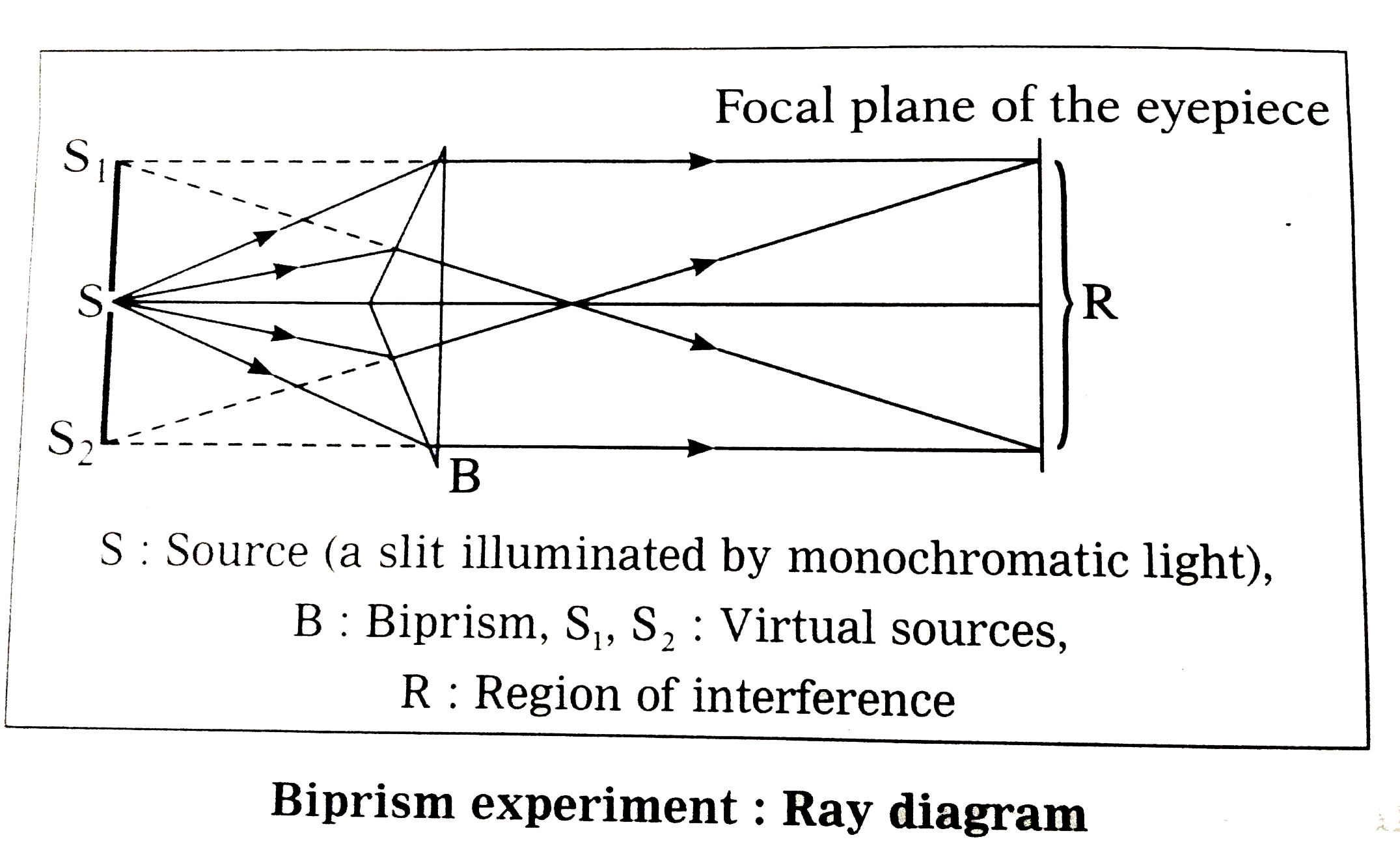
Fresnel's biprism experiment :
Apparatus : (1) A heavy optical bench, about one and half metres long, carries four movable vertical stands to hold an adjustabl slit, biprism, convex lens and eyepiece.
(2) The slit and biprism can be rotated about the horizontal axis parallel to the bench.
Adjustments : (1) The slit S is made vertical and narrow. It is illuminated by monochromatic light from a source placed behind it.
(2) The stand carrying the biprism is fixed at about 10 cm to 20 cm in front of the slit.
(3) The eyepiece stand is fixed at about one metre from the slit. All the three are accurately aligned.
(4) The biprism is slowly rotated about the horizontal axis. When its refracting edge becomes exactly parallel to the slit, the interference pattern appears in the field of the eyepiece. It consists of alternate bright and dark bands or fringes, parallel to the slit.
Measurements : (1) The distance D between the sources and the eyepiece is measured directly on the scale marked on the optical bench.
(2) To measure the fringe width X, the micrometer screw fitted to the eyepiece is adjusted such that the vertical cross wire coincides with one of the bright fringes. The corresponding micrometer reading `x_(1)` is noted. By rotating the screw in the same sense, the vertical cross wire is made to coincide with (say) the fifth, tenth and fifteenth bright fringe and the corresponding micrometer readings are noted. Hence, the average width of five bright fringes is foubd and, therefrom the mean fringe width X.

(3) Since the coherent sources are virtual, the distance between them is determined indirectly using the conjugate foci method as follows:
A convex lens of suitables focal length, less than `D//4`, is mounted on the stand between the biprism and the eyepiece, without disturbing the slit and the biprism. there are two positions of the lens for which sharp images of `S_(1)` and `S_(2)` can be seen through the eyepiece. For position `L_(1)` of lens, nearer to the biprism, the distance `d_(1)` between the two magnified images is measured by the micrometer on the eyepiece. Moving the lens toward the eyepiece to the conjugate position `L_(2)`, the distance `d_(2)` between the two diminished images in measured.
Then, `d=sqrt(d_(1)d_(2))`.
Formula to determine `lambda` : The wavelength `lambda` of the monochromatic light is determined with the formula :
`lambda=(Xd)/(D)=(Xsqrt(d_(1)d_(2)))/D`
Promotional Banner

Topper's Solved these Questions

  • EXPERIMENTS AND DIAGRAMS

    NAVNEET PUBLICATION - MAHARASHTRA BOARD|Exercise ELECTRONS AND PHOTONS|1 Videos
  • EXPERIMENTS AND DIAGRAMS

    NAVNEET PUBLICATION - MAHARASHTRA BOARD|Exercise ATOMS, MOLECULES AND NUCLEI|1 Videos
  • EXPERIMENTS AND DIAGRAMS

    NAVNEET PUBLICATION - MAHARASHTRA BOARD|Exercise CURRENT ELECTRICITY|1 Videos
  • DISTINGUISH BETWEEN

    NAVNEET PUBLICATION - MAHARASHTRA BOARD|Exercise Assingment|3 Videos
  • EXPLANATION, CHARACTERISTICS AND PROPERTIES

    NAVNEET PUBLICATION - MAHARASHTRA BOARD|Exercise Assignments|2 Videos

Similar Questions

Explore conceptually related problems

The critical angle of a certain medium is sin^(-1)(3/2) . The polarizing angle of the medium:

The critical angle of a certain medium is sin ^(-1)((3)/(5)) . The polarizing angle of the medium is :

Wave length of light in denser medium is 4000 A it is grazing into a rarer medium.If critical angle for the pair of media is sin^(-1) ((2)/(3)) then the wave length of light in rarer medium is

