Construction of a metre bridge : A rectangular wooden board has three thick copper strips along its three edges. A uniform resistance wire, one metre long, is soldered to the two end copper strips and stretched over a metre scale between the strips. The two gaps between the end-strips and the centre strip are for introducing the unknown resistance X and a variable known resistance R. The common point of X and R, junction B, is connected through a centre-zero galvanometer to a pancil kockey. A cell of emf E, in series with a rheostat Rh and a plug key K, is connected across AC.
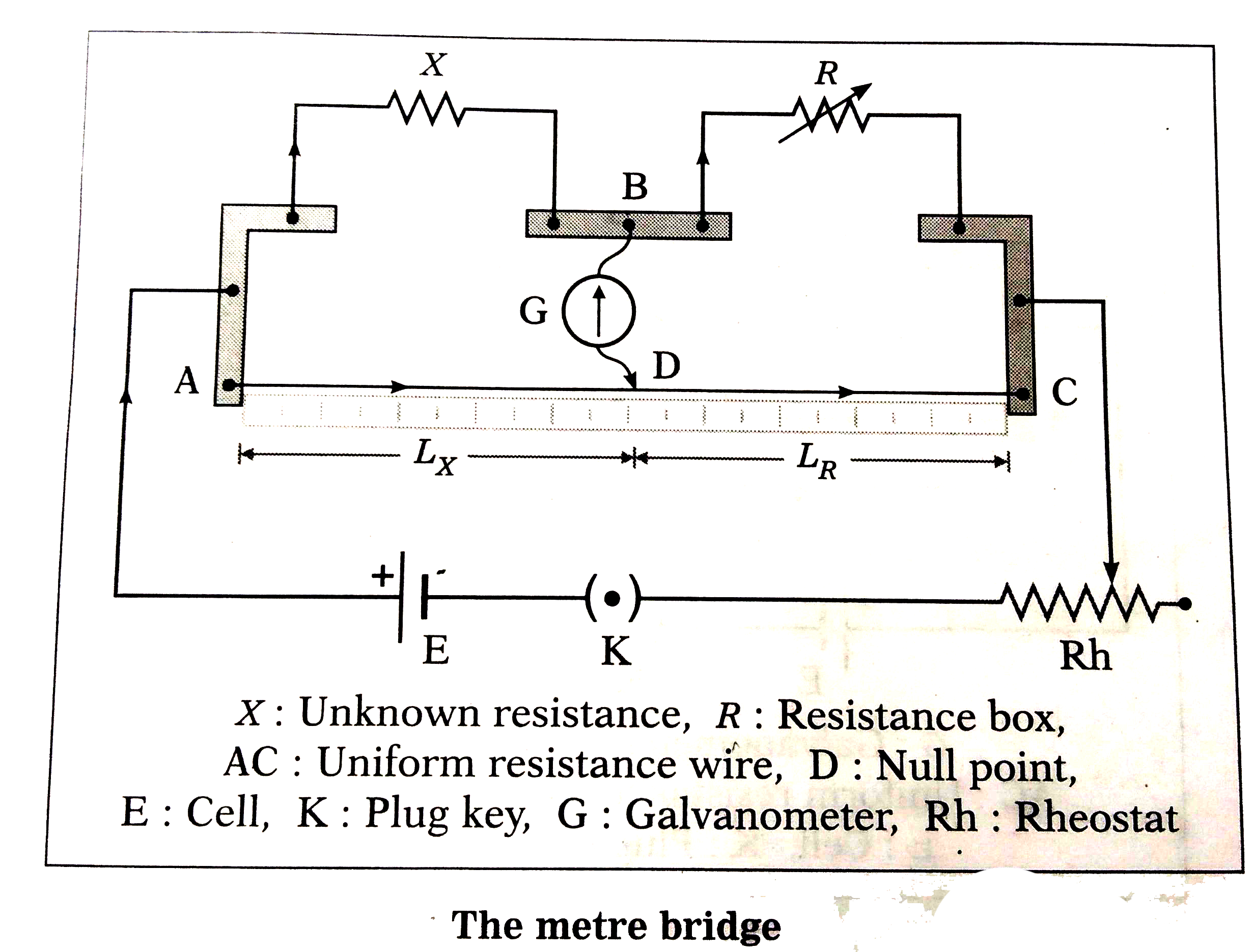
Working : Keeping a suitable resistance R in the resistance box, key K is closed to pass a current through the circuit.
The kockey is tapped along the wire to locate the equipotential point D when the galvanometer shows zero deflection. The bridge is then balanced and point D is called the null point and the method is called as null deflection method. Distances `L_(X)` and `L_(R)` of the null point from the two ends of the wire are measured.
According to the principle of Wheatstone's network,
`X/R=("resistance of the wire of length "L_(X))/("resistance of the wire of length "L_(R))`
If `lambda` be the resistance per unit length of the wire,
`:. X/R=(lambda L_(X))/(lambda L_(R))=L_(X)/L_(R)" ":. X=R L_(X)/L_(R)`
As R, `L_(X)` and `L_(R)` are known, the unknown resistance X can be calculated.


