Home
Class 12
PHYSICS
In Kelvin's method of finding the resist...

In Kelvin's method of finding the resistance of a galvanometer, we

Text Solution

Verified by Experts
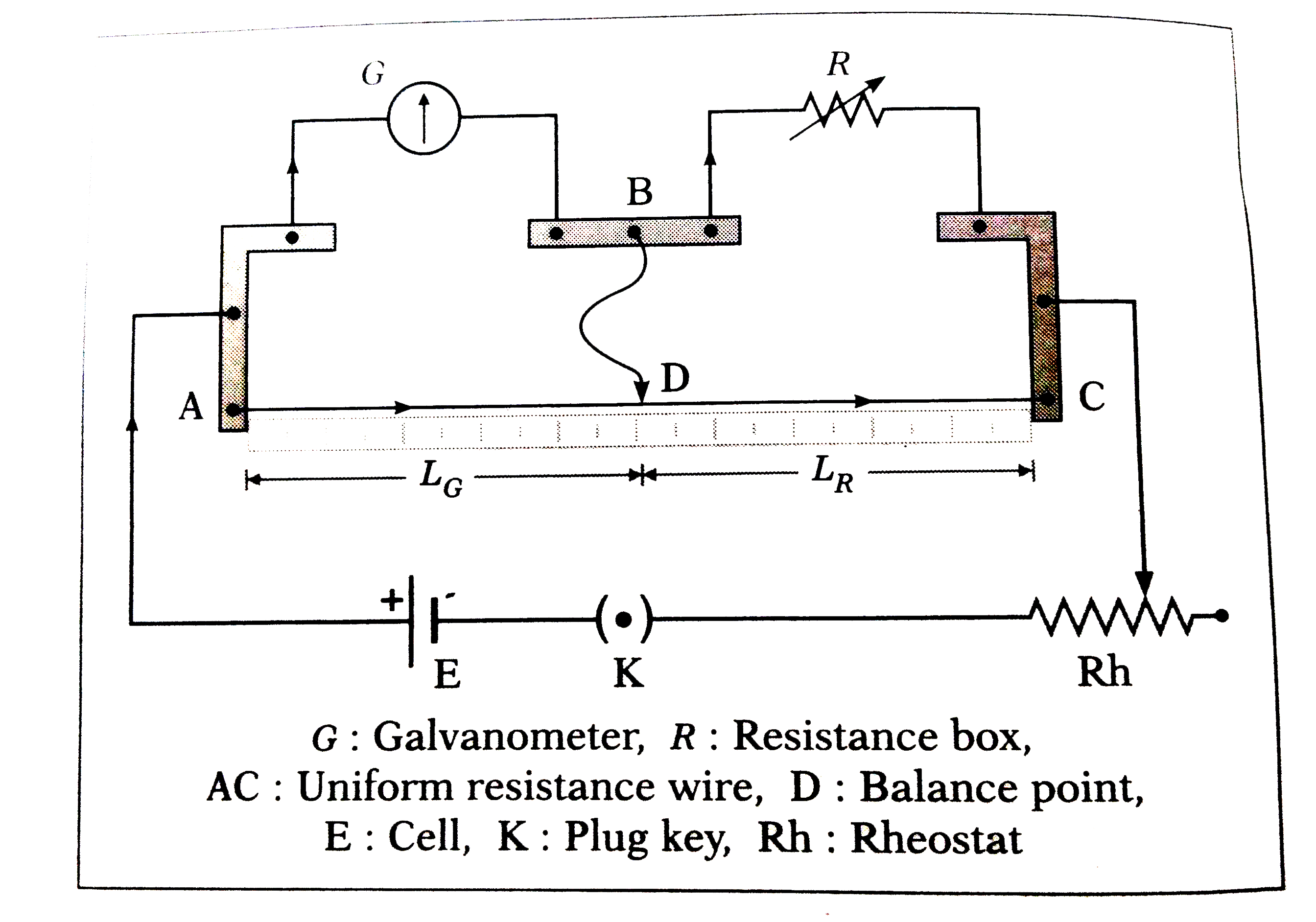
Circuit : The metre bridge circuit for Kelvin's method of determination of the resistance of a galvanometer is shown in the figure. The galvanometer whose resistance G is be determined, is connected in one gap of the metre bridge. A variable known resistance R is connected in the other gap. The junction B of the galvanometer and the resistance box is connected directly to a pencil jockey. A cell of emf E, a key (K) and a rheostat (Rh) are connected across AC.

Working : Keeping a suitable resistance R in the resistance box and maximum resistance in the rheostat, key K is closed to pass the current. The rheostat resistance is slowly reduced such that the galvanometer shows about `2//3` rd of the full-scale deflection.
On tapping the jockey at end-points A and C, the galvanometer deflection should change to opposite sides of the initial deflection. Only then will there be a point D on the wire which is equipotential with point B. The jockey is tapped along the wire to locate the equipotential point D when the galvanometer shows no change in deflection. Here, point D is called the balance point and Kelvin's method is thus an equal deflection method. At this balanced condition,
`G/R=("resistance of the wire of length "L_(G))/("resistance of the wire of length "L_(R))`
where `L_(G) equiv` the length of the wire opposite to the galvanometer and `L_(R) equiv` the length of the wire opposite to the resistance box.
If `lambda equiv` the resistance per unit length of the wire,
`G/R=(lambdaL_(G))/(lambda L_(R))=L_(G)/L_(R)" ":. G=R L_(G)/L_(R)`
The quantities on the right hand side are known, so that G can be calculated.
Promotional Banner

Topper's Solved these Questions

  • EXPERIMENTS AND DIAGRAMS

    NAVNEET PUBLICATION - MAHARASHTRA BOARD|Exercise ELECTRONS AND PHOTONS|1 Videos
  • EXPERIMENTS AND DIAGRAMS

    NAVNEET PUBLICATION - MAHARASHTRA BOARD|Exercise ATOMS, MOLECULES AND NUCLEI|1 Videos
  • EXPERIMENTS AND DIAGRAMS

    NAVNEET PUBLICATION - MAHARASHTRA BOARD|Exercise CURRENT ELECTRICITY|1 Videos
  • DISTINGUISH BETWEEN

    NAVNEET PUBLICATION - MAHARASHTRA BOARD|Exercise Assingment|3 Videos
  • EXPLANATION, CHARACTERISTICS AND PROPERTIES

    NAVNEET PUBLICATION - MAHARASHTRA BOARD|Exercise Assignments|2 Videos

Similar Questions

Explore conceptually related problems

In a circuit for finding the resistance of a galvanometer by half deflection method, a 6 V battery and a high resistance of 11 kOmega are used. The figure of merit of the galvanometer is 60 muA//"division" . In the absence of shunt resistance, the galvanometer produces a deflection of theta =9 divisions when current flows in the circuit. The value of the shunt resistance that can cause the deflection of theta//2 , is closet to :

In an experiment to determine the resistance of a galvanometer by half deflection method, the circuit shown is used. In one set of readings , if R = 10 Omega S = 4 Omega , then the resistance of the galvanometer is

If a galvanometer is connected in series with a high resistance so that potential drop across the galvanometer is 1/n th of the total applied voltage, then show that the combined resistance of the galvanometer and the series resistor is n times the resistance of the galvanometer i.e.,

When a moving coil galvanometer is shunted with a resistance of 10 Omega ,the deflection in the galvanometer reduces from 30 divisions to 6 divisions. The resistance of the galvanometer is

In a galvanometer 5\% of the total current in the circuit passes through it. If the resistance of the galvanometer is G, the shunt resistance S connected to the galvanometer is

