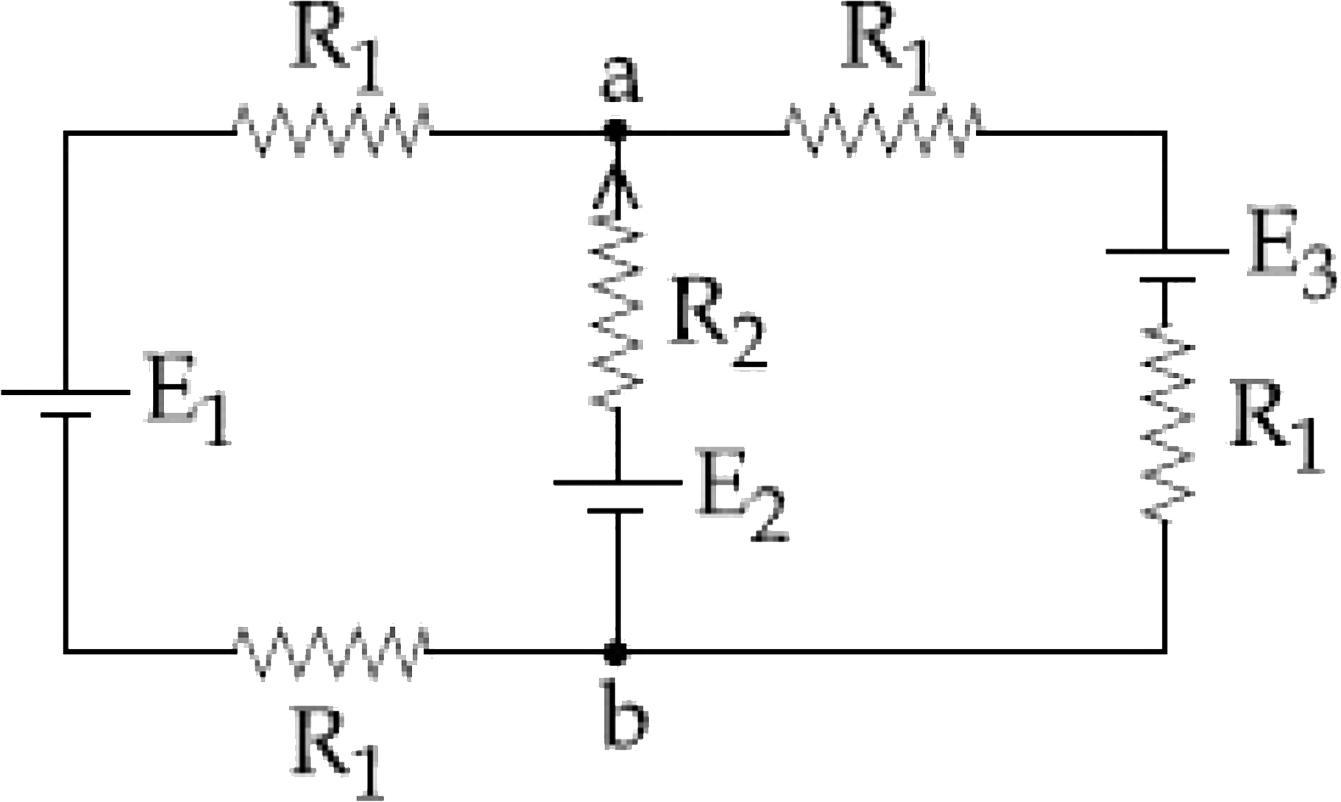
For the circuit shown, with `R_(1)=1.0Omega,R_(2)=2.0Omega,E_(1)=2V` and `E_(2)=E_(3)=4V`, the potential difference between the points `'a'` and `'b'` is approximately (in `V`):
For the circuit shown, with R_1=1.0 Omega,R_2=2.0Omega,E_1=2V and E_2=E_3=4V the potential difference between the points ‘a’ and ‘b’ is __________(in V)
In the circuit as shown in figure, E_(1)=2V , E_(2)=2V, E_(3)=1V, and R=r_(1)=r_(2)=r_(3)Omega . The potential difference between points A and B will be
In the circuit shown in figure , (epsilon)_(1)=3V,(epsilon)_(2)=2V,(epsilon)_(3)=1V and r_(1)=r_(2)=r_(3)=1(Omega) .Find the potential difference between the points A and B and the current through each branch.
In the circuit shown in fig. E_(1)=3" volt",E_(2)=2" volt",E_(3)=1" vole and "R=r_(1)=r_(2)=r_(3)=1 ohm. (i) Find potential difference in Volt between the points A and B with A & B unconnected. (ii) If r_(2) is short circuited and the point A is coneted to point B through a zero resistance wire, find the current through R in ampere.
Find a potentail difference varphi_(1) - varphi_(2) between points 1 and 2 of the circuit shown in Fig if R_(1) 1= 10 Omega, R_(2) = 20 Omega, E_(1) = 5.0 V , and E_(2) = 2.0 V . The internal resisances of the current sources are negligible.
In the circuit shown here, E_(1) = E_(2) = E_(3) = 2 V and R_(1) = R_(2) = 4 ohms . The current flowing between point A and B through battery E_(2) is
In the circuit in figure E_1=3V, E_2=2V, E_3=1V and R=r_1-r_2-r_3=1Omega a. Find the potential differece between the points A and B and the currents through each branch. b. If r_2 is short circuited and the point A is connected to point B , find the currents through E_1,E_2, E_3 and the resistor R
In the given circuit, R_(1) = 10Omega R_(2) = 6Omega and E = 10V, then correct statement is