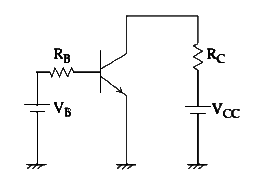
A common emitted amplifier circuit, built using an npn transistor, is shown in the figure. Its dc current gain is `250,R_(C)=1Komega` and `V_(C C)=10V`. What is the minimum base current for `V_(CE)` to reach saturation?
In the common emitter amplifier circuit, Fig. an npn transistor with output voltage of the amplifier as 1 V, the current gain of transistor amplifier is :
Refer to the common emitter amplifier circuit shown below, using a transistor with beta =80 and V_(BE) = 0.7 volt. The value of resistance R_B is
In a common emitter transistor circuit, the base current is 40 muA, then V_(BE) is -
In a common base transistor circuit, I_C is the Output current and I_E is the input current. The current gain alpha is
The output characteristics of a transistor is shown in the figure. When V_(CE) is 10 V and I_C = 4.0 mA , then value of beta_(ac) is _________
In the common emitter circuit as shown in Fig, the value of the current gain is 100. Find I_(B),V_(CE),V_(BE),V_(BC) when I_(C)=1.5mA . The transistor is in active, cutoff or saturation state.
Output characteristic of n-p-n transistor in CE configuration is shown. From the characteristic curve determine the current gain at V_(CE)=1V -
In common emitter transistor as shown in Fig., the V_(BB) supply can be varied from 0 V to 5.0V. The Si. Transistor has beta_(ac)=250 and R_(B)=100kOmega, R_(c)=1k Omega,V_(C C)=5.0V . Assume that when the transistor is saturated, V_(CE)=0V and V_(BE)=0.8V . Calculate the minimum base current, for which the transistor will reach saturation. Hance, determine V_(i) when the transistor is 'switched on' find ranges of V_(i) for which the transistor is switched off and switched on.