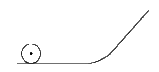
A solid sphwere and solid cylinder of identical radii approach an incline with the same linear velocity (see figure). Both roll without slipping all throughout. The two climb maximum heights `h_(sph)` and `h_(cyl)` on the incline. The ratio `(h_(sph)/(h(cyl)))` is given by :
Two uniform solid spheres having unequal rdii are released from rest from the same height on a rough incline. Ilf the spheres roll without slipping
A solid sphere and a solid cylinder are in pure roling on a rough curved surface with the same speed. The ratio of maximum heights reached by the two bodies if they roll without shipping is
A solid cylinder of mass M and radius R rolls down an inclined plane of height h without slipping. The speed of its centre when it reaches the bottom is.
The speed of a uniform solid cylinder after rolling down an inclined plane of vertical height H, from rest without sliding is :-
A solid cylinder rolls down from an inclined plane of height h. What is the velocity of the cylinder when it reaches at the bottom of the plane ?
A solid cylinder of mass M and radius R rolls down an inclined plane of height h. The angular velocity of the cylinder when it reaches the bottom of the plane will be :
A ring, disc, spherical shell and solid sphere of same mass and radius are rolling on a horizontal surface without slipping with same velocity. If they move up an inclined plane, which can reach to a maximum height on the inclined plane?
A ring, cylinder and solid sphere are placed on the top of a rough incline on which the sphere can just roll without slipping. When all of them are released at the same instant from the same position, then