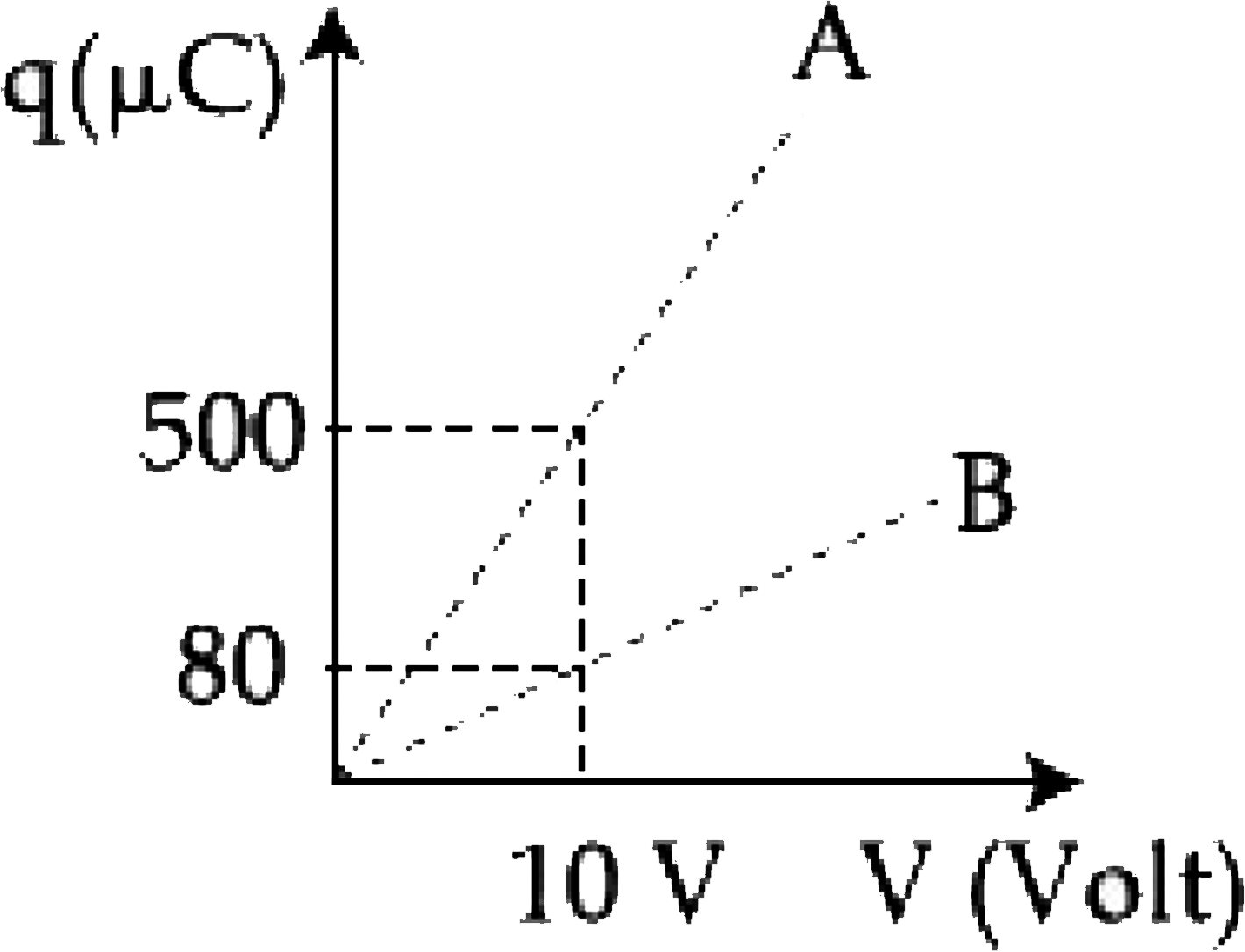
Figure shows charge (q) versus voltage (V) graph for series and parallel combination to two given capacitors. The capacitances are:
Explain the series and parallel combinations of capacitors.
Combination of capacitors| series and parallel combination
combination OF capacitor ( series and parallel )
A capacitor of capacitance C_(1) is charged to a potential V_(1) while another capacitor of capacitance C_(2) is charged to a potential difference V_(2) . The capacitors are now disconnected from their respective charging batteries and connected in parallel to each other . (a) Find the total energy stored in the two capacitors before they are connected. (b) Find the total energy stored in the parallel combination of the two capacitors. (c ) Explain the reason for the difference of energy in parallel combination in comparison to the total energy before they are connected.
Energy stored in a capacitor |Series combination|Parallel combination
Two identical capacitors are connected in series with a source of constant voltage V . If Q is the charge on one of the capacitors, the capacitance of each capacitor is :
Plot A & B represent variation of charge with potential difference across the combination (series and parallel) of two capacitors. Then Find the values of capacitance of capacitors.
A battery is used to charge a parallel plate combination of two identical capacitors. If the potential difference across the battery is V and the total charge Q flows through the battery during the charging process then 1) The charge on each capacitor is Q/2 and the potential of each capacitor is V/2 2) The charge on each capacitor is Q and the potential of each capacitor is V 3) The charge on each capacitor is Q/2 and the potential of each capacitor is V 4) The charge on each capacitor is Q and the potential of each capacitor is V/2