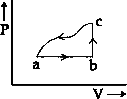
A sample of an ideal gas is taken through the cyclic process abca and shown in the figure. The chagne in the internal energy of the gas along the path ca is `-180J`. The gas aborbs 250J of heat along the path ab and 60 J along the path bc. the work done by the along the path abc is:
An ideal gas is taken along the path AB as shown in the figure. The work done by the gas is
One mole of an ideal monoatomic gas is caused to go through the cycle shown in figure. Then, the change in the internal energy is expanding the gas from a to c along the path abc is:
One mole of an ideal monoatomic gas undergoes a cyclic process as shown in figure. Then the change in the energy in expanding the gas from a to c along the path abc is:
One mole of an ideal mono-atomic gas is caused to go through the cycle shown in the figure below. Then the change in the internal enegry in expanding the gas from a to c along the path abc is:
One mole of ideal monoatmic gas is carried throught the reversible cyclic process as shown in figure. Calculate net heat absorbed by the gas in the path BC
One mole of ideal monoatomic gas is taken round the cyclic process as shown in figure. The heat rejected by the gas in the path is ………...and the heat absorbed by the gas in the path AB is ………...........
One mole of an ideal diatomic gas undergoes a transition from A to B along a path AB as shown in the figure The change to internal energy of the gas during the transition is
One mole of an ideal diatomic gas undergoes a transition from A to B along a path AB as shown in the figure, The change in internal energy of the gas during the transition is :