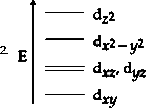
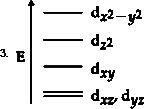
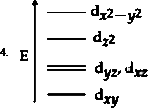
Complete removal of both the axial ligands (along the z-axis) from an octahedral complex leads to which of the following splitting patterns ? (relative orbital energies not on scale)
in which of the following change both the electrons are removed from same orbital ?
The splitting diagram for square planar complexes is more complex than for octahedral and tetrahedral complexes and is shown below with the relative energies of each orbital. Calculate crystal field stabilisation energy for a diamagnetic square planar d^(8) metal complex with the help of above diagram neglecting pairing energy (P)
According to cystal field theory, interaction between central metal atom/ion and ligand is electrostatic in nature. In free metal ions, the five d-orbitals are degenerate. However, in a ligand field e.g., tetrahedral, octahedral, square planar, square pyramidal, trigonal bipyramidal, the degeneracy of 5d-orbitals is lost. If lobes of d-orbitals of central metal atom/ion are along the axes through which ligands are approaching, the energy of corresponding d-orbital is raised more than the d-orbitals having lobes between teh axes. e.g., octahedral complexes, square planar complexes, square pyramidal compexes. Which of the following orbitals has the highest energy in square pyramidal ligand field ?
When degenerate d-orbitals of an isolated atom/ion come under influence of magnetic field of ligands, the degeneray is lost. The two set t_(2g)(d_(xy),d_(yz),d_(xz)) and e_(g) (d_(x^(2))-d_(x^(2)-y^(2)) are either stabilized or destabilized depending upon the nature of magnetic field. it can be expressed diagrammatically as: Value of CFSE depends upon nature of ligand and a spectrochemical series has been made experimentally, for tetrahedral complexes, Delta is about 4/9 times to Delta_(0) (CFSE for octahedral complex). this energy lies in visible region and i.e., why electronic transition are responsible for colour. such transition are not possible with d^(0) and d^(10) configuration. Q. For an octahedral complex, which of the followin d-electron configuration will give maximum CFSE?
According to V.B.T., atoms of element form bond only to pair up their unpaired electrons present in ground state or excited state. This pairing of unpaired electron will take place by overlapping of orbitals each one having one unpaired electron with opposite spin. Which of the following combination of orbitals does not from any type of covalent bond (if z-axis is molecular axis)?