Home
Class 12
PHYSICS
Find the electric field at a point P on ...

Find the electric field at a point P on the perpendicular bisector of a uniformly charged rod. The lengthof the rod is L, the charge on it is Q and the distance of P from the centre of the rod is a.

Text Solution

Verified by Experts
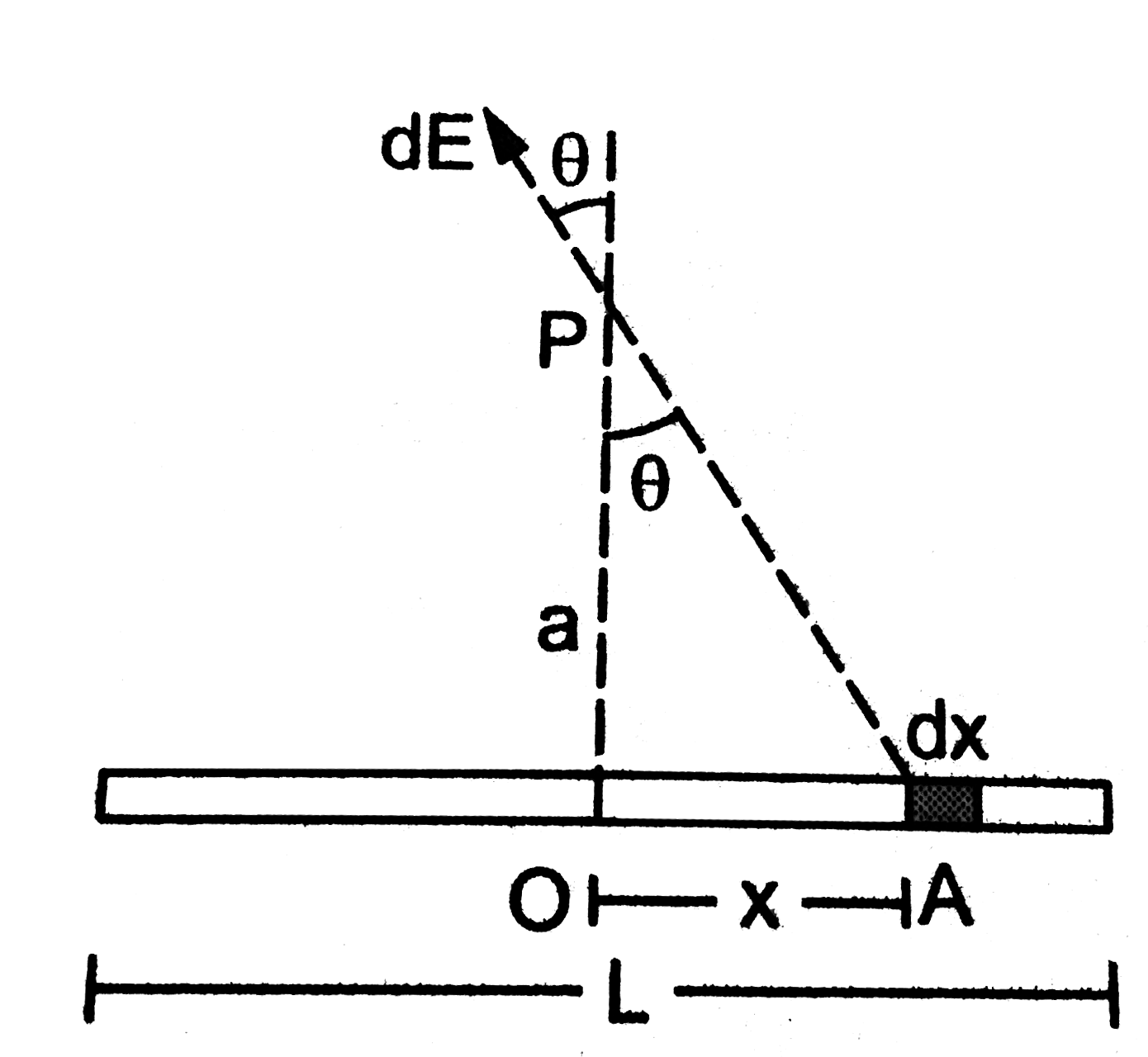

Let us take an element of length dx at a distance x from
the centre of the rod . The charge on this
element is
` dQ=(Q)/(L) dx`.
The electric field at P due to this element is
`dE=(dQ)/(4piepsilon_0 (AP)^2)`
. By symmetry, the resultant field at P will be along OP
(if the charge is positive). The component of dE along
OP is
`dE cos theta = (dQ)/(4piepsilon_0 (AP)^2) . (OP)/(AP) = (aQdx)/(4piesilon_0 L(a^2+x^2 )^(3/2)`
Thus, the resultant field at P is
`E =int dE cos theta`
`= (aQ)/(4piesilon_0L) int_(-L/2)^(L/2) (dx) /(a^2+x^2 (3/2)).`
We have `x = a tan theta or dx = a sec^2theta dtheta.`
theus,`int(dx)/(a^2+x^2)^(3/2) = int (alpha sec^2theta dthetatheta)/(alpah^3 sec ^3 theta)
`= (1)/(a^2) int cos theta d theta = (1)/(a^2) sin theta = (1)/(alpha^2) (x)/(x^2 + alpha^2 )^(1/2)`
. From(i)
`E=(alphaQ)/(4piepsilon_0 La^2) [(x)/(x^2 + alpha^2 )^(1/2) ]_(-L/2)^(L/2)`
`= (aQ)/(4piepsilon_0 La^2) [(2L)/(L^2+4alpah^2)^(1/2)]`
`= (Q)/(2piepsilon_0 alpha sqrt(L^2+4a^2))`.
Promotional Banner

Topper's Solved these Questions

  • ELECTRIC FIELD AND POTENTIAL

    HC VERMA|Exercise Short Answer|14 Videos
  • ELECTRIC FIELD AND POTENTIAL

    HC VERMA|Exercise Objective 1|9 Videos
  • ELECTRIC FIELD AND POTENTIAL

    HC VERMA|Exercise Exercises|75 Videos
  • ELECTRIC CURRENT THROUGH GASES

    HC VERMA|Exercise Exercises|23 Videos
  • ELECTROMAGNETIC INDUCTION

    HC VERMA|Exercise EXERCISE|9 Videos

Similar Questions

Explore conceptually related problems

The electric foield at a point A on the perpendicular bisector of a uniformly charged wire of length l=3m and total charge q = 5 nC is x V/m. The distance of A from the centre of the wire is b = 2m. Find the value of x.

Find the electric field at point P (as shown in figure) on the perpendicular bisector of a uniformly charged thin wire of length L carrying a charge Q. The distance of the point P from the centre of the rod is a =sqrt3/2L .

Find : (i)Electric field intensity due to an infinitely long uniformly charged, straight conductor , at a perpendicular distance d from rod. (ii)Electric field intensity at a point on perpendicular bisector of uniformly charged rod of length l and charge Q at a distance d from the centre of rod.

Calculate the potential at a point on the perpendicular bisector of uniformly charged thin rod (linear density of charge = lambda ) of length 2l at a distance a from the centre of the rod.

The electric field at a point P which is at a distance l on the perpendicular bisector of a uniformly charged wire of length 1 , charge Q=(Q)/(2 pi varepsilon_(0)l^(2)sqrt(k)) where k = ?

What is the electric field intensity at any point on the axis of a charged rod of length 'L' and linear charge density lambda ? The point is separated from the nearer end by a.

The maximum electric field intensity on the axis of a uniformly charged ring of charge q and radius R is at a distance x from the centre of the ring.The value of x is

A charge of 1 coul. is placed at one end of a non-conducting rod of length 0.6m. the rod is rotated in a vertical plane about a horizontal axis passing through the other end of the rod with angular frequency 10^(4) pi "radian/sec" . Find the magnetic field at a point on the axis ofrotation at a distance of 0.8 from the centre of the path. Now half of the charge is removed from one end and placed on the other end. The rod is rotated in a vertical plane about horizontal axis passing through the mid-point of the rod with the same angnlar frequency. Calculate the magnetic field at a point on the axis at a distance of 0.4m form the centre of the rod.

Calculate the potential due to a thin uniformly charged rod of length L at the poiot P shown in figure. The lioear charge density of the rod is lambda C//m

HC VERMA-ELECTRIC FIELD AND POTENTIAL-Worked Out Examples
  1. Charges 5.0 xx ^(-7) C and 1.0 xx 10^(-7) C are held fixed at the ...

    Text Solution

    |

  2. Two particles A and B having charges 8.0 xx 10 ^(-6) C and -2.0 xx 1...

    Text Solution

    |

  3. Three equal charges, each having a magnitude of. 2.0 xx 10 ^ (-6) C, ...

    Text Solution

    |

  4. Two small iron particles, each of mass 280 mg, are. placed at a distan...

    Text Solution

    |

  5. A charge Q is to be divided on two objects. What shouold. be the valu...

    Text Solution

    |

  6. Two particles, each having a mass of 5 g and charge. 1.0 xx 10^(-7) C...

    Text Solution

    |

  7. A vertical electric field of magnitude 4.00xx 10^5 NC^(-1) just preven...

    Text Solution

    |

  8. Three charges, each equal to q, are placed at the three. corners of a ...

    Text Solution

    |

  9. A Charged particle of mass 1.0 g is suspended through a . silk threa...

    Text Solution

    |

  10. A particle a having a charge of 5.0 xx 10 ^(-7) C is fixed in. a verti...

    Text Solution

    |

  11. Four particles each having a charge q, are placed on the four vertices...

    Text Solution

    |

  12. Find the electric field at a point P on the perpendicular bisector of ...

    Text Solution

    |

  13. A uniform electric field E is created between two parallel charged pla...

    Text Solution

    |

  14. In a circuit, 10 C of charge is passed through a battery . in a give...

    Text Solution

    |

  15. charges 2.0 xx 10^(-6) C and 1.0 xx 10^(-6) C are placed at. corners A...

    Text Solution

    |

  16. The electric field in a region is given by vecE = (A/x^3) vecI. Write ...

    Text Solution

    |

  17. Three point charges q, 2q and 8q are to be placed on a . 9cm long st...

    Text Solution

    |

  18. An HCl molecule has a dipole moment of 3.4xx 10(-30) Cm . Assuming t...

    Text Solution

    |

  19. show an electric dipole formed by two . particles fixed at the ends ...

    Text Solution

    |

